380 vs 9mm vs 45 ACP 2026: Ballistics, Recoil, Size & Self-Defense Compared header image
[ < Back to guides ]
PistolBallisticsComparisonCCW

380 vs 9mm vs 45 ACP 2026: Ballistics, Recoil, Size & Self-Defense Compared

The three most popular pistol calibers in America, compared across every dimension that matters. The .380 ACP enables the smallest carry pistols. The 9mm dominates through capacity, cost, and modern bullet technology. The .45 ACP delivers the heaviest hits with natural subsonic performance. This guide breaks down ballistics, terminal performance, recoil, platform size, capacity, cost, and real-world defensive effectiveness backed by FBI protocol data.

By AB|Last reviewed February 2026

Key Takeaways

  • Ballistics: .45 ACP leads in energy per round (356-400 ft-lbs), 9mm is the middle ground (332-364 ft-lbs), and .380 ACP trails significantly (190-240 ft-lbs). 9mm is fastest at 1,070-1,200 fps.
  • Terminal Performance: Modern 9mm and .45 ACP hollow points both meet FBI 12-18" gel penetration standards. .380 hollow points often fall short at 9-12", reducing margin for error.
  • Recoil: .380 produces ~3.5 ft-lbs (lightest), 9mm ~5.5 ft-lbs (moderate), .45 ACP ~7.5 ft-lbs (heaviest). Lower recoil means faster follow-up shots and easier training.
  • Platform Size: .380 enables true pocket pistols (10-12 oz). Micro-compact 9mm (17-18 oz) requires IWB holster. .45 ACP is full-size territory (26-39 oz).
  • Cost: 9mm is cheapest ($0.22-0.30/rd), .380 costs more despite being weaker ($0.35-0.45/rd), and .45 ACP is most expensive ($0.40-0.60/rd).

Which Caliber Matches You?

Rate your priorities from 0 to 10, or select a preset. Scores weight each caliber's strengths against your needs.

5
5
5
5
5
5

.380 ACP

Max concealability

57
ConcealabilityLow Recoil

9mm Luger

Best all-around

73
CapacityBudget

.45 ACP

Max per-round impact

55
SuppressedStopping Power
Your match: 9mm Luger

The 9mm offers the best balance of capacity, terminal performance, and ammo cost for your priorities. Modern micro-compacts like the SIG P365 make it concealable, and it dominates in ammo availability and defensive load selection.

Cartridge History & Development

The 9x19mm Parabellum was designed by Georg Luger in 1901 for the German Navy. The cartridge prioritized lighter bullets at higher velocity, enabling smaller and lighter pistols with higher magazine capacity. The 9mm became the NATO standard pistol cartridge in 1955, and today it is the most widely used handgun cartridge in the world. Over 60% of law enforcement agencies in the United States issue 9mm duty pistols.

The .45 ACP (Automatic Colt Pistol) was developed by John Browning in 1905 and adopted by the U.S. military in 1911 with the iconic M1911 pistol. The cartridge was designed in response to the Philippine-American War, where the .38 Long Colt revolver failed to stop determined attackers. The military demanded a pistol cartridge with "one-shot stopping power," and the .45 ACP's heavy 230-grain bullet traveling at 830 fps delivered that capability. The cartridge served as the U.S. military sidearm caliber for 74 years.

The .380 ACP (also known as 9mm Short or 9x17mm) was designed by Browning in 1908 for the Colt Model 1908 pocket pistol. The cartridge was engineered specifically for compact, blowback-operated pistols where a locked breech was unnecessary. Its moderate pressure (21,500 psi SAAMI max) and shorter case allow simpler, lighter pistol designs that prioritize concealability over raw performance. The .380 shares the same 0.355-inch bullet diameter as 9mm but differs in case length (17.3mm vs 19.15mm) and operating pressure.

The critical inflection point for all three cartridges was the development of modern hollow point ammunition in the 1990s and 2000s. When limited to full metal jacket ammunition, the .45 ACP's larger diameter created objectively larger wound channels. Modern hollow points engineered to expand to 1.5-2x their original diameter eliminated much of this advantage, because a 9mm bullet expanding from 0.355" to 0.60"+ creates a wound channel comparable to a .45 ACP expanding from 0.452" to 0.70". The .380's lower velocity makes reliable expansion more difficult, which is why bullet selection matters most in that caliber.

380 vs 9mm vs 45 ACP Ballistics Comparison

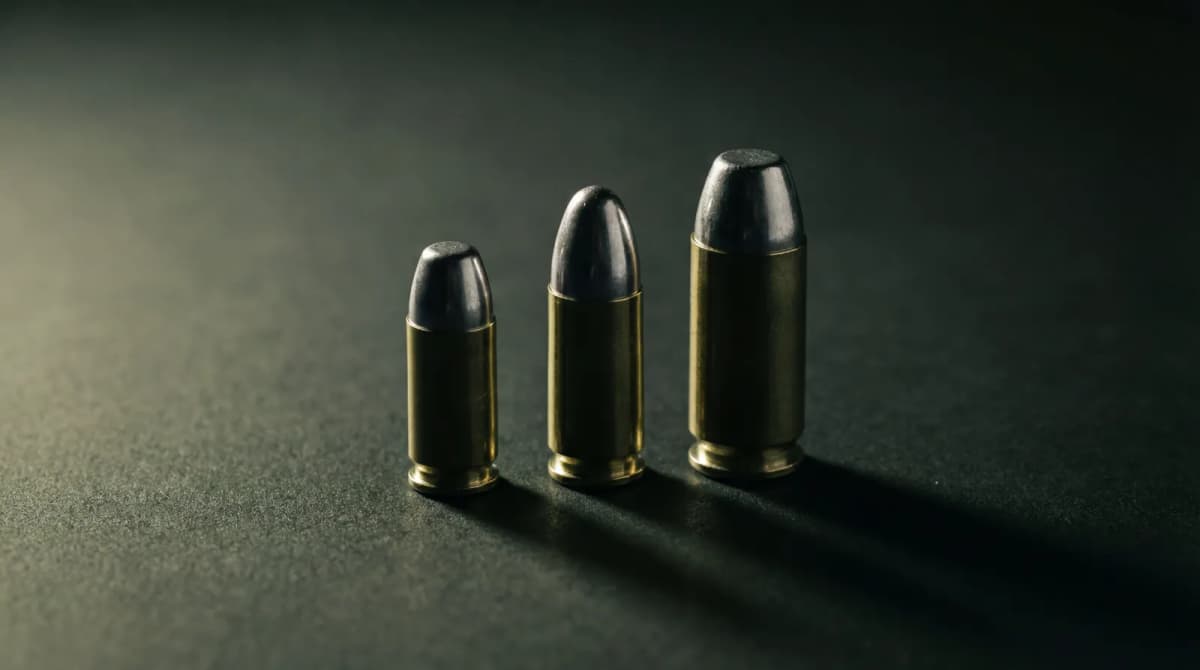
The ballistic spectrum across these three calibers is wide. The .380 ACP fires a light bullet (85-95 grains) at moderate velocity (900-1,000 fps from a 3.5" barrel), producing 190-240 ft-lbs of muzzle energy. The 9mm fires a medium bullet (115-147 grains) at higher velocity (1,070-1,200 fps from a 4" barrel), producing 332-364 ft-lbs. The .45 ACP fires a heavy bullet (185-230 grains) at lower velocity (830-950 fps from a 5" barrel), producing 356-400 ft-lbs. Each achieves its energy through a different balance of mass and velocity.

Velocity drives hollow point expansion, which is where these differences become practically significant. Premium hollow points are engineered to expand reliably within a specific velocity window. 9mm defensive loads are designed for 950-1,200 fps, where expansion is consistent. Premium .380 loads operate at 900-1,000 fps from short barrels, placing them at the bottom edge of reliable expansion velocity, making them more sensitive to barrel length and clothing barriers. The .45 ACP operates at the lower end of the velocity spectrum, but its larger starting diameter means it needs less expansion to create an effective wound channel.

Momentum (mass x velocity) tells a different story than energy. The .45 ACP produces roughly 30% more momentum than 9mm, which translates to greater penetration through barriers and more tissue displacement. The .380 produces the least momentum of the three. This is why some shooters still prefer .45 ACP for specific applications: the heavier bullet maintains its path through intermediate barriers better than the lighter, faster 9mm or the much lighter .380.

Specification.380 ACP9mm Luger.45 ACP
Bullet Diameter0.355"0.355"0.452"
Common Bullet Weights85, 90, 95 gr115, 124, 147 gr185, 200, 230 gr
Muzzle Velocity (Standard)900-1,000 fps1,070-1,200 fps830-950 fps
Muzzle Energy190-240 ft-lbs332-364 ft-lbs356-400 ft-lbs
SAAMI Max Pressure21,500 psi35,000 psi21,000 psi
Case Length17.3mm19.15mm22.8mm
Cartridge Overall Length0.984"1.169"1.275"
Action Type (Typical)BlowbackLocked breechLocked breech
Supersonic?BorderlineYes (all standard)No (230gr subsonic)

Terminal Performance & Stopping Power

The FBI's ammunition testing protocol, established after the 1986 Miami shootout, defines the performance standard for defensive handgun ammunition. The protocol requires 12-18 inches of penetration in calibrated 10% ballistic gelatin through six different barriers: bare gel, heavy clothing, sheet steel, wallboard, plywood, and automobile glass. Any load that meets these standards is considered adequate for defensive use regardless of caliber.

Premium 9mm defensive loads consistently meet this standard with margin. Federal HST 147gr achieves 15.24 inches of penetration with 0.606 inches of expansion. Speer Gold Dot 124gr achieves 14.50 inches with 0.538 inches of expansion. These results fall squarely within the FBI performance window. For our complete ranking of 9mm defensive loads, see the Best 9mm Self-Defense Ammo guide.

Premium .45 ACP defensive loads also perform well. Federal HST 230gr achieves 14.6 inches of penetration with 0.850 inches of expansion. The .45 ACP's larger expanded diameter (0.70-0.85") creates a wider wound channel than expanded 9mm (0.50-0.60"), though the difference is less dramatic than comparing unfired bullet diameters suggests.

Premium .380 ACP defensive loads are more inconsistent. Hornady Critical Defense 90gr achieves 10.5-11.5 inches of penetration with 0.45-0.50 inches of expansion. Federal HST Micro 99gr achieves 11.0-12.5 inches with 0.50-0.55 inches of expansion. Several loads fall short of the 12-inch minimum, particularly through heavy clothing barriers where the lower velocity fails to drive reliable expansion. The .380 has less margin for error in defensive scenarios.

FBI Protocol Gel Test Results (Bare Gelatin)

LoadVelocityPenetrationExpansionEnergy
.380 ACP Loads
Hornady Critical Defense 90gr990 fps11.00"0.480"196 ft-lbs
Federal HST Micro 99gr930 fps11.80"0.530"190 ft-lbs
Speer Gold Dot 90gr950 fps10.80"0.460"180 ft-lbs
9mm Loads
Federal HST 147gr970 fps15.24"0.606"308 ft-lbs
Federal HST 124gr1,072 fps13.87"0.606"316 ft-lbs
Speer Gold Dot 124gr1,150 fps14.50"0.538"364 ft-lbs
Hornady Critical Duty 135gr +P1,110 fps14.80"0.530"370 ft-lbs
.45 ACP Loads
Federal HST 230gr889 fps14.60"0.850"400 ft-lbs
Speer Gold Dot 230gr872 fps14.20"0.710"388 ft-lbs
Hornady Critical Duty 220gr +P975 fps15.40"0.530"464 ft-lbs
Winchester Ranger T 230gr875 fps13.80"0.780"391 ft-lbs

Recoil & Shootability

Recoil is one of the clearest differentiators across these three calibers. A .380 ACP 95gr load from a Ruger LCP MAX (10.6 oz) produces roughly 3.5 ft-lbs of free recoil energy. A 9mm 124gr load from a Glock 19 (24 oz) produces roughly 5.5 ft-lbs. A .45 ACP 230gr load from a Glock 21 (29.5 oz) produces roughly 7.5 ft-lbs. Despite the .45 ACP pistol being the heaviest, it still produces the most felt recoil.

Split times illustrate the practical impact. Competitive shooters typically achieve 0.15-0.20 second splits with .380, 0.18-0.22 seconds with 9mm, and 0.25-0.32 seconds with .45 ACP. In a five-round defensive engagement, .380 and 9mm allow the shooter to place all five rounds significantly faster than .45 ACP while maintaining the same accuracy standard.

The .380's low recoil has real training benefits. Shooters who flinch or anticipate recoil develop bad habits that take effort to correct. Starting with .380 can help new shooters build proper trigger discipline without recoil anxiety. However, there is a counterintuitive factor: the lightest .380 pocket pistols can feel snappy despite the cartridge's lower energy. A 10-ounce pocket pistol absorbs recoil differently than a 24-ounce compact. The blowback action common in .380 designs produces a sharper impulse than the locked-breech action in 9mm pistols.

Lower recoil also means less shooter fatigue during extended practice. Combined with lower ammunition cost, 9mm creates a compounding training advantage over .45 ACP: the 9mm shooter can afford more practice rounds and shoot them with less strain. The .45 ACP's recoil impulse is often described as a "push" rather than a "snap," which some experienced shooters find more controllable, but measurable data (split times, qualification scores) consistently favors the lighter-recoiling calibers for speed and accuracy.

Metric.380 ACP9mm.45 ACP
Free Recoil Energy3.5 ft-lbs5.5 ft-lbs7.5 ft-lbs
Typical Split Times0.15-0.20s0.18-0.22s0.25-0.32s
Recoil ImpulseMildSharp, snappySlow push
Muzzle RiseMinimalModerateSignificant
New Shooter FriendlyExcellentGoodChallenging

Platform Size & Concealed Carry

Platform size is the reason .380 ACP still exists in 2026. The cartridge's lower pressure and shorter case enable pistol designs that are genuinely smaller than any 9mm option. The Ruger LCP MAX weighs 10.6 ounces and measures 5.17 inches long by 0.81 inches wide. These pistols fit in a front jeans pocket, a suit jacket pocket, or an ankle holster without printing.

The smallest 9mm pistols are meaningfully larger. The SIG P365 weighs 17.8 ounces and measures 5.8 inches long by 1.06 inches wide, 68% heavier, 12% longer, and 31% wider than the LCP MAX. These are excellent concealed carry pistols, but they require an IWB holster and a belt. They do not disappear into a pocket.

The .45 ACP is full-size territory. The Glock 21 weighs 29.5 ounces. Even compact .45s (Glock 30 at 24 oz, Springfield XD-S .45 at 21.5 oz) are heavier than any 9mm compact. For concealed carry, .45 ACP platforms are the hardest to conceal and carry the fewest rounds for their size.

This size difference matters for specific concealment scenarios. In athletic wear, a pocket .380 is carryable while a micro-compact 9mm is not without a belly band. In formal attire, a .380 pocket pistol is virtually undetectable. For ankle carry as a backup gun, a .380 is dramatically more comfortable during an 8+ hour shift. See our best concealed carry pistols guide for our full ranking and our holster guide for concealment options.

Platform Size Comparison: .380 vs 9mm vs .45 ACP

PistolCaliberWeightLengthWidthCapacity
Ruger LCP MAX.38010.6 oz5.17"0.81"10+1
S&W Bodyguard 2.0.38012.0 oz5.25"0.83"10+1
SIG P3659mm17.8 oz5.80"1.06"10-15+1
Glock 199mm24.0 oz7.36"1.26"15+1
Glock 30.45 ACP24.0 oz6.96"1.27"10+1
Glock 21.45 ACP29.5 oz8.22"1.34"13+1

Magazine Capacity

Magazine capacity is 9mm's most decisive advantage over .45 ACP. The smaller cartridge allows significantly more rounds in the same frame size. A Glock 19 (compact 9mm) holds 15+1. A Glock 21 (full-size .45 ACP) holds 13+1 in a substantially larger frame. The SIG P365 (micro-compact 9mm) holds 10-15 rounds. The smallest .45 ACP pistols hold 6-7 rounds.

The .380 vs 9mm capacity comparison is closer than expected in the micro-compact class. The Ruger LCP MAX holds 10+1 of .380. The SIG P365 holds 10+1 of 9mm with its flush magazine (up to 15+1 with extended). Both carry the same number at baseline, though the P365 offers the option to extend to 15 in a slightly longer grip. Where 9mm capacity dominates is in compact and full-size frames.

In defensive scenarios, capacity matters. FBI data shows average law enforcement shootings involve 3-4 rounds, but outlier events can require 10+. Hit rates under stress are typically 20-30% for trained officers, meaning having 15 rounds versus 7 provides a significant margin of safety.

Capacity Comparison by Frame Size

Frame Size.380 ACP9mm.45 ACP
Pocket / Micro6-10+110-15+15-6+1
CompactN/A15+110+1
Full-SizeN/A17+113+1
1911-PatternN/A17-20+17-8+1

Cost & Availability

9mm ammunition is the cheapest of the three despite being more powerful than .380. Practice-grade 9mm FMJ runs $0.22-0.30 per round. Practice-grade .380 FMJ runs $0.35-0.45 per round, counterintuitively more expensive due to lower production volume. Practice-grade .45 ACP FMJ runs $0.40-0.60 per round.

The cost difference compounds dramatically with regular training. At 200 rounds per week, annual costs are $2,300-3,100 for 9mm, $3,600-4,700 for .380, and $4,200-5,200 for .45 ACP. The 9mm shooter saves $1,800-2,000 versus .45 ACP annually, money that can fund additional training courses or gear upgrades.

Availability overwhelmingly favors 9mm. As the world's most popular handgun cartridge, 9mm is manufactured in dozens of loadings by every major company. During the 2020-2021 ammunition shortage, 9mm returned to normal availability months before .45 ACP. The .380 was among the hardest calibers to find. The variety of proven defensive loads in 9mm dwarfs both .380 and .45 ACP selections.

Category.380 ACP9mm.45 ACP
Practice FMJ$0.35-0.45/rd$0.22-0.30/rd$0.40-0.60/rd
Premium Defensive$1.00-1.40/rd$0.90-1.30/rd$1.20-1.60/rd
Annual Training (200 rds/wk)$3,600-4,700$2,300-3,100$4,200-5,200
AvailabilityLimitedExcellentGood
Defensive Load VarietyNarrowExtensiveModerate

Suppressed Use

This is where .45 ACP has a clear, unambiguous advantage. Standard .45 ACP 230gr ammunition is naturally subsonic at 830-850 fps, well below the speed of sound (~1,125 fps at sea level). Every standard .45 ACP load can be fired through a suppressor without the supersonic crack that defeats the purpose of suppression.

Standard 9mm ammunition is supersonic. To achieve subsonic 9mm performance, shooters must use specialty 147gr subsonic loads (940-970 fps) or 158gr+ heavy bullets. These loads work well, but not all 9mm pistols cycle reliably with subsonic ammunition without a heavier recoil spring. .380 ACP is borderline: most loads are close to the speed of sound, and the limited energy makes suppressors on .380 an uncommon choice.

For dedicated suppressed pistol use, .45 ACP simplifies the equation. Any box off the shelf will be quiet through a suppressor. Platforms like the FN FNX-45 Tactical or HK45 Tactical are purpose-built for this role. However, modern 9mm pistols paired with quality 147gr subsonic loads achieve comparable sound reduction at lower cost per round.

Which Caliber for Which Mission

The right caliber depends on the specific application. Each has strengths that make it the better tool for certain missions.

Deep Concealment

.380 ACP

True pocket carry, ankle holster, or athletic wear. The LCP MAX at 10.6 oz disappears where no 9mm can. A .380 you carry every day beats a 9mm sitting in a safe.

Concealed Carry (Primary)

9mm

Best balance of size, capacity, and terminal performance. Modern micro-compacts like the SIG P365 carry 10-15 rounds at 17.8 oz. See our best concealed carry pistols.

Home Defense

9mm

Higher capacity without reloading. Lower recoil under stress improves hit probability. Broader weapon light options. See our best pistol lights guide.

Suppressed Shooting

.45 ACP

All standard loads are subsonic. No specialty ammunition required. FNX-45 Tactical and HK45 Tactical are purpose-built suppressor hosts.

First Pistol / Training

9mm

Cheapest practice ammo, manageable recoil, widest platform selection. Save $1,800+/yr vs .45 ACP on ammo alone. See our best 9mm pistols.

Competition

9mm / .45 ACP

9mm dominates Open, Carry Optics, and Production divisions. .45 ACP remains competitive in Single Stack (USPSA) and CDP (IDPA) divisions designed around the 1911 platform.

Choose .380 When

  • True pocket carry is required
  • Athletic/minimal clothing
  • Backup gun (ankle/vest)
  • Recoil sensitivity

Choose 9mm When

  • Primary carry gun
  • Can conceal a micro-compact
  • Training budget matters
  • Maximum capacity needed

Choose .45 ACP When

  • Suppressed pistol host
  • 1911 platform preference
  • Barrier penetration priority
  • Adding to existing collection

Popular Carry Pistols

Ammunition • Mid-Range

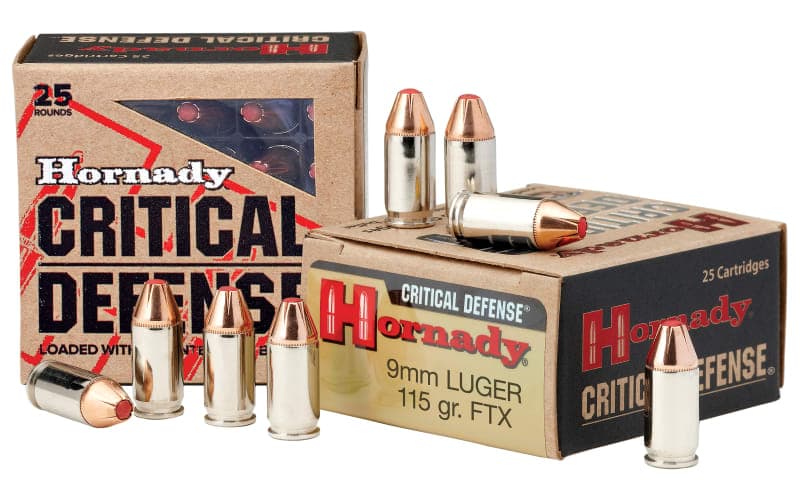
Hornady Critical Defense 9mm 115gr FTX

Optimized for concealed carry pistols with shorter barrels. The FTX polymer tip prevents hollow point clogging while the lighter bullet reduces recoil for fast follow-up shots.

  • 115 grain FTX
  • 9mm Luger
  • 1142 fps muzzle velocity
Verified Retailer
Check Price at OpticsPlanet
View Full Details
Bags & Cases • $180

5.11 LV Covert Carry Pack 45L

Full-size 45L CCW backpack with dedicated concealed carry compartment, laptop sleeve, and grey man styling for extended travel or all-day EDC.

  • Total volume: 45L
  • Rear CCW compartment with loop panel
  • Fits laptops up to 17"
Verified Retailer
View on Amazon
View Full Details
Bags & Cases • $55

5.11 Select Carry Pistol Pouch

Budget CCW fanny pack with hot-pull tabs, internal holster, and adjustable strap up to 67" for versatile wear positions.

  • Dimensions: 6.5"H × 14"W
  • Internal holster with mag slots
  • Hot-Pull deployment tabs
Verified Retailer
View on Amazon
View Full Details
Gas System Components • Budget

BRT EZTune Gas Tube - Pistol

Precision-ported pistol-length gas tube for SBRs and AR pistols. Essential for high-backpressure short barrels.

  • Pistol length gas tube
  • Multiple port sizes available
  • No gas block removal required
Verified Retailer
Check Best Price
View Full Details
Ammunition • Mid-Range

Federal HST 9mm 124gr JHP

The gold standard for law enforcement duty ammunition. Consistent expansion and penetration through all FBI protocol barriers. Trusted by more LE agencies than any other 9mm load.

  • 124 grain JHP
  • 9mm Luger
  • 1135 fps muzzle velocity
Verified Retailer
Check Price at OpticsPlanet
View Full Details
Ammunition • Mid-Range

Speer Gold Dot 9mm 147gr JHP

Heavy subsonic Gold Dot with bonded-core construction. Controlled penetration with the weight retention Gold Dot is known for, ideal for suppressed and compact pistols.

  • 147 grain bonded JHP
  • 9mm Luger
  • 952 fps muzzle velocity
Verified Retailer
Check Price at OpticsPlanet
View Full Details

Get Pistol & Ammo Reviews

Weekly coverage of new pistol releases, ammunition testing, carry gear reviews, and caliber comparisons.

Unlock free printable targets, drill cards, and reference sheets. Plus weekly guides and reviews. No spam.

Frequently Asked Questions

Which is more powerful, 9mm or 45 ACP?
The .45 ACP produces more muzzle energy per round (roughly 356-400 ft-lbs vs 332-364 ft-lbs for 9mm). However, 'power' in a defensive context depends on terminal performance, not raw energy. Modern 9mm hollow points like the Federal HST 147gr achieve 0.606 inches of expansion and 15.2 inches of penetration in ballistic gel, meeting the same FBI performance standards as .45 ACP defensive loads. The 9mm's lower recoil allows faster, more accurate follow-up shots, which is arguably more important than per-round energy in real-world defensive scenarios.
Will a .380 stop an attacker?
Yes, .380 ACP can stop an attacker with quality defensive ammunition and accurate shot placement. Modern .380 hollow points like the Hornady Critical Defense 90gr and Federal HST Micro 99gr achieve 10-12 inches of penetration in ballistic gel with reliable expansion. While this falls slightly short of the FBI's ideal 12-18 inch window, it is within the acceptable range for defensive use. The key limitation is margin for error: .380 has less energy reserve to penetrate heavy clothing or intermediate barriers compared to 9mm. For maximum effectiveness, use premium hollow points specifically engineered for the .380's lower velocity range.
Why do police not use 45 ACP?
Most law enforcement agencies switched from .45 ACP to 9mm because modern hollow point ammunition closes the terminal performance gap while 9mm offers significant practical advantages: higher magazine capacity (15-17 rounds vs 7-8 in same-size frames), lower recoil for faster qualification scores, lower ammunition cost for more frequent training, and lighter pistols for all-day carry. The FBI's 2014 protocol testing confirmed that 9mm, .40 S&W, and .45 ACP all met minimum performance standards, making 9mm the clear choice when capacity, controllability, and cost are factored in.
Is .380 a good concealed carry caliber?
The .380 ACP is an excellent concealed carry caliber for situations where maximum concealability is the top priority. Pistols like the Ruger LCP MAX (10.6 oz, 0.81 inches wide) and Smith & Wesson Bodyguard (12 oz) are significantly smaller and lighter than the smallest 9mm options, making them ideal for deep concealment in dress clothes, athletic wear, or pocket carry. The trade-off is reduced terminal performance compared to 9mm. For most carriers, a modern micro-compact 9mm like the SIG P365 (17.8 oz) offers a better balance of concealability and effectiveness. Choose .380 when you genuinely cannot conceal a micro-compact 9mm.
Why did the military switch from 45 to 9mm?
The U.S. military replaced the M1911 (.45 ACP) with the Beretta M9 (9mm) in 1985 primarily for NATO standardization. The 9x19mm Parabellum is the standard NATO pistol cartridge, simplifying logistics across allied forces. Secondary factors included higher magazine capacity (15 rounds vs 7), lighter weight for the pistol and ammunition, easier qualification for smaller-statured soldiers, and lower per-round cost. The military uses full metal jacket (FMJ) ammunition due to the Hague Convention, so the hollow point performance advantage of .45 ACP does not apply in military contexts.
Can you shoot .380 in a 9mm pistol or vice versa?
No. While .380 ACP and 9mm share the same 0.355-inch bullet diameter, they have different case lengths (17.3mm vs 19.15mm) and operating pressures (21,500 vs 35,000 psi). A .380 round may chamber in some 9mm pistols but will headspace incorrectly, causing unreliable ignition and safety issues. A 9mm round will not fit in a .380 pistol. The .45 ACP is completely different with a 0.452-inch bullet diameter. Always use only the caliber specified by the manufacturer for your firearm.
Why is .380 ammo more expensive than 9mm?
The .380 ACP costs more than 9mm despite using less material because of economies of scale. 9mm is the world's most popular handgun cartridge, manufactured in vastly greater quantities by every major ammunition company. Higher production volume means lower per-unit cost. Practice .380 FMJ runs $0.35-0.45 per round versus $0.22-0.30 for 9mm. During ammunition shortages, 9mm returns to shelves faster than .380 due to higher production priority.
What is the effective range of .380 ACP?
The effective defensive range of .380 ACP is approximately 7-15 yards, which covers the vast majority of self-defense encounters. Beyond 15 yards, the .380's lower velocity causes significant bullet drop and reduced hollow point expansion reliability. At 25 yards, a .380 bullet has lost roughly 30-40% of its muzzle energy. By comparison, 9mm maintains better energy retention and flatter trajectory out to 25+ yards, and .45 ACP's heavier bullet retains energy well at typical handgun distances. For typical concealed carry defensive distances (3-7 yards), all three calibers are adequate.

The Verdict

9mm is the better caliber for most shooters in most scenarios. Modern hollow point ammunition has closed the terminal performance gap that historically justified .45 ACP's existence. When 9mm matches .45 ACP in FBI gel tests while offering nearly double the magazine capacity, substantially lower recoil, and the cheapest ammunition of the three calibers, the math is straightforward. The best 9mm pistols offer the best combination of capacity, controllability, cost, and terminal effectiveness available today.

The .45 ACP retains genuine advantages in specific niches. Suppressed shooting is simpler with inherently subsonic ammunition. The cartridge's momentum advantage provides better barrier penetration. And for shooters who prefer the 1911 platform, the .45 ACP remains the definitive chambering with over a century of development behind it.

The .380 ACP fills a narrow but real niche that neither 9mm nor .45 ACP can: true pocket carry in a sub-11-ounce pistol. For deep concealment in minimal clothing, backup gun duty, or shooters with physical limitations that make 9mm recoil problematic, the .380 provides defensive capability in a package that would otherwise mean carrying nothing at all. A .380 you carry every day is infinitely more effective than a 9mm sitting in a safe.

For a first pistol, buy 9mm. Pair with quality defensive ammunition, a quality holster, and a pistol red dot for a complete carry setup. Consider adding a .380 pocket pistol for deep concealment and a .45 ACP suppressor host as your collection grows.

Related guides

Continue exploring with these related resources

View all guides →

Header image: AI generated. Ballistic gel test data sourced from manufacturer specifications and independent testing by Lucky Gunner Labs.