Optics & Sighting • $2,119
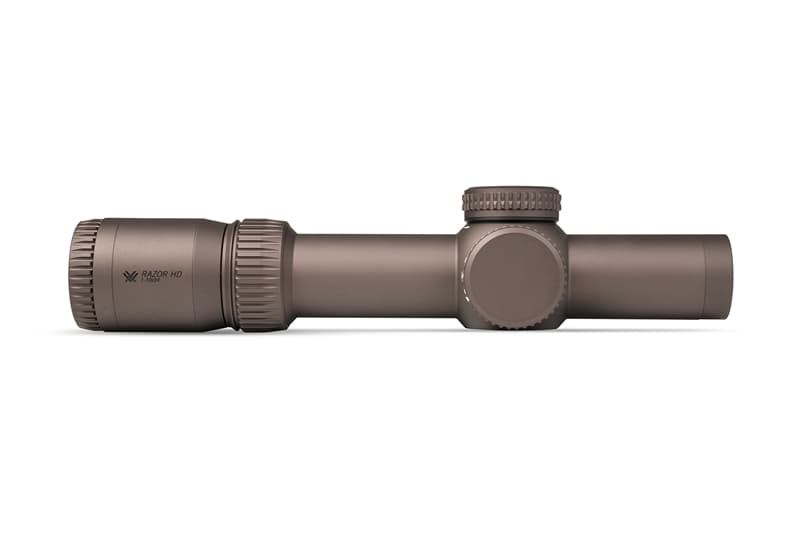
Vortex Razor HD Gen III 1-10x24
- 1-10x magnification
- First focal plane
$2499.00
View at OpticsPlanet
1 MOA is 1.047 inches at 100 yards and 1 MRAD is 3.6 inches (10 cm at 100 m). Convert MOA, MRAD, inches, and centimeters at any distance, read the subtension chart, then turn a measured miss into whole turret clicks using the click value of your actual scope or red dot.
To convert MOA to inches, multiply MOA by 1.047 and by the distance in hundreds of yards: 2 MOA at 300 yards is 2 x 1.047 x 3 = 6.28 inches. To convert MRAD to MOA, multiply by 3.438; MOA to MRAD, divide by 3.438. Type in any one field below and the other two update at the distance you set.
Type in any field and the other two update. The highlighted field is your input; linear size is computed at the distance above.
1 MOA covers 0.26 inches at 25 yards, 0.52 at 50, 1.05 at 100, 2.09 at 200, 5.24 at 500, and 10.47 inches at 1,000 yards. 1 MRAD is exactly 3.6 inches per 100 yards and exactly 10 cm per 100 meters, which is why 0.1 MRAD turrets are 1 cm per click at 100 m. Both tables use true MOA (1.047 inches), not the 1-inch shooter's MOA shortcut.
| Distance (yd) | 1 MOA (in) | 1/4 MOA click (in) | 1 MRAD (in) | 0.1 MRAD click (in) |
|---|---|---|---|---|
| 25 | 0.26 | 0.07 | 0.9 | 0.09 |
| 50 | 0.52 | 0.13 | 1.8 | 0.18 |
| 100 | 1.05 | 0.26 | 3.6 | 0.36 |
| 200 | 2.09 | 0.52 | 7.2 | 0.72 |
| 300 | 3.14 | 0.79 | 10.8 | 1.08 |
| 400 | 4.19 | 1.05 | 14.4 | 1.44 |
| 500 | 5.24 | 1.31 | 18 | 1.8 |
| 600 | 6.28 | 1.57 | 21.6 | 2.16 |
| 700 | 7.33 | 1.83 | 25.2 | 2.52 |
| 800 | 8.38 | 2.09 | 28.8 | 2.88 |
| 900 | 9.42 | 2.36 | 32.4 | 3.24 |
| 1000 | 10.47 | 2.62 | 36 | 3.6 |
| Distance (m) | 1 MOA (cm) | 1/4 MOA click (cm) | 1 MRAD (cm) | 0.1 MRAD click (cm) |
|---|---|---|---|---|
| 25 | 0.73 | 0.18 | 2.5 | 0.25 |
| 50 | 1.45 | 0.36 | 5 | 0.5 |
| 100 | 2.91 | 0.73 | 10 | 1 |
| 200 | 5.82 | 1.45 | 20 | 2 |
| 300 | 8.73 | 2.18 | 30 | 3 |
| 400 | 11.64 | 2.91 | 40 | 4 |
| 500 | 14.54 | 3.64 | 50 | 5 |
| 600 | 17.45 | 4.36 | 60 | 6 |
| 800 | 23.27 | 5.82 | 80 | 8 |
| 1000 | 29.09 | 7.27 | 100 | 10 |
A 2 inch low miss at 100 yards is 1.91 MOA, which rounds to 8 clicks up on a 1/4 MOA turret, 4 clicks on 1/2 MOA, 2 clicks on a 1 MOA red dot, and 6 clicks on a 0.1 MRAD turret. Enter the distance, how far the group landed from point of aim, and either a standard click value or your optic from the catalog list; the calculator returns elevation and windage clicks with direction.
Impact was:
Enter distance and impact offset to calculate adjustments.
A turret correction is an angle, so the clicks you dial for a miss measured at 25 yards are the same clicks at 100 yards; only the linear size changes. This calculator takes a miss in inches, centimeters, MOA, or MRAD at distance A, rounds it to whole clicks on the selected turret, and shows what that same correction and its rounding residual are worth at distance B. Use it when you confirm zero at 25 or 50 and shoot at 100 or 300, or when a 1 MOA pistol dot cannot land exactly on a 7 yard miss.
Miss is 1.91 MOA (7.64 clicks exact); 8 clicks dial 2 MOA.
Whole clicks over-correct by 0.09 MOA. The angle is the same at every distance; the linear residual grows with range.
Dial the clicks, fire another group, and re-measure; one correction rarely lands dead center because the first group had its own dispersion. The optic zeroing guide covers the full procedure with printable 50/200 and 36/300 targets, and the pistol red dot zeroing guide covers the 10 versus 25 yard question for 1 MOA handgun dots. Once zeroed, run your load through the ballistics calculator for drop in the same MOA or MRAD units your turret uses.
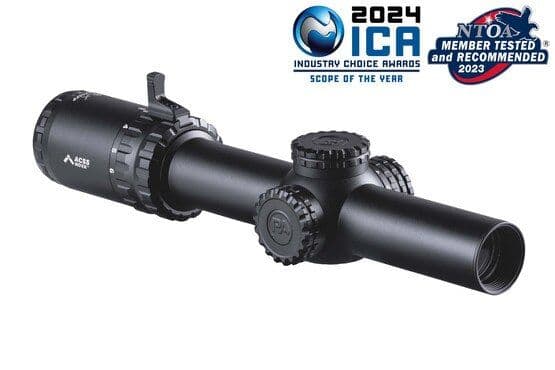
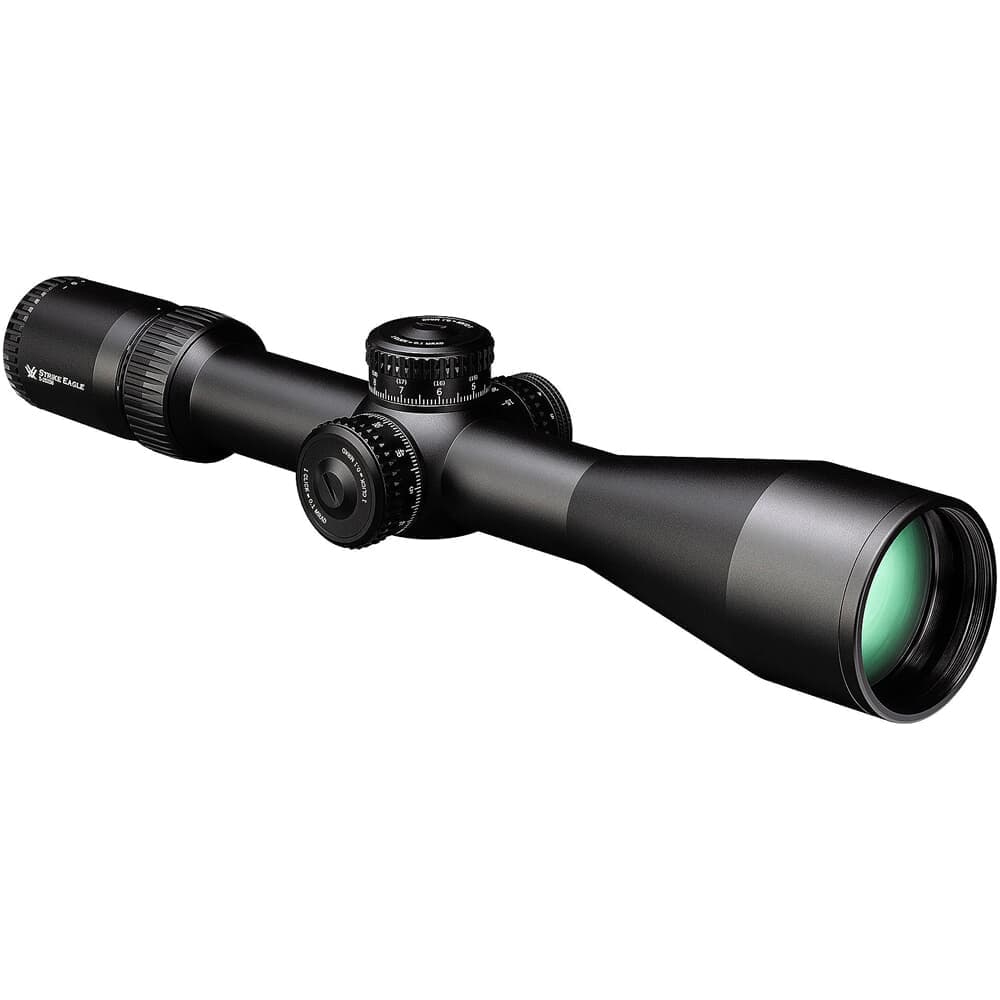
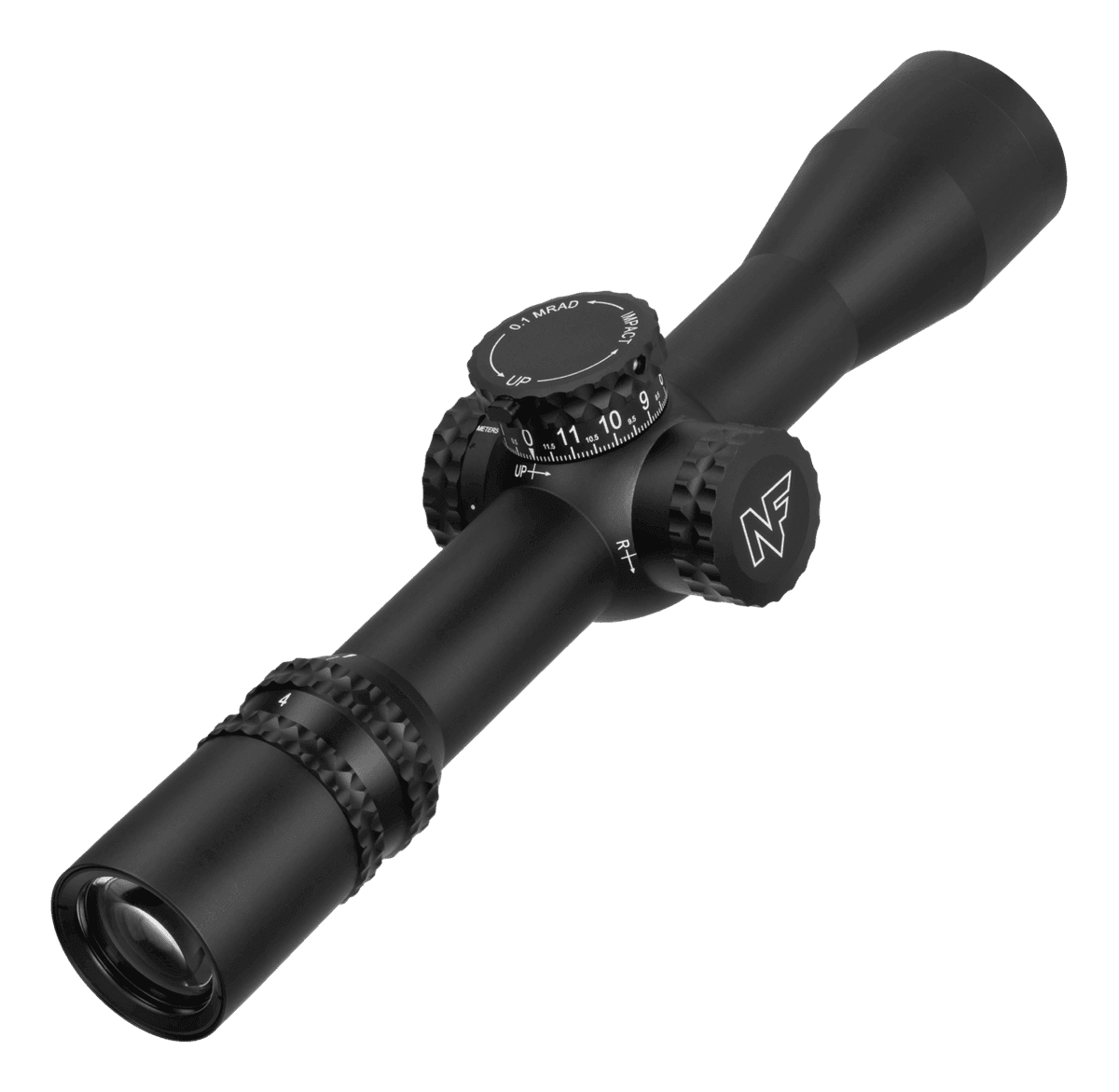
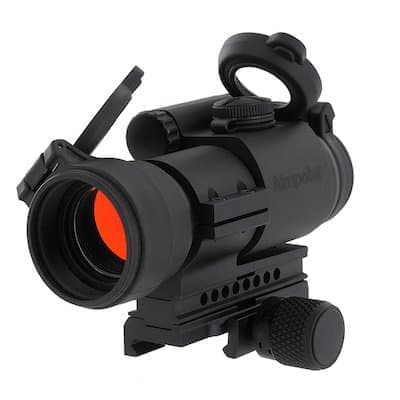
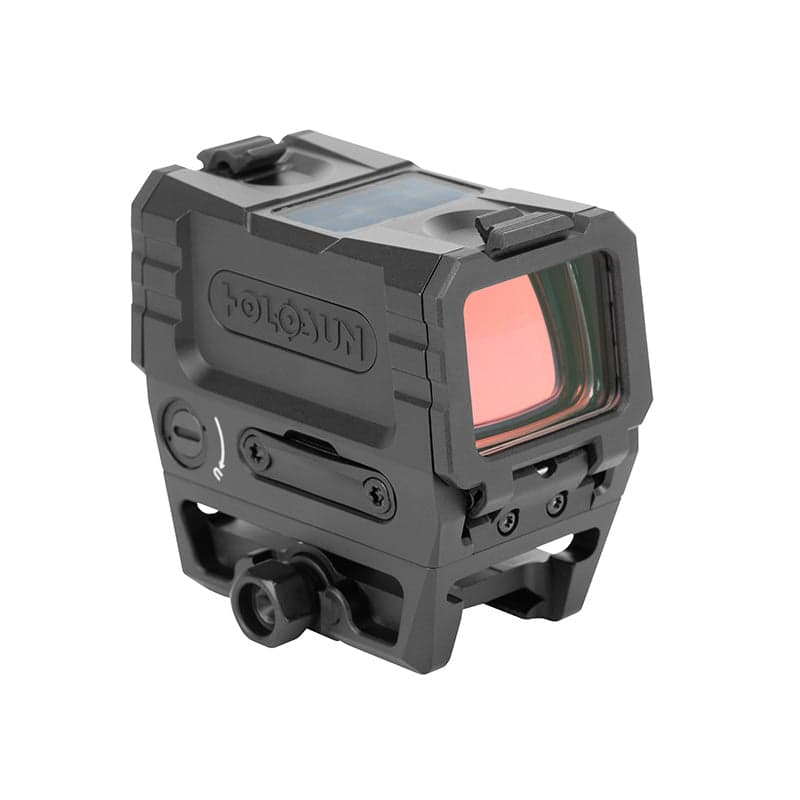
Match the turret to the reticle, and buy the click value you want to dial: Vortex Razor HD Gen III 1-10x24 (0.1 MRAD or 1/4 MOA per click), Primary Arms SLx 1-6x24 Gen IV (0.1 MRAD per click), Vortex Strike Eagle 5-25x56 FFP (1/4 MOA per click), Nightforce ATACR 4-16x42 F1 (0.1 MRAD or 1/4 MOA per click), Aimpoint PRO (1/2 MOA per click), Holosun AEMS EVO (1/2 MOA per click). Every optic below is in the preset list above with its maker-published click value. For ranked picks by budget, see the best LPVO guide, the best long range scope guide, and the best AR-15 red dot guide.
Affiliate links (?)
A minute of angle (MOA) is 1/60th of one degree, an angular slice that spreads to 1.047 inches at 100 yards and grows in proportion with distance. Because it scales linearly, one number describes both your group size and your turret correction at any range. A milliradian (MRAD or MIL) is the same idea on a metric-friendly scale, spanning exactly 10 cm at 100 m and 3.6 inches at 100 yards; 1 MRAD equals 3.44 MOA. Neither unit is more precise; MOA turrets simply use finer steps (0.26 inches per 1/4 MOA click at 100 yards versus 0.36 inches per 0.1 MRAD click).
Click value is the one spec that changes the math, and it is not standard across optics. Precision and hunting scopes dial 1/4 MOA or 0.1 MRAD; many LPVOs use 1/2 MOA or 0.2 MRAD; rifle red dots and holographics like the Aimpoint PRO, EOTech EXPS3, and Holosun AEMS are 0.5 MOA; pistol dots like the Trijicon RMR, Holosun 507C, and Leupold DeltaPoint Pro are 1 MOA; the Holosun EPS and SIG ROMEO-X SIG-LOC PRO are 1.5 MOA; and the Trijicon RMRcc moves 3 MOA per click. Assuming 1/4 MOA on a 1 MOA dot means dialing four times too far, which is why the preset list pulls the value from the maker's spec sheet.
1 MOA at 100 yards is 1.047 inches, usually rounded to 1 inch for quick range math. At 100 meters 1 MOA is 2.91 cm. The same angle is 0.52 inches at 50 yards, 2.09 inches at 200 yards, and 10.47 inches at 1,000 yards, so a rifle that shoots 1 MOA prints roughly 1 inch groups at 100 yards and 10 inch groups at 1,000.
1 MOA is 4 clicks on a 1/4 MOA turret, 2 clicks on a 1/2 MOA turret, 8 clicks on a 1/8 MOA turret, and 1 click on a 1 MOA red dot such as a Trijicon RMR or Holosun 507C. On a 0.1 MRAD turret, 1 MOA is 0.29 MRAD, which rounds to 3 clicks (0.3 MRAD, or 1.03 MOA). The click value is printed on the turret cap or in the optic's manual; the preset list on this page pulls it from the maker's spec sheet.
1 inch at 100 yards is 0.955 MOA, so it takes 4 clicks on a 1/4 MOA turret (which moves 1.047 inches, 0.05 inch more than needed), 2 clicks on 1/2 MOA, or 1 click on a 1 MOA dot. On a 0.1 MRAD turret, 1 inch is 0.278 MRAD, which rounds to 3 clicks and moves 1.08 inches. The leftover after rounding is the residual the zero shift calculator reports.
Most precision and hunting scopes adjust in 1/4 MOA or 0.1 MRAD, matched to the reticle. Many LPVOs are coarser: the Vortex Strike Eagle 1-6 and 1-8, SIG Tango MSR, and Steiner P4Xi dial 1/2 MOA, and the Vortex Viper PST Gen II 1-6 MRAD is 0.2 MRAD. Rifle red dots and holographics (Aimpoint PRO, T-2, CompM5, EOTech EXPS3, Holosun AEMS) are 0.5 MOA. Pistol dots (Trijicon RMR, SRO, Holosun 507C, Leupold DeltaPoint Pro) are 1 MOA, the Holosun EPS and SIG ROMEO-X SIG-LOC PRO are 1.5 MOA, and the Trijicon RMRcc is 3 MOA per click. When in doubt, read the turret cap; the number there overrides any assumption.
Divide the distance you are shooting by 100, and that is roughly how many inches 1 MOA covers at that distance. At 250 yards, 250 / 100 = 2.5, so 1 MOA is about 2.5 inches. The precise figure is 1.047 inches per 100 yards, so a miss in inches converts to MOA as: inches divided by (distance in yards / 100 x 1.047). A 3 inch miss at 200 yards is 3 / (2 x 1.047) = 1.43 MOA, which is 6 clicks on a 1/4 MOA turret.
1 MOA equals 1.047 inches at 100 yards, and it scales linearly with distance: 2.09 inches at 200 yards, 3.14 inches at 300 yards, and 10.47 inches at 1,000 yards. For field math, the '1 inch per 100 yards' shortcut is accurate to within 5 percent, which is smaller than most groups inside 300 yards.
1 MOA at 50 yards is 0.52 inches. The ladder is easy to memorize: 1 MOA equals roughly 1/4 inch at 25 yards, 1/2 inch at 50 yards, 1 inch at 100 yards, 2 inches at 200 yards, and 3 inches at 300 yards. This is why a 2 MOA red dot covers about 1 inch of target at 50 yards and 2 inches at 100.
1 MOA at 400 yards is 4.19 inches. That is four times the 1.047 inch spread at 100 yards, since MOA grows in direct proportion to distance. A rifle that shoots 1 MOA groups will therefore print roughly 4.2 inch groups at 400 yards, and a 1/4 MOA turret click moves impact about 1 inch at that range.
2 MOA at 50 yards is just over 1 inch (1.05 inches exactly). This matters for red dot shooters: a 2 MOA dot, the most common size on pistol and rifle optics, covers about an inch of your target at 50 yards. It also means a group that measures 1 inch at 50 yards is a 2 MOA group, not a 1 MOA group.
1 MOA at 1 mile (1,760 yards) is 18.4 inches. That single minute of angle covering a torso-width span is why extreme long range shooters obsess over wind calls and turret precision: a 1 MOA misjudgment that would move an impact 1 inch at a 100 yard zero check becomes a complete miss at a mile.
Multiply MRAD by 3.44 to get MOA (the exact ratio is 3.4377), or divide MOA by 3.44 to go the other direction. So a 0.5 MRAD adjustment is 1.7 MOA, and a 1 MOA group is 0.29 MRAD. In linear terms, 1 MRAD covers 3.6 inches at 100 yards while 1 MOA covers 1.047 inches. The converter above does this both directions at any distance.
Neither system is more accurate; they are two ways of measuring the same angles. MOA turrets adjust in finer steps (1/4 MOA is 0.26 inches per click at 100 yards versus 0.36 inches for 0.1 MRAD), and MOA maps neatly onto inches and yards. MRAD wins for metric ranges (0.1 MRAD is exactly 1 cm at 100 m), faster communication of big corrections, and it is the standard in precision rifle matches and military use. Pick the system your reticle uses, and make sure turrets and reticle match: a MRAD reticle with MOA turrets forces conversion math on every correction.
0.1 MRAD is 0.36 inches at 100 yards, and exactly 1 centimeter at 100 meters. That is the value of one click on a standard MRAD turret, so a correction of 5 clicks moves impact 1.8 inches at 100 yards or 5 cm at 100 meters. Doubling the distance doubles the movement: at 200 yards one 0.1 MRAD click is 0.72 inches.
Yes, on a standard 0.1 MRAD turret, 10 clicks equal 1 full MRAD, which moves impact 3.6 inches at 100 yards or 10 cm at 100 meters. Some precision turrets adjust in 0.05 MRAD, making 1 MRAD 20 clicks. For MOA optics the equivalents are 4 clicks per MOA on a 1/4 MOA turret and 2 clicks on a 1/2 MOA turret. Check the turret cap before dialing; assuming the wrong click value scales every correction by the same error.
True MOA is 1.047 inches per 100 yards; shooter's MOA (also called SMOA or inch-per-hundred-yards) rounds that to exactly 1 inch. Inside 300 yards the 4.7 percent difference is smaller than most groups and safe to ignore. At long range it compounds: dialing a 30 MOA correction at 1,000 yards moves impact 314 inches in true MOA but 300 inches in SMOA, a 14 inch discrepancy. Nearly all quality scopes adjust in true MOA; this calculator uses true MOA throughout.
Use the Configurator to compare optics on your build, from 2 MOA red dots to MRAD precision glass, with compatibility checked against your platform.
Launch Configurator