Stocks & Braces • $99.99
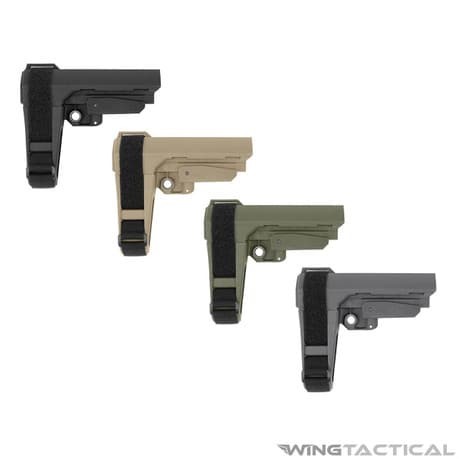
SB Tactical SBA3 Brace
- 5-position adjustable
- Mil-spec tube
$99.99
Shop at MidwayUSA
State Legality MatrixClass Breakdown
Statute-cited, last verified 2026-08-04
Common braced-pistol hosts are banned in 7 jurisdictions and restricted in 4, which leaves 40 states with no added state restriction. The 7 ban jurisdictions are Connecticut, Delaware, Hawaii, Illinois, New Jersey, New York, and Washington, D.C. California, Colorado, Massachusetts, and Washington impose configuration or purchase restrictions without categorically banning the brace itself. Texas, Florida, Arizona, Georgia, and the rest of the country have no state statute that specifically reaches a brace or an otherwise lawful brace-equipped pistol.
Pistol Braces
The 2023 ATF rule that would have reclassified most brace-equipped pistols as short-barreled rifles was vacated nationwide and is not being enforced, but the vacatur did not categorically exempt every firearm carrying an accessory labeled a brace. Under 26 U.S.C. § 5845, the federal question still turns on whether the specific weapon is designed and intended to be fired from the shoulder. A configuration that meets the short-barreled-rifle definition requires a Form 1, fingerprints, CLEO notification, a NICS check, and NFA registration; a configuration that remains a pistol does not. The federal making tax has been $0 since January 1, 2026 and eForm approvals run days to a couple of weeks.
A brace can still matter in states that ban short-barreled rifles outright when the specific brace-equipped firearm remains a pistol under federal and state law. Rhode Island is the clearest case: it prohibits possession of any rifle under 26 inches overall or with a barrel under 16 inches with no NFA exemption, while its 2025 assault weapons law does not reach detachable-magazine pistols. Maryland is the mirror image, where a semi-auto centerfire rifle under 29 inches is a banned copycat weapon and the state police classify qualifying brace-equipped firearms as handguns. In the jurisdictions that prohibit common braced AR- and AK-pattern pistols, the state restriction usually attaches to the host through an assault-weapon feature test the pistol already trips bare, so removing the brace does not make that host legal.
Where it is restricted
These 11 jurisdictions ban or restrict braced pistols. Only Connecticut, Illinois, and Virginia name the brace in statute; the rest reach the host firearm through a feature test, usually a magazine that attaches outside the pistol grip. Each row cites the controlling statute and the date the entry was last verified against primary sources.
| State | Status | Rule | Statute / Case |
|---|---|---|---|
| California | Restricted | California does not ban braces categorically, but common detachable-magazine AR- and AK-pattern pistols are assault weapons and a shoulder-fired configuration may be a prohibited short-barreled rifle. Effective 2000-01-01. | Cal. Penal Code § 30515(a)(4)(D); Cal. Penal Code §§ 17170 & 33215 |
| Colorado | Restricted | Buying or transferring a braced gas-operated semi-automatic handgun requires a sheriff-issued eligibility card. Effective 2026-08-01. | Colo. Rev. Stat. § 18-12-116 (SB25-003) |
| Connecticut | Banned | Connecticut names arm braces as an assault-weapon feature, and braced AR-pattern pistols are prohibited either way. Effective 2023-06-06. | Conn. Gen. Stat. § 53-202a(1)(E)(iv)(I), (1)(G)(vii) (P.A. 23-53) |
| Delaware | Banned | Braced AR- and AK-pattern pistols are prohibited copycat weapons because the magazine attaches outside the pistol grip. Effective 2022-06-30. | 11 Del. C. §§ 1465(6), 1466 (HB 450) |
| Hawaii | Banned | Braced AR- and AK-pattern pistols are prohibited assault pistols, and Hawaii bans every rifle with a barrel under 16 inches. Effective 1992-07-01. | Haw. Rev. Stat. §§ 134-1, 134-4(e), 134-8(a) |
| Illinois | Banned | PICA names arm braces as an assault-weapon feature, so a braced detachable-magazine semiautomatic pistol is prohibited. Effective 2023-01-10. | 720 ILCS 5/24-1.9; 720 ILCS 5/24-1(a)(7)(ii) & 5/24-2(c)(7) |
| Massachusetts | Restricted | Braces are not named, but most braced AR-pattern pistols independently fail the two-feature assault-style firearm test. Effective 2024-10-02. | Mass. Gen. Laws ch. 140, § 121 (St. 2024, c. 135); ch. 140, § 131M |
| New Jersey | Banned | A braced AR- or AK-pattern pistol is a substantially identical assault firearm, and New Jersey separately bans short-barreled rifles. | N.J. Stat. §§ 2C:39-1(o), (w) & 2C:39-5(f); N.J. Attorney General Guidelines on the substantially identical provision |
| New York | Banned | Any detachable-magazine semiautomatic pistol with a threaded barrel, barrel shroud, or 50-ounce weight is a banned assault weapon. Effective 2013-01-15. | N.Y. Penal Law §§ 265.00(3), 265.00(22)(c), 265.02(7) & 400.00(16-a) |
| Washington | Restricted | A braced AR-pattern pistol is an assault weapon barred from sale, import, and manufacture; possession stays legal. Effective 2023-04-25. | RCW 9.41.010(2)(a); RCW 9.41.390 |
| District of Columbia | Banned | Braced AR-pattern pistols are unregistrable assault weapons, and the District cannot register a short-barreled rifle either. | D.C. Code § 7-2501.01(3A)(A)(i)(V)(dd); D.C. Code § 7-2502.02(a)(3), (a)(6) |
Contested entries
Courts stay, revive, and sever these laws mid-year, and grandfather clauses change what a ban means in practice. This is where each contested entry stands.
The brace is not itself a listed assault-weapon feature. Section 30515(a)(4)(D) reaches a semiautomatic pistol without a fixed magazine when it can accept a detachable magazine outside the pistol grip, which covers common AR- and AK-pattern pistols even without a brace. A semiautomatic pistol with a fixed magazine of ten rounds or fewer does not fall within § 30515(a)(4) or (5) on that basis alone. Separately, §§ 17170 and 33215 prohibit short-barreled rifles without a civilian NFA exemption, so a brace-equipped configuration that is designed and intended for shoulder firing can still create state and federal SBR exposure.
Colorado regulates the host, not the brace. The covered class is a gas-operated semiautomatic handgun with a detachable magazine, and the statute expressly folds blowback operation into gas-operated, so braced direct-impingement AR pistols and braced blowback PCC pistols are both caught while recoil-operated handguns such as Glocks and 1911s are excluded. This is a purchase and transfer eligibility requirement, not a possession ban: anything lawfully owned before August 1, 2026 is untouched and there is no registration. Colorado has no state short-barreled rifle ban, so a Form 1 remains available, and the 15-round magazine cap applies to either configuration.
Connecticut is one of only three states to name the device: § 53-202a(1)(G)(vii) lists an arm brace or other stabilizing brace that could allow the firearm to be fired from the shoulder as a qualifying feature. Which clause applies turns on barrel length, because § 53a-3(18) defines a pistol as any firearm with a barrel under twelve inches: a braced AR with a sub-12-inch barrel is a pistol caught by the magazine-outside-the-grip prong, while one with a longer barrel is caught directly by the brace clause. A Form 1 is no workaround, since a short AR rifle is itself banned. P.A. 23-53 closed the pre-1994 grandfather; anyone in lawful possession on June 5, 2023 had to obtain a certificate of possession by May 1, 2024.
Delaware never mentions braces. The ban lands on the host through § 1465(6)c, a one-feature test for semiautomatic pistols that accept a detachable magazine, whose first listed feature is the ability to accept a magazine that attaches outside the pistol grip. Adding or removing a brace changes nothing. Section 1466 reaches manufacture, sale, transfer, purchase, and possession, with possession before June 30, 2022 grandfathered under transport restrictions. Delaware has no standalone short-barreled rifle ban, but a Form 1 does not help because the resulting short rifle is itself a banned copycat weapon.
Hawaii's assault pistol definition is a two-characteristic test covering a magazine attaching outside the pistol grip, a threaded barrel, a barrel shroud, an unloaded weight of 50 ounces or more, a centerfire pistol with an overall length of 12 inches or more, and semiautomatic versions of automatic firearms. An AR or AK pistol trips two of those before a brace is involved. The brace still matters at the margin on a conventional handgun, where it can push overall length past 12 inches and supply the second characteristic. There is no NFA safe harbor: § 134-8(a) bans rifles under 16 inches flatly, so a Form 1 is unavailable, and only assault pistols registered in state before July 1, 1992 are grandfathered.
PICA applies a one-feature test to a pistol that accepts a detachable magazine, and one listed feature is a buffer tube, arm brace, or other part that protrudes horizontally behind the pistol grip and is designed to allow the firearm to be fired from the shoulder. PICA is written independently of federal classification, so the vacatur of the ATF rule changed nothing here, and an AR pistol independently trips the magazine-outside-the-grip feature, meaning removing the brace does not cure it. Registration closed January 1, 2024 and no new acquisitions are permitted. Illinois short-barreled rifles are Curio & Relic only under 5/24-2(c)(7), so the Form 1 path is closed for ordinary builds. The Seventh Circuit upheld PICA in Barnett v. Raoul on July 9, 2026.
The 2024 firearms law does not use the words brace or stabilizing; the pistol prong is what bites. A semiautomatic pistol that accepts a detachable feeding device is an assault-style firearm with two of: a magazine well outside the pistol grip, a second grip for the non-trigger hand, a threaded barrel, or a barrel shroud. A typical AR pistol carries a threaded barrel and a heat-shielding handguard, so it is covered regardless of what sits on the buffer tube, while a braced pistol without two listed features stays lawful. Any host with a barrel under 16 inches is a firearm under § 121, so a Class A License to Carry is required; short-barreled rifles are permitted on the same terms. Chapter 135 faces a certified veto referendum on the November 3, 2026 ballot but remains in force.
The brace is not an enumerated feature in New Jersey. The Attorney General guidelines make a semi-auto pistol substantially identical to a listed assault firearm when it accepts a detachable magazine and has two of: a magazine outside the pistol grip, a threaded barrel, a barrel shroud, an unloaded manufactured weight of 50 ounces or more, or being the semi-auto version of an automatic firearm. Any AR or AK pistol clears that on shroud plus weight alone. Section 2C:39-1(o) folds rifles with barrels under 16 inches into the sawed-off shotgun definition with no NFA exemption, so there is no lawful short AR path at all. The en banc Third Circuit ruling of July 17, 2026 addressed semi-automatic rifles and by its own terms did not decide the question for semi-automatic pistols, which were remanded.
New York applies a one-feature test to semi-auto pistols taking a detachable magazine, covering a folding or telescoping stock, a thumbhole stock, a second protruding handgrip, a magazine outside the pistol grip, a threaded barrel, a barrel shroud, a manufactured unloaded weight of 50 ounces or more, or a semi-auto version of an automatic firearm. A typical AR pistol trips three of those before a brace is installed, and an adjustable brace on a buffer tube is separately exposed as a telescoping stock. Possession is a class D felony and the only grandfather is SAFE Act registration for weapons possessed before January 15, 2013, a window that closed in 2014. Penal Law § 265.00(3) sweeps sub-16-inch rifles into the firearm definition and § 400.00 licenses only pistols and revolvers, so a Form 1 is not a workaround.
Washington uses a single-feature test: a semiautomatic pistol that accepts a detachable magazine and has a threaded barrel, a barrel shroud, a second hand grip, or the capacity to accept a magazine at some location outside of the pistol grip. The brace is not a listed feature, so removing it does not make an AR pistol saleable. RCW 9.41.390 reaches manufacture, import, distribution, and sale only, so a resident who already owns a braced AR pistol may keep and use it. Two traps: the definition also reaches a part or combination of parts from which an assault weapon can be assembled, and swapping the brace for a stock creates a semi-auto rifle under 30 inches, which is itself an assault weapon. Short-barreled rifles are legal under RCW 9.41.190 with federal compliance, so a Form 1 on a lawfully possessed receiver stays open where a new braced-pistol purchase does not.
The District uses the same magazine-location feature test as the other ban jurisdictions: a semiautomatic pistol with a detachable magazine is an assault weapon if it can accept a magazine at some location outside of the pistol grip. Every firearm in the District needs a registration certificate, and § 7-2502.02(a)(6) forbids issuing one for an assault weapon, so unregistrable means unpossessable. Section 7-2502.02(a)(3) closes the other path by barring registration of a short-barreled rifle. No District statute names the brace; the host firearm is already barred.
Maryland State Police Advisory LD-FRU-23-001 states that firearms previously classified as handguns with stabilizing braces remain classified as handguns by Maryland statute and require no additional documentation. Maryland never adopted the federal reclassification, so the vacatur changed nothing on the state side; the advisory's separate instructions to file a federal Form 1 by May 2023 were overtaken when the ATF rule was struck down. The practical consequence for a configuration that remains a pistol federally is the handgun channel: a Handgun Qualification License, an MSP 77R application, a seven-day wait, and a licensed-dealer transfer. Maryland's enumerated assault pistol list does not reach AR or AK pistols, but Crim. Law § 4-301(i) makes any semi-auto centerfire rifle under 29 inches overall a banned copycat weapon, so a Form 1 short-barreled rifle is not an alternative.
Michigan classifies by overall length rather than by what the rear attachment is called: any firearm 26 inches or less in length is a pistol, so a braced AR pistol carries the full pistol regime, meaning a purchase license or concealed pistol license for private transfers, an RI-060 pistol sales record filed with the state police, and pistol carry rules. Because the test is length, a long or fully extended brace that pushes the firearm past 26 inches flips it out of pistol status, and MCL 750.228 bars newly registering anything over 26 inches as a pistol. Michigan has no assault weapon ban, and short-barreled rifles are lawful under MCL 750.224b when federally compliant.
Pennsylvania has no assault weapon ban and no statute naming braces, and short-barreled rifles are lawful with federal NFA compliance. The trap is § 6102's unusual firearm definition, which reaches any pistol or revolver with a barrel under 15 inches as well as anything under 26 inches overall, so a braced AR pistol qualifies on barrel length alone no matter how long the brace makes it. That puts it in the handgun class: § 6111(c) requires a private sale or transfer between unlicensed people to happen at a licensed dealer or a county sheriff's office, excepting transfers between spouses, parent and child, or grandparent and grandchild, and § 6106 makes carrying it concealed or in a vehicle without a License to Carry Firearms an offense. Readers who treat a braced pistol like a long gun get both of those wrong, and removing the brace changes neither.
The introduced version of the 2025 Assault Weapons Ban Act listed a buffer tube, arm brace, or other part protruding horizontally behind the pistol grip as a prohibited pistol feature, but that clause did not survive into the enacted law: the only semiautomatic pistol clause in § 11-47.2-1 covers a fixed magazine capacity over ten rounds, and an AR pistol's magazine is detachable. Section 11-47-8(b) bans possession of any rifle under 26 inches overall or with a barrel under 16 inches, with no NFA exemption, so a Form 1 is unavailable. A brace-equipped firearm that remains a pistol under the federal configuration-specific test is a handgun under § 11-47-2, so the pistol purchase permit, safety certificate, and carry license rules apply.
Vermont has no assault weapon ban and no short-barreled rifle prohibition, so both a Form 1 short-barreled rifle and a braced pistol are lawful. The trap is 13 V.S.A. § 4021, which caps magazines at 10 rounds for a long gun and 15 for a handgun, with magazines possessed before April 11, 2018 grandfathered. A braced AR pistol is a handgun, so the 15-round line governs it and a standard 30-round magazine cannot lawfully be acquired in state for either configuration.
Virginia is one of three states to name the device. Under the 2026 acts a semi-automatic centerfire pistol is an assault firearm with two or more characteristics, one of which is a buffer tube, arm brace, or other part that protrudes horizontally behind the pistol grip and is designed to facilitate firing from the shoulder; the others include a magazine attaching outside the pistol grip, a second handgrip, a barrel shroud, and a threaded barrel. A braced AR pistol usually hits two, while a braced Glock-pattern chassis may not, because its magazine seats inside the grip. The acts reach import, sale, manufacture, purchase, and transfer rather than ordinary possession, and Virginia circuit-court injunctions extended statewide currently block enforcement while the challenges proceed. Short-barreled rifles remain legal in Virginia.
Where it is legal
Forty states add no brace-specific or host-configuration restriction, including Texas, Florida, Arizona, Georgia, Ohio, Pennsylvania, Virginia, Rhode Island, and Maryland. Federal classification remains configuration-specific, and several states classify a qualifying brace-equipped firearm as a handgun for purchase and carry purposes.
What to buy
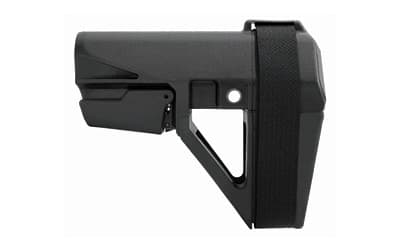
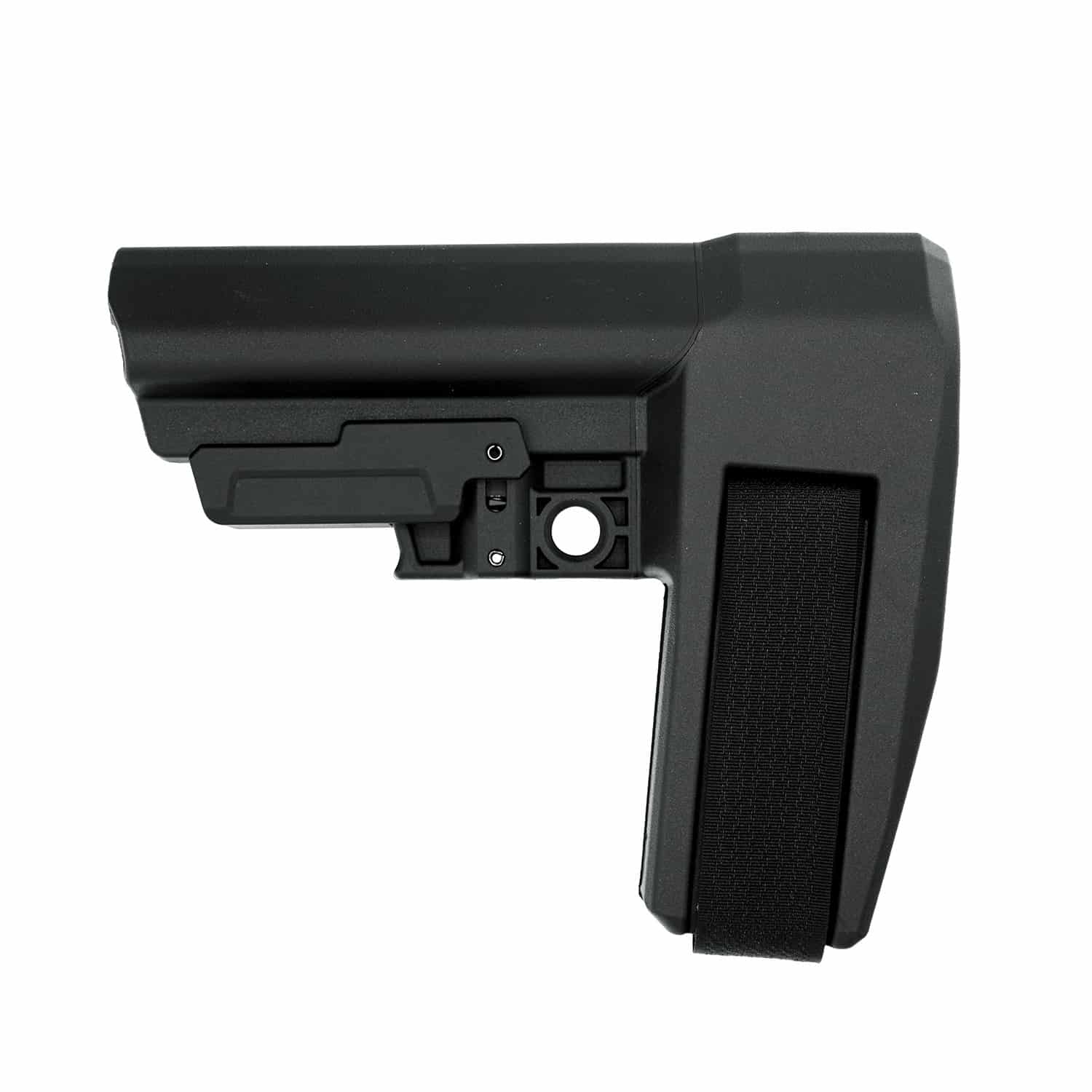
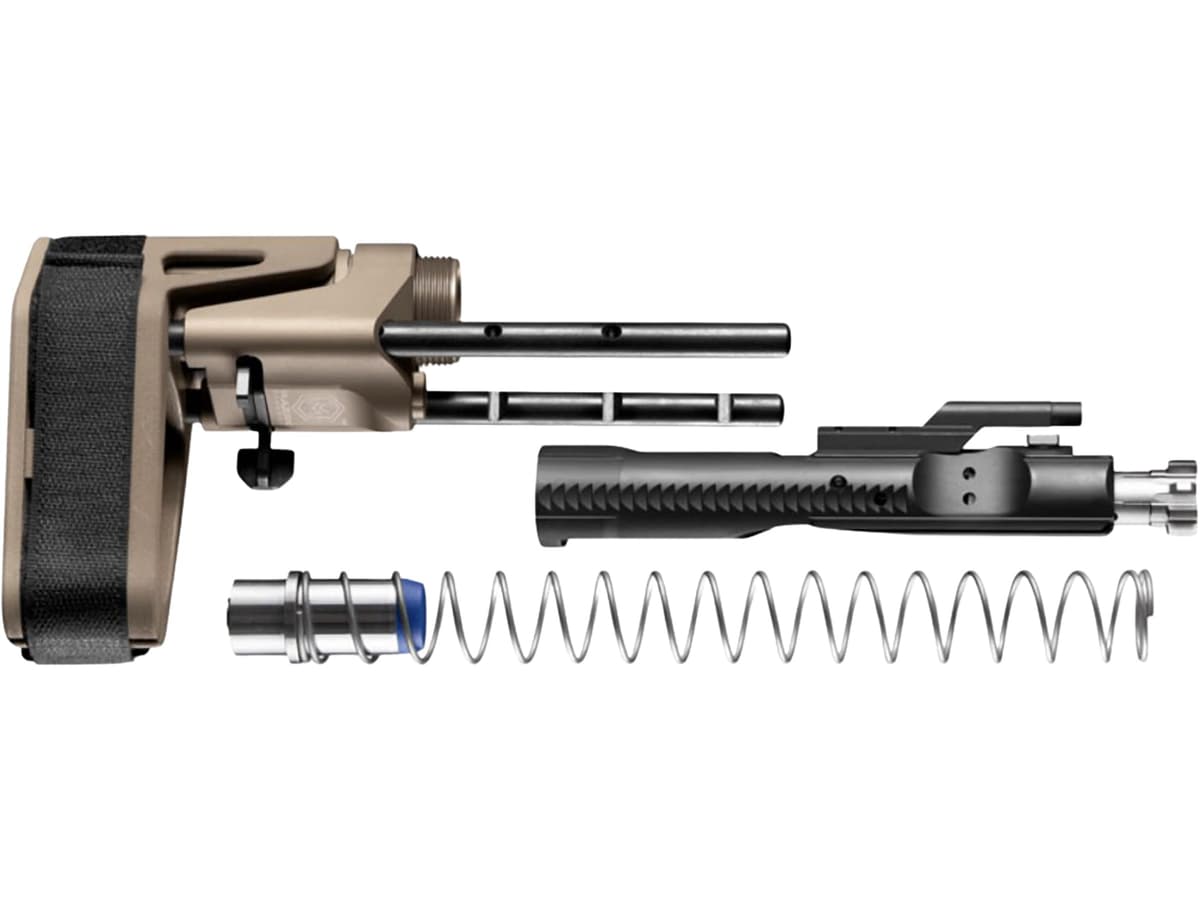
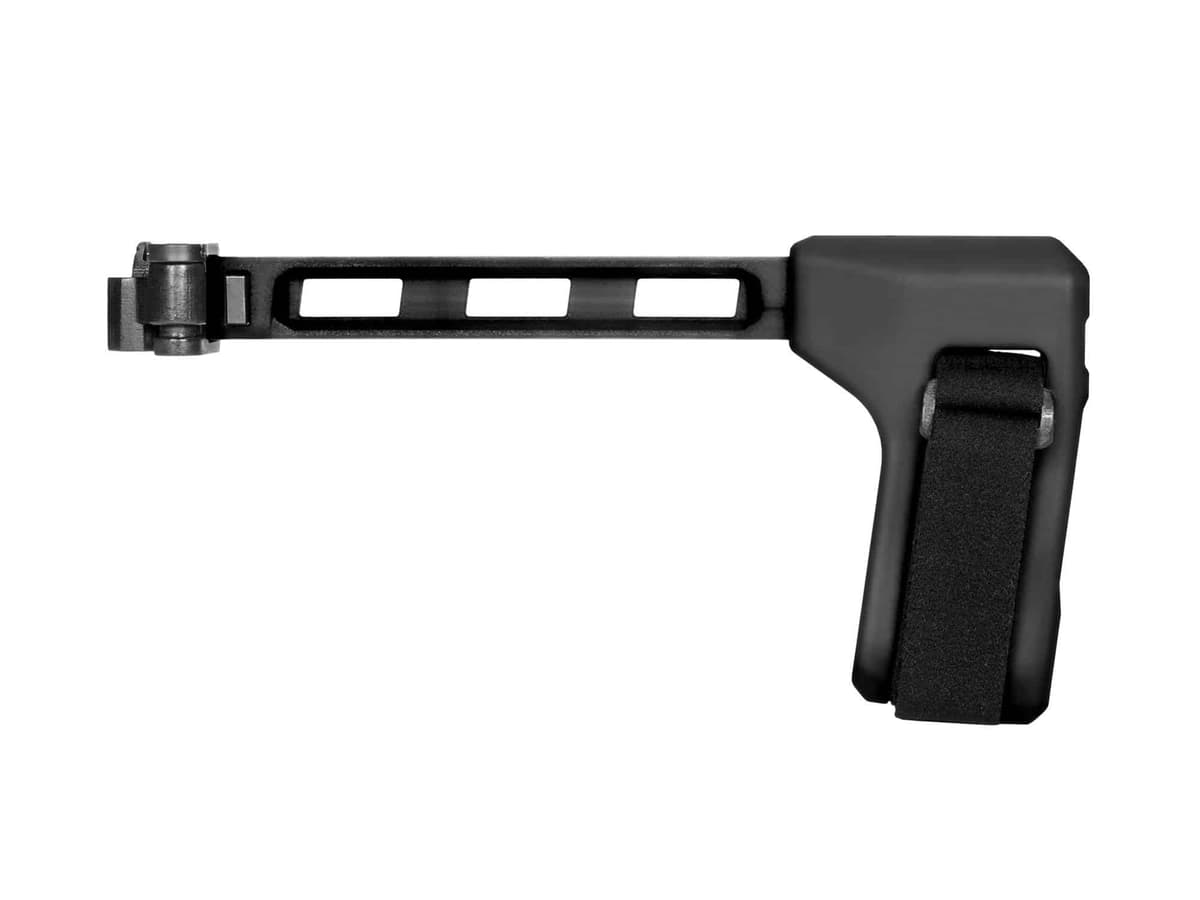
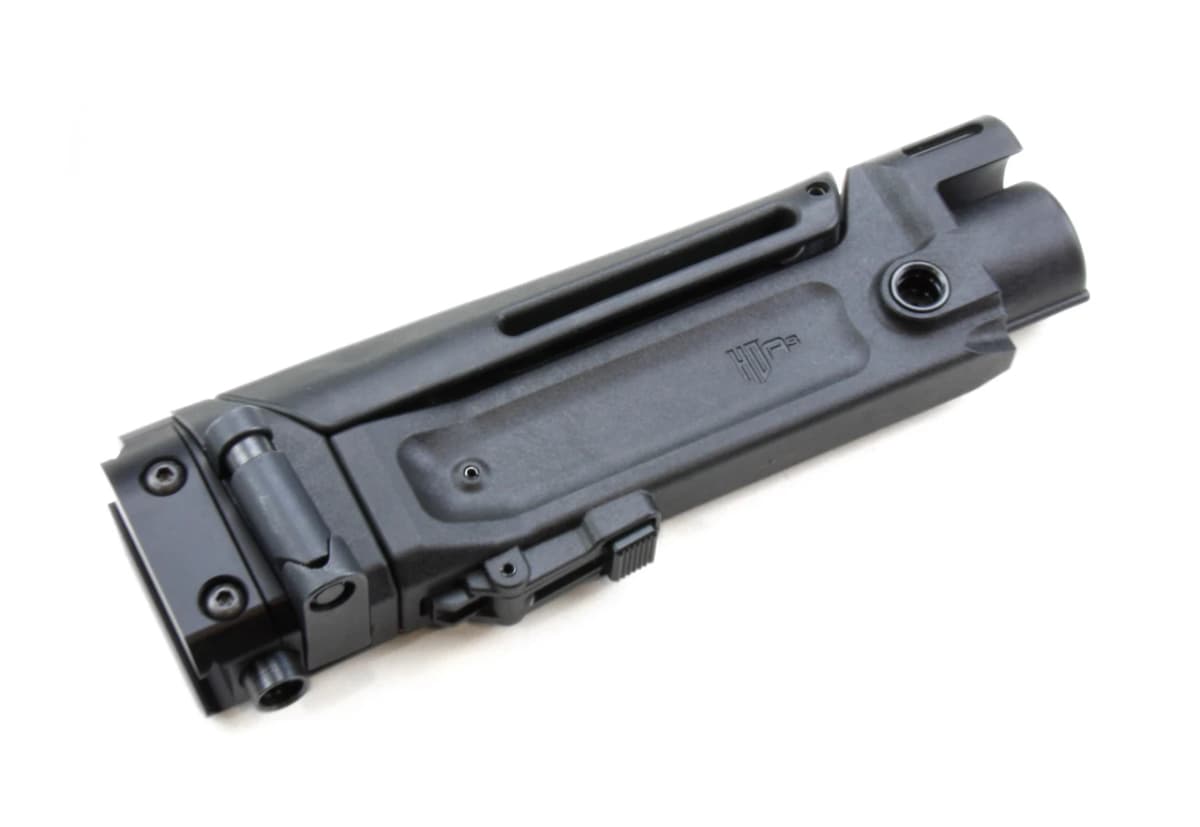
If your state is green on the map, these are the braces that matter. The SB Tactical SBA3, SBA5, and SBA6 are the buffer-tube cuff standards across AR pistols, the Maxim Defense SCW is the shortest collapsed PDW system shipping, and the FS1913A and A3 Industries HDA3 Universal cover folding 1913 hosts like the Scorpion, Stribog, and Kuna.
Affiliate links (?)
Federal law
The 2023 ATF stabilizing-brace rule was vacated nationwide and is not enforced, but that does not categorically make every brace-equipped firearm a pistol. Under 26 U.S.C. § 5845, federal classification still turns on whether the specific weapon is designed and intended to be fired from the shoulder. A brace-equipped firearm that meets the short-barreled-rifle definition requires NFA approval and registration; a configuration that remains a pistol does not. Building an actual short-barreled rifle is still an NFA act: Form 1, fingerprints, CLEO notification, a NICS check, and registration all apply. The federal making tax has been $0 since January 1, 2026 under the One Big Beautiful Bill Act, and eForm approvals currently run days to a couple of weeks.
Federal baseline verified 2026-08-04.
Common questions
No. The 2023 ATF rule that would have reclassified most brace-equipped pistols as short-barreled rifles was vacated nationwide and is not being enforced. The vacatur does not categorically exempt every brace-equipped firearm, however: federal classification still turns on whether the specific weapon is designed and intended to be fired from the shoulder, and a configuration that meets the short-barreled-rifle definition still requires NFA approval and registration.
Texas adds no state restriction on braces or otherwise lawful brace-equipped pistols, and the 2023 federal brace rule is vacated. Federal classification still depends on the specific configuration. Texas also allows short-barreled rifles when registered under the NFA, so a Form 1 remains the clear route for putting a shoulder stock on a short-barreled host.
A Form 1 is the clear route when the goal is a shoulder-fired short-barreled rifle; attaching a brace does not categorically keep a firearm outside the NFA. The federal making tax has been $0 since January 1, 2026 and eForm approvals run days to a couple of weeks. In a state that bans short-barreled rifles but permits pistols, a brace-equipped configuration may remain available only when that specific firearm is still classified as a pistol under federal and state law.
Usually not. Only Connecticut, Illinois, and Virginia name the brace as a feature in statute. California, Delaware, Hawaii, New Jersey, New York, Washington, and Washington, D.C. reach the host firearm through a feature test that an AR or AK pistol already fails bare, most often because the magazine attaches at a location outside the pistol grip. Taking the brace off those guns changes nothing.
California does not ban braces categorically, but common AR- and AK-pattern pistol hosts are restricted. Penal Code § 30515(a)(4)(D) makes a semiautomatic pistol without a fixed magazine an assault weapon when it can accept a detachable magazine outside the pistol grip; a fixed-magazine pistol holding ten rounds or fewer does not fall within that provision on magazine configuration alone. Short-barreled rifles are separately prohibited under §§ 17170 and 33215, so a brace-equipped firearm that is designed and intended for shoulder firing creates additional state and federal SBR exposure.
Yes, on the purchase side. Since August 1, 2026, Colo. Rev. Stat. § 18-12-116 requires a safety course and a sheriff-issued eligibility card to buy or transfer a gas-operated semiautomatic handgun with a detachable magazine, and the statute folds blowback operation into gas-operated, so braced AR pistols and braced PCC pistols are both covered. Recoil-operated handguns are excluded, there is no possession ban and no registration, and anything owned before August 1, 2026 is untouched.
Not new, in state. RCW 9.41.390 bans the manufacture, import, distribution, and sale of assault weapons, and RCW 9.41.010's single-feature test covers a detachable-magazine semiautomatic pistol whose magazine attaches outside the pistol grip. Possession is not banned, so an owner may keep and use one, and short-barreled rifles remain legal in Washington under RCW 9.41.190 with federal compliance.