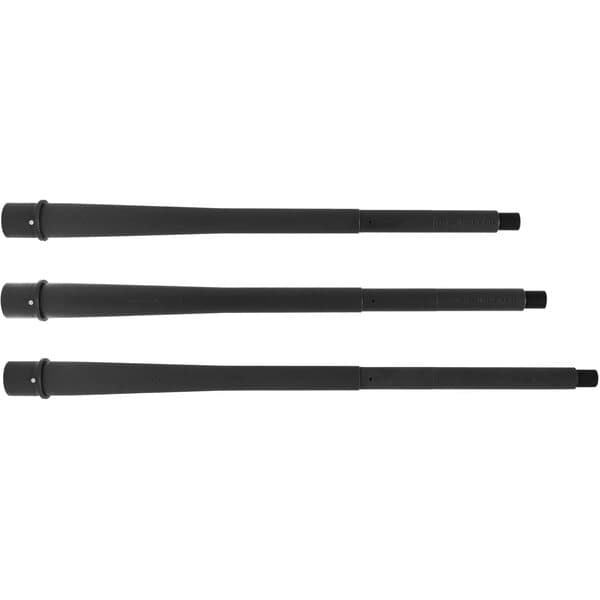
Barrels • $313.49
Criterion CORE Mid-Length Barrel
- 16" barrel
- Mid-length gas system
$313.49
Shop at MidwayUSA
Check whether your barrel twist will stabilize your bullet using the Miller stability formula, the same math behind the Berger and JBM calculators. Pick a preset load or enter bullet dimensions, and get the stability factor, effective BC, and the minimum twist your next barrel needs.
Compute the Miller gyroscopic stability factor (SG) for any bullet and barrel twist. Select a preset load or enter bullet dimensions directly.
Bullet: 55 gr, 0.224" dia, 0.741" long
Velocity: 3240 fps
BC: 0.243 (G1)
Standard military ball ammunition. High velocity, velocity-dependent fragmentation.
Cold, dense air at low altitude is the worst case for stability. Check marginal combinations at the coldest temperature you expect to shoot in.
Stability Factor (SG)
3.06
Miller formula, corrected for velocity and air density
Effective BC
100%
Share of published BC delivered at this SG
Twist for SG 1.5
1:11.4
Slowest twist that fully stabilizes this bullet; keyholes past 1:14.0
Verdict
Fully StableSG under 1.0 unstable, 1.0-1.5 marginal, 1.5+ stable
Full gyroscopic stability. The bullet delivers its published BC and this twist has margin for colder, denser air.
| Twist | SG | Verdict | Effective BC |
|---|---|---|---|
| 1:6.5 | 4.63 | Fully Stable | 100% |
| 1:7 | 3.99 | Fully Stable | 100% |
| 1:7.5 | 3.48 | Fully Stable | 100% |
| 1:8Selected | 3.06 | Fully Stable | 100% |
| 1:9 | 2.42 | Fully Stable | 100% |
| 1:12 | 1.36 | Marginal | 96% |
| 1:14 | 1.00 | Unstable | keyholes |
Plastic-tipped and flat-base bullets run slightly more stable than the Miller formula predicts, so these SG values are a conservative floor for tipped match bullets.
Rifling spins the bullet so gyroscopic rigidity keeps it point-forward against the aerodynamic force trying to tumble it. The longer the bullet, the harder air pushes on its nose relative to its center of gravity, so long bullets need faster spin. That is why bullet length, not weight, is the primary driver of the twist you need: a long low-drag 77gr match bullet demands far more spin than a stubby 55gr ball round of nearly the same caliber length ratio. The calculator runs Don Miller's stability formula, which estimates the gyroscopic stability factor (SG) from bullet weight, diameter, length, twist, and velocity, then corrects for air density.
Read SG in three bands. Below 1.0 the bullet is unstable and will keyhole. From 1.0 to 1.5 it flies point-forward and can group acceptably at short range, but the coning motion costs ballistic coefficient, so drop and wind drift grow at distance. At 1.5 and above the bullet delivers its full published BC with margin for cold, dense air. Buy barrels for SG 1.5, not SG 1.0: a load that squeaks by at sea level in summer can fall below 1.0 at 20 degrees F, and marginal stability is the classic cause of a rifle that shoots fine at 100 yards but falls apart at 600. To see what that BC loss does to your drop table, run the same load through our ballistics calculator.
Twist interacts with barrel length choices too. Short barrels lose muzzle velocity, and slower bullets get slightly less stability from the same twist, which is one reason 1:7 became the standard on military carbines running heavy ball from short barrels. Our barrel length guide covers the velocity side, and the best AR-15 barrels guide ranks specific barrels by steel, twist, and gas system.
If the calculator says your current twist is the bottleneck, the fix is a barrel swap. Modern 1:7 and 1:8 5.56 barrels stabilize everything from 55gr ball through 77gr match, and fast-twist .300 Blackout barrels handle 220gr subsonics.
Affiliate links (?)
1:8 or faster. A Sierra 77gr MatchKing at 2,750 fps computes to a stability factor of 1.74 from a 1:8 twist and 2.28 from the military 1:7, both fully stable. A 1:9 barrel manages only SG 1.38, which is marginal: the bullet flies point-forward but gives up roughly 4 percent of its BC, and it slides toward instability in cold, dense air. The slowest twist that fully stabilizes the 77gr MatchKing at that velocity is about 1:8.6, so 1:8 is the practical floor for heavy 5.56 match loads.
1.5 or higher. Below SG 1.0 a bullet tumbles out of the barrel and keyholes. Between 1.0 and 1.5 it flies point-forward and can group well at short range, but coning flight reduces its effective BC, about 3 percent for every 0.1 that SG sits below 1.5 per Bryan Litz's Applied Ballistics testing. At 1.5 and above the bullet delivers its full published BC. Don Miller, who derived the formula this calculator uses, recommended designing to SG 2.0 so winter air never pushes you below full stability.
1:8 is the better all-around choice for a civilian AR-15, and 1:7 is never wrong. Both fully stabilize everything from 55gr ball to 77gr match: with 77gr MatchKings, 1:8 gives SG 1.74 and 1:7 gives 2.28. The military runs 1:7 because the M856 tracer is far longer than its weight suggests. The twist to avoid is 1:9, which is marginal with 75 to 77gr match bullets, and 1:12, which computes a marginal SG 1.36 even with short 55gr M193, giving up BC in cold, dense air.
1:8 or faster, and 1:7 gives comfortable margin. A Sierra 220gr MatchKing at 1,050 fps computes SG 2.09 from a 1:8 twist, fully stable. From a 1:10 it drops to a marginal 1.34, and a 1:12 .308 barrel computes 0.93, which keyholes. This is why you cannot shoot heavy subsonics through a re-chambered 1:12 barrel, and why keyholing subsonics are a suppressor baffle-strike risk: an unstable 220gr bullet can yaw hard inside the can.
Rarely. Ballistician W.C. Davis, quoted in Miller's original paper, called overstability a myth for practical purposes: SG values up to 3.5 showed no accuracy penalty, and 55gr ball from a 1:7 carbine runs SG around 4.0 without trouble. The two real exceptions are thin-jacketed varmint bullets, which can shed their jackets from centrifugal force at the 300,000-plus RPM a fast twist and high velocity produce, and a slight increase in spin drift at very long range. For match and duty bullets, err fast.
Keyholing means the bullet is hitting the target sideways because the twist is too slow to stabilize it, an SG below 1.0. The usual causes are a long bullet in a slow-twist barrel (77gr match in a 1:12, 220gr subsonic in a 1:10), cold dense air pushing a marginal combination over the edge, or a wrong-diameter bullet. Check the combination in the calculator: if SG computes below about 1.2 at your coldest expected temperature, move to a faster twist or a shorter bullet before blaming the barrel's accuracy.
Yes. Cold, dense air destabilizes; thin, warm air helps. Stability scales with air density, and the classic case is the 1988 Dunham's Bay benchrest match: 70gr 6mm boat tails from a 14 inch twist computed SG 1.08 at standard conditions but 0.94 at the minus 10 F match temperature, and shooters watched their groups turn to keyholes. The same physics works in your favor at altitude: a 77gr MatchKing from a 1:9 twist computes a marginal 1.38 at sea level but 1.84 at a 6,000 foot summer range. Always check stability at the coldest, lowest conditions you plan to shoot.
Within a few percent for conventional jacketed rifle bullets, which is accurate enough to choose a barrel. In Miller's own validation the formula predicted the required twist of the 168gr Sierra International within 3 percent of the measured value, and it tracked ballistician Bill Davis's six-degree-of-freedom computer results within about 7 percent, erring conservative. It runs conservative for plastic-tipped bullets, because the light tip adds length without mass, so a tipped bullet that computes marginal is usually slightly better off than the number suggests. Berger cautions it is least accurate for flat-base bullets, and it does not model dynamic instability in the transonic zone.
Use the Configurator to pick a platform and barrel matched to your bullet, then layer on the optic, muzzle device, and suppressor that fit it.
Launch Configurator