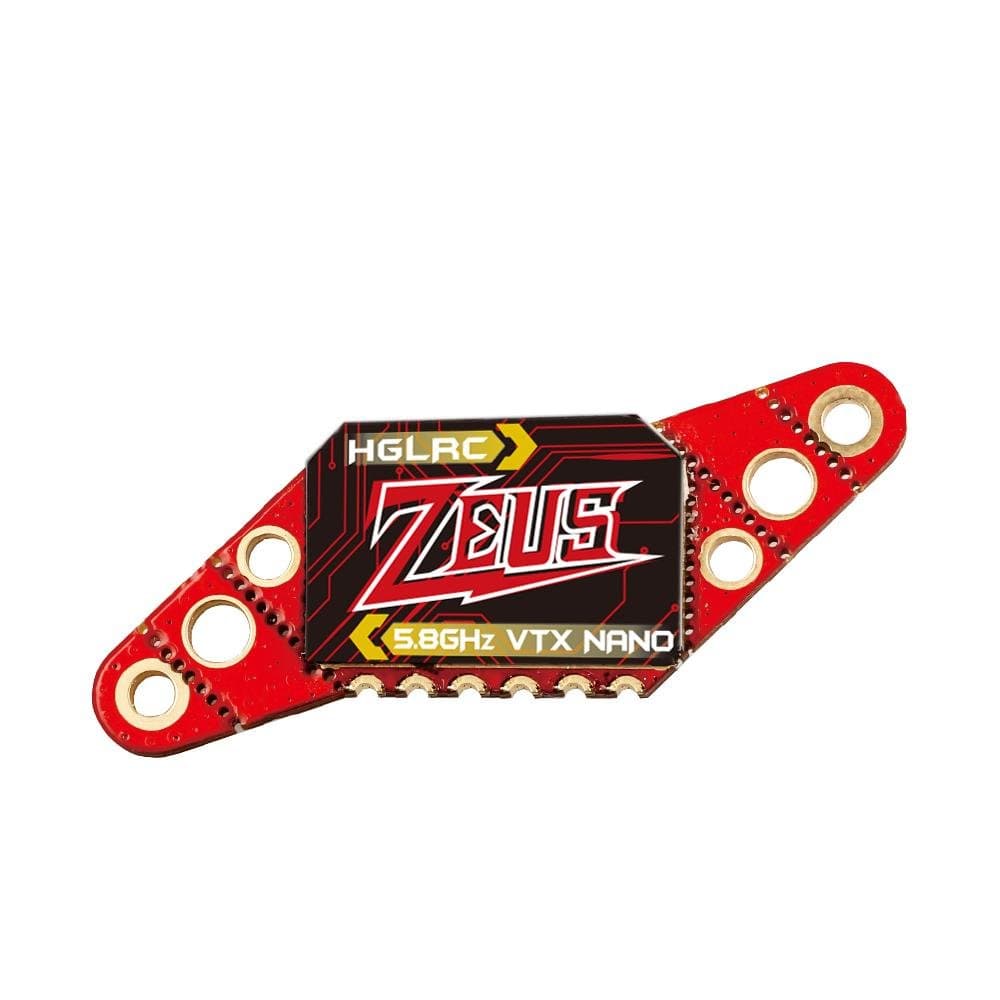
Zeus Nano 350mW VTX
2.4 g analog video transmitter, 40 channels, switchable from pit mode to 350 mW, with three mounting patterns.
- Price
- $27
- Weight
- 0.7 oz
- Brand
- HGLRC
- Category
- Drone & FPV Gear
Featured in
Features
- •5.8 GHz, 40 channels across A/B/E/F/R bands
- •PIT / 25 / 100 / 200 / 350 mW switchable
- •5 V DC input
- •Built-in microphone
- •16x16 mm and 25.5x25.5 mm (M2), 20x20 mm (M3) mounting
- •18.6 x 13.6 x 6 mm, 2.4 g
Overview
The video transmitter is the part of an analog build that gets people in trouble, and the feature that keeps you out of it is pit mode. Powering up a quad on a busy field with the transmitter live wipes out whoever is currently flying on that frequency. Pit mode drops output to roughly nothing so you can boot, check the OSD, and confirm your channel before anyone's feed breaks. The Zeus Nano has it, along with 25, 100, 200, and 350 mW steps, all switchable from the goggles or the radio rather than by shorting a button pad.
Coverage is the standard 40 channels across the A, B, E, F, and R bands, which is enough to find clean air at any field and to match whatever the person next to you is running. Power draw scales with output: 75 mA in pit, 180 mA at 25 mW, and 400 mA at 350 mW, which is why the 5 V rail on your flight controller stack needs to be a real 3 A supply and not a 500 mA afterthought.
The board is 18.6 x 13.6 x 6 mm and weighs 2.4 g, with mounting holes cut for three patterns: 16x16 mm and 25.5x25.5 mm on M2 hardware, 20x20 mm on M3. That covers essentially every stack layout, which is the reason this board ends up in so many builds. A microphone is built in, so if your goggles carry an audio channel you get motor sound in the DVR.
A word on power: 350 mW is plenty for a 5-inch freestyle quad flying within sight, and higher-output transmitters sold for long range carry licensing obligations in the US that a first build does not need.
Key Features
- Pit mode lets you power up without stepping on another pilot's video
- PIT / 25 / 100 / 200 / 350 mW output, switchable in flight
- 40 channels across the A, B, E, F, and R bands
- Three mounting patterns: 16x16 and 25.5x25.5 mm M2, 20x20 mm M3
- 2.4 g board in an 18.6 x 13.6 x 6 mm footprint
- Built-in microphone for goggle DVR audio
- DC 5 V input, 75 mA in pit mode to 400 mA at 350 mW
Pros
- +Pit mode is the etiquette feature every shared field requires
- +Triple mounting pattern fits almost any stack layout
- +2.4 g and 6 mm tall, so it disappears into a crowded frame
- +40-channel coverage finds clean air even on a busy flying day
Cons
- −350 mW is a freestyle number, not a long-range number
- −5 V draw at full power needs a genuine 3 A rail on the flight controller
- −Antenna is a separate purchase and the connector type must match your build
Detailed Specifications
- frequency
- 5.8 GHz
- channels
- 40 (A/B/E/F/R bands)
- outputPower
- PIT / 25 / 100 / 200 / 350 mW
- inputVoltage
- DC 5 V
- currentDraw
- 75 mA (pit) to 400 mA (350 mW)
- microphone
- Built in
- mounting
- 16x16 and 25.5x25.5 mm (M2), 20x20 mm (M3)
- dimensions
- 18.6 x 13.6 x 6 mm
- weight
- 2.4 g
Similar Products
Build Your Custom Configuration
Add the Zeus Nano 350mW VTX to your build and see how it enhances your platform.