Suppressor Cleaning Guide 2026: Rimfire, 9mm, Rifle Cans & Tools
Rimfire and 9mm cans need cleaning every 500 to 2,500 rounds. Sealed centerfire rifle cans almost never do. Pick the wrong solvent on aluminum baffles and you can etch them permanently. This guide covers when to clean, what to use, and the manufacturer-sourced product picks that will not damage your can.
When to Clean (and When to Leave It Alone)
Cleaning interval depends entirely on what cartridge runs through the can. Rimfire suppressors need cleaning every 500 to 1,000 rounds because 22 LR is the dirtiest common cartridge: unburned powder, lead vapor, wax lubricant, and primer compound all accumulate inside the baffle stack. Ignore it long enough and your 4 oz can turns into a 6 oz brick that hangs off the muzzle and threatens to bend the host's threads on the next install. 9mm pistol cans run cleaner than rimfire but still accumulate lead at a rate that demands attention every 1,500 to 2,500 rounds.
Sealed centerfire rifle cans are the opposite problem. The high gas pressures generated by 5.56, 7.62, and 308 burn cleaner and blow most of the carbon out the bore rather than letting it settle in the baffle stack. SilencerCo, SureFire, and Q all publish guidance that their sealed rifle cans are largely self-cleaning. The standard maintenance recommendation: weigh the can when new, log that number, and only consider cleaning when it gains 2 to 3 ounces over factory weight. Most rifle cans never reach that threshold in their service life.
- Rimfire (22 LR)500-1,000 roundsWhyUnburned powder, lead vapor, and wax lubricant accumulate fast. Skip cleaning and the can gains 1-2 oz in a single 1k session.MethodFull disassembly soak in HUXWRX or Breakthrough; scrub baffles individually.
- 9mm pistol cans1,500-2,500 roundsWhyLead deposits build slower than rimfire but faster than rifle. Bullet weight retention shifts over time as lead loads up.MethodDisassemble if serviceable; HUXWRX closed-system soak for sealed pistol cans.
- 5.56 / 7.62 sealed rifleAlmost neverWhyHigh gas pressure self-cleans the baffles. Carbon blows out rather than accumulating.MethodWeigh new, clean only when can gains 2-3 oz over factory weight. Chemical-only, no disassembly.
- Subsonic 300 BLK rifle1,500-3,000 roundsWhySubsonic loads run heavier bullets at lower pressure, leaving more residue than supersonic 5.56 or 308.MethodIf serviceable, disassemble and soak. If sealed, HUXWRX closed-system or send back to manufacturer for service.
- Shotgun cans (rare)Manufacturer-specificWhyShotgun cans are uncommon and design-specific. Plastic wad residue and shot lubricant create unique fouling.MethodFollow manufacturer manual; do not improvise solvents.
| Host Type | Cleaning Interval | Why | Method |
|---|---|---|---|
| Rimfire (22 LR) | 500-1,000 rounds | Unburned powder, lead vapor, and wax lubricant accumulate fast. Skip cleaning and the can gains 1-2 oz in a single 1k session. | Full disassembly soak in HUXWRX or Breakthrough; scrub baffles individually. |
| 9mm pistol cans | 1,500-2,500 rounds | Lead deposits build slower than rimfire but faster than rifle. Bullet weight retention shifts over time as lead loads up. | Disassemble if serviceable; HUXWRX closed-system soak for sealed pistol cans. |
| 5.56 / 7.62 sealed rifle | Almost never | High gas pressure self-cleans the baffles. Carbon blows out rather than accumulating. | Weigh new, clean only when can gains 2-3 oz over factory weight. Chemical-only, no disassembly. |
| Subsonic 300 BLK rifle | 1,500-3,000 rounds | Subsonic loads run heavier bullets at lower pressure, leaving more residue than supersonic 5.56 or 308. | If serviceable, disassemble and soak. If sealed, HUXWRX closed-system or send back to manufacturer for service. |
| Shotgun cans (rare) | Manufacturer-specific | Shotgun cans are uncommon and design-specific. Plastic wad residue and shot lubricant create unique fouling. | Follow manufacturer manual; do not improvise solvents. |
For thread-pitch, mount style, and host pairing details, see the suppressor compatibility guide. Heat management after a heavy session is a separate problem addressed in the suppressor covers guide.
Sealed vs Serviceable: What Comes Apart
A serviceable suppressor disassembles into individual baffles, and a sealed suppressor does not. That single distinction determines every cleaning decision downstream. The Dead Air Mask 22 HD, SilencerCo Sparrow 22, Banish RF 22 Ti, and most rimfire and pistol cans are serviceable: the front cap unscrews with the included tool, the baffles push out in sequence, and each piece gets individual attention. Every can in our best .22 LR suppressors guide is serviceable for this reason. The SureFire SOCOM series, the welded centerfire rifle cans, and most modern flow-through designs are sealed: the baffles are pinned, welded, or permanently fixed inside the tube and the manufacturer warns that any disassembly attempt voids the warranty.
Sealed cans are not a problem because they almost never need cleaning. The few times one accumulates enough fouling to matter, the path forward is a closed-system chemical cleaner that works without disassembly. HUXWRX Suppressor Sauce is the dominant product in that space: pour Part A into a soaking tube with the can submerged, let the carbon-removal chemistry dissolve fouling, drain, then repeat with Part B for heavy metals. No baffles come out, no welds get cut, and the warranty stays intact.
The one universal rule: never run a cleaning rod or patch through the bore of any suppressor, sealed or serviceable. A patch can lodge inside the baffle stack, sit there silently, and become a projectile on the next shot. The Dead Air manual calls this out explicitly. Clean baffles individually if the can comes apart; clean the assembled can chemically if it does not.
Baffle Materials and What Solvents Are Safe
The single most expensive mistake in suppressor cleaning is pouring the wrong solvent on aluminum baffles. Ammonia-based copper solvents (Hoppe's Bench Rest 9, Sweet's 7.62) will etch aluminum on prolonged contact, pitting the baffle surfaces and reducing suppression performance permanently. Strong alkaline cleaners and lye-based bore foam cause the same damage. SilencerCo explicitly warns owners of the older Sparrow 22 aluminum monocore to keep ammonia and ultrasonic cleaners away from it. If you do not know what your baffles are made of, default to ammonia-free pH-balanced cleaners and you cannot go wrong on any material.
- AluminumAluminumExamplesSilencerCo Sparrow 22 monocore (older), budget rimfire bafflesSafe SolventsHUXWRX, Breakthrough BT-SCK, Bore Tech Eliminator, Ballistol, DawnAvoidAmmonia copper solvents (Hoppe's Bench Rest 9, Sweet's 7.62), lye bore foam, ultrasonic on monocores
- Stainless steelStainless steelExamplesDead Air Mask 22 HD baffles (17-4 PH), most modern rimfire and 9mmSafe SolventsEvery common solvent: HUXWRX, Breakthrough, Otis, Hoppe's No. 9, Bore Tech, ultrasonicAvoidNothing material-specific; just dry thoroughly to prevent flash rust
- TitaniumTitaniumExamplesHUXWRX FLOW Ti series, Q The Lefty, Faxon Ion, premium centerfire rifle cansSafe SolventsHUXWRX, Breakthrough, Otis, Ballistol, Bore Tech EliminatorAvoidWire brushes on polished Ti finishes; abrasive media in ultrasonic tanks
- InconelInconelExamplesSureFire SOCOM rifle cans, Dead Air Sandman, sealed centerfire rifle bafflesSafe SolventsAlmost never needs cleaning; HUXWRX closed-system if absolutely requiredAvoidDisassembly attempts (welded sealed) and any solvent without manufacturer approval
| Baffle Material | Examples | Safe Solvents | Avoid |
|---|---|---|---|
| Aluminum | SilencerCo Sparrow 22 monocore (older), budget rimfire baffles | HUXWRX, Breakthrough BT-SCK, Bore Tech Eliminator, Ballistol, Dawn | Ammonia copper solvents (Hoppe's Bench Rest 9, Sweet's 7.62), lye bore foam, ultrasonic on monocores |
| Stainless steel | Dead Air Mask 22 HD baffles (17-4 PH), most modern rimfire and 9mm | Every common solvent: HUXWRX, Breakthrough, Otis, Hoppe's No. 9, Bore Tech, ultrasonic | Nothing material-specific; just dry thoroughly to prevent flash rust |
| Titanium | HUXWRX FLOW Ti series, Q The Lefty, Faxon Ion, premium centerfire rifle cans | HUXWRX, Breakthrough, Otis, Ballistol, Bore Tech Eliminator | Wire brushes on polished Ti finishes; abrasive media in ultrasonic tanks |
| Inconel | SureFire SOCOM rifle cans, Dead Air Sandman, sealed centerfire rifle baffles | Almost never needs cleaning; HUXWRX closed-system if absolutely required | Disassembly attempts (welded sealed) and any solvent without manufacturer approval |
Stainless steel and titanium are the most forgiving materials: they tolerate everything from Dawn dish soap to aggressive ammonia solvents to ultrasonic tanks without damage. The only consideration on titanium is to avoid wire brushes on polished finishes, which will mark the surface even if the chemistry is fine. Inconel baffles, found in sealed rifle cans like the SureFire SOCOM series and Dead Air Sandman, are essentially maintenance-free; the metal is harder than the carbon trying to accumulate on it, and the can's sealed construction prevents user intervention anyway.
Best Suppressor Cleaning Kits & Tools Ranked
Ranked by baffle material safety, cleaning effectiveness, and use case. Sealed centerfire rifle cans rarely need cleaning; serviceable rimfire and 9mm cans drive most of the demand.
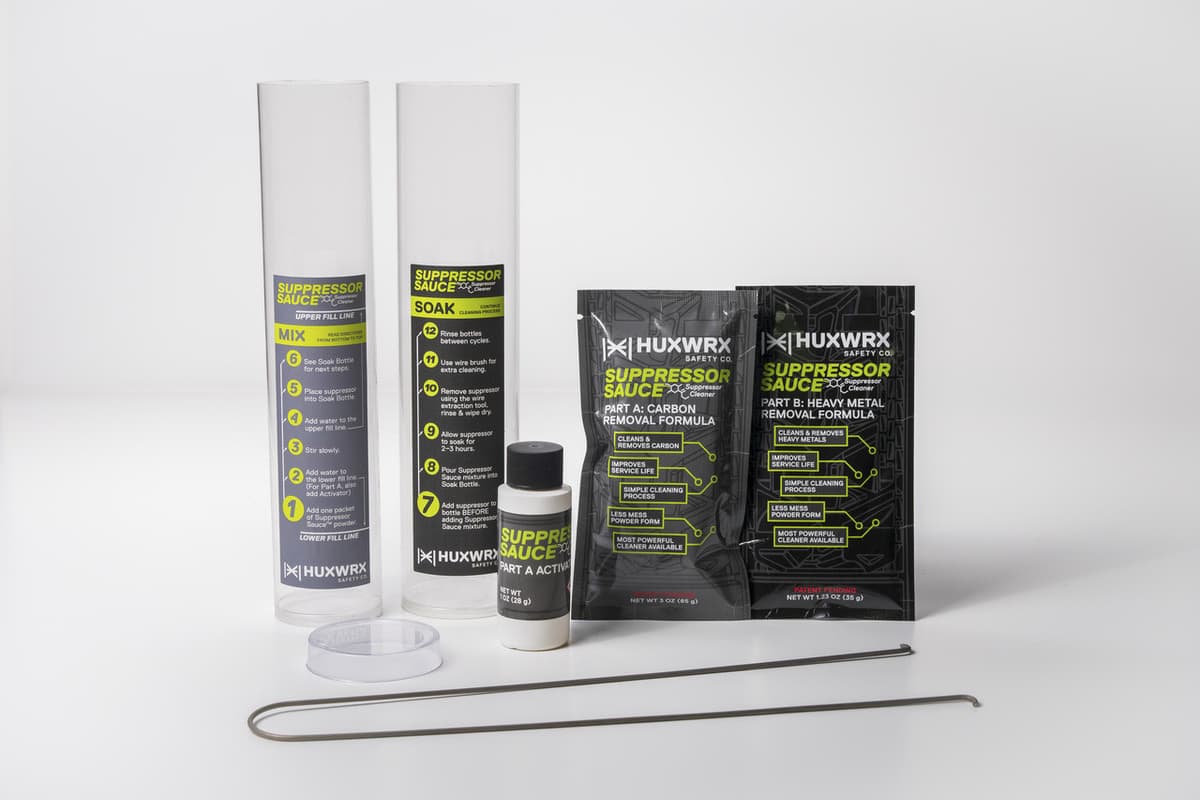
HUXWRX Suppressor Sauce Cleaning Kit
Best for sealed cans and mixed-material baffles
- +Two-part chemistry handles carbon and heavy-metal fouling in one cycle
- +Manufacturer-rated safe on titanium, Inconel, stainless, and aluminum
- +Closed-system soak works on sealed welded centerfire cans
- −Single-use packaging stacks up cost for high-volume rimfire shooters
- −Refill kits sometimes out of stock at major retailers
- −Proprietary formula, no public ingredient disclosure
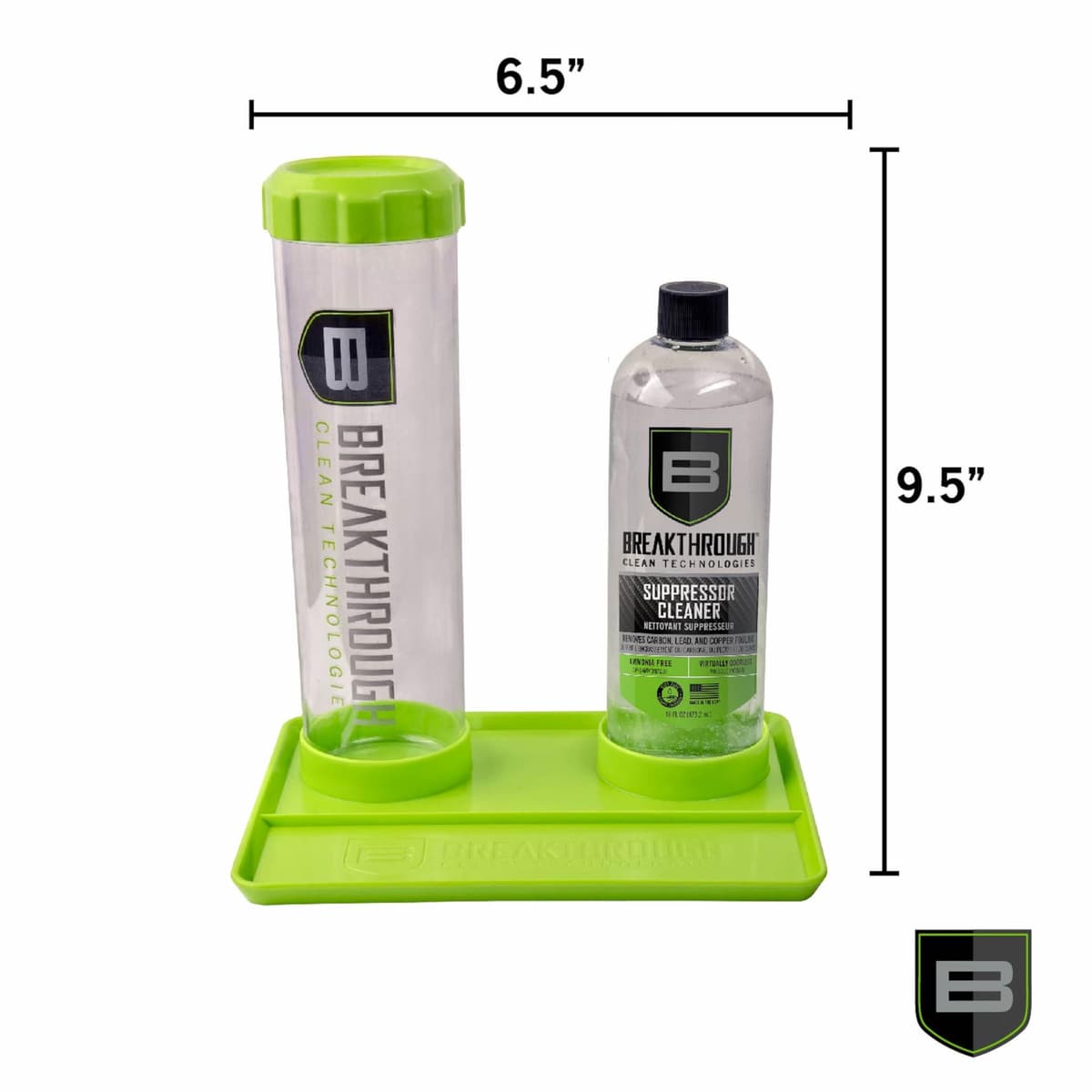
Breakthrough Clean Suppressor Cleaning Kit (BT-SCK)
Best complete kit for serviceable cans
- +16 oz solvent, soaking tube, hook, two brushes, cleaning tray
- +Ammonia-free water-based formula safe on aluminum baffles
- +Low odor enables indoor cleaning
- −Tube sized for pistol and rimfire diameters, large rifle cans need a separate container
- −Not designed for sealed welded cans (no disassembly path)
- −Heavy lead deposits still need multiple soak cycles
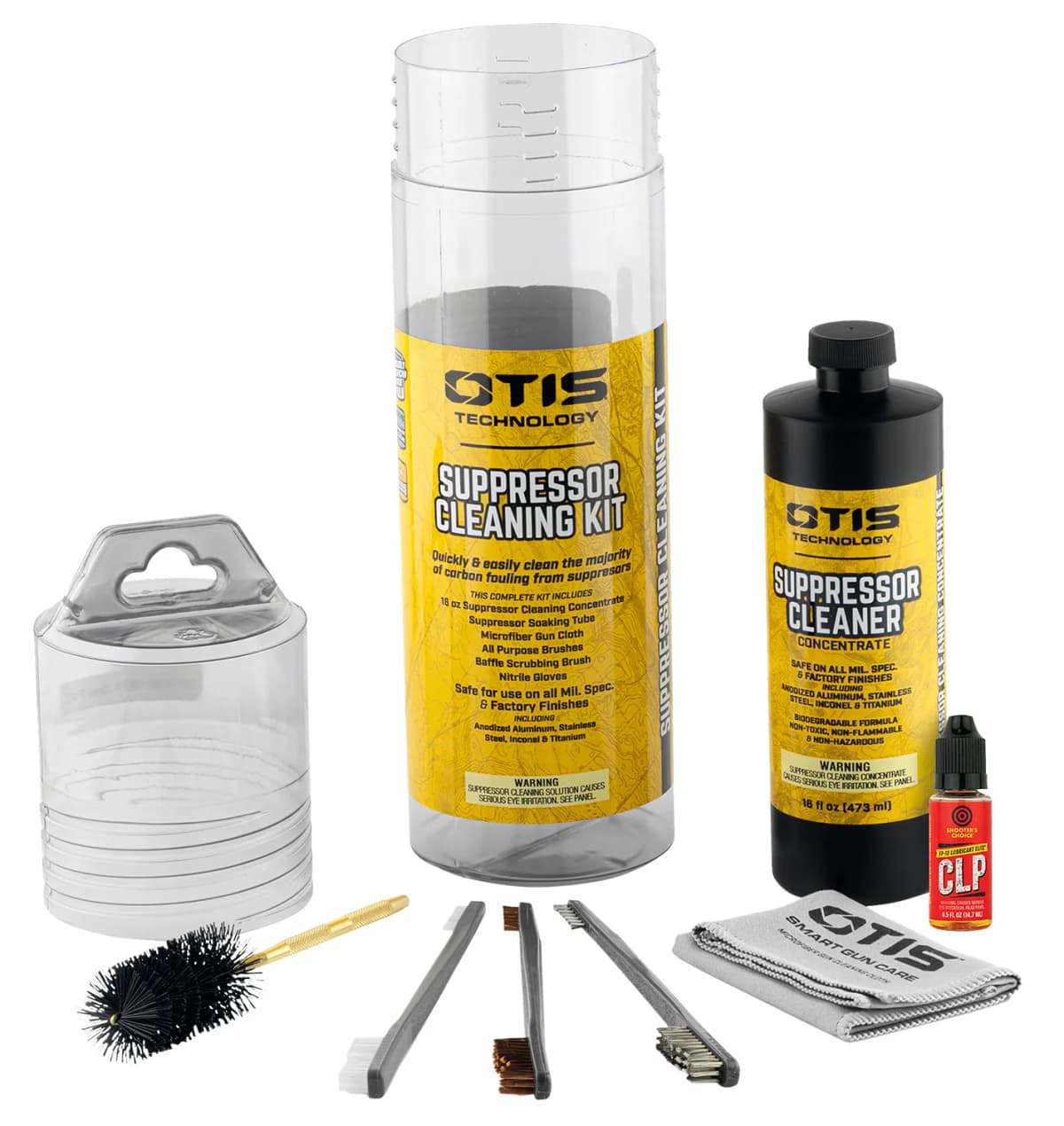
Otis Technology Suppressor Cleaning Kit (FG-SUP-CLN)
Best value starter kit
- +Best price among complete suppressor cleaning kits
- +Three AP brushes (bronze, nylon, stainless) cover every baffle material
- +Cleaner sold as concentrate stretches multiple cleanings
- −Smaller soaking container than premium kits
- −Cleaner formulation less aggressive than HUXWRX or Breakthrough on heavy lead
- −Stainless brush should be used carefully on titanium
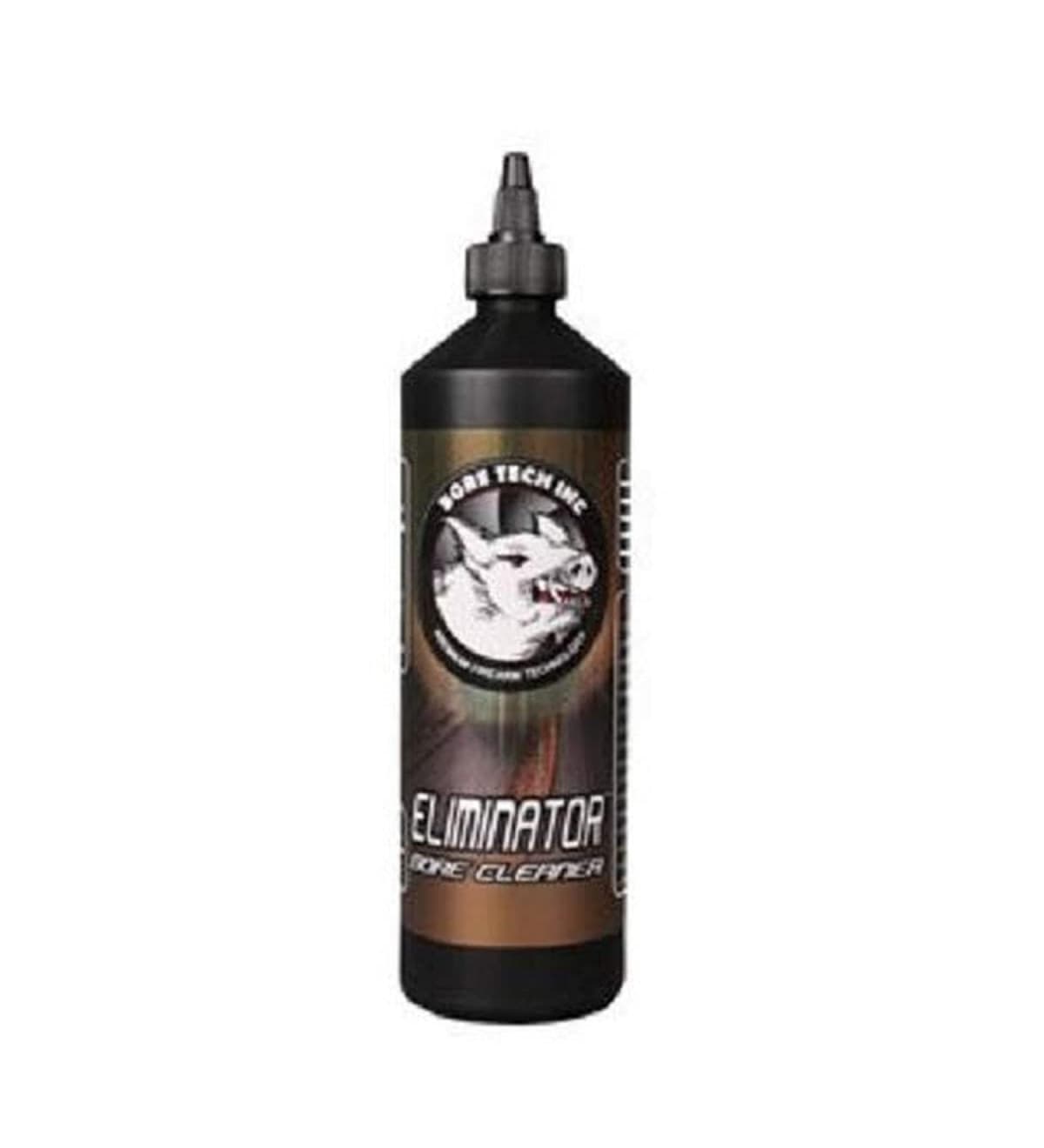
Bore Tech Eliminator Bore Cleaner
Best dual-purpose solvent for the host barrel
- +Dual-action removes carbon and copper in one product
- +Ammonia-free, pH balanced, non-hazardous classification
- +Safe for overnight soaking without bore etching
- −Slower than ammonia-based solvents on heavy copper deposits
- −Higher cost per ounce than basic petroleum solvents
- −Color changes can be subtle in poor lighting
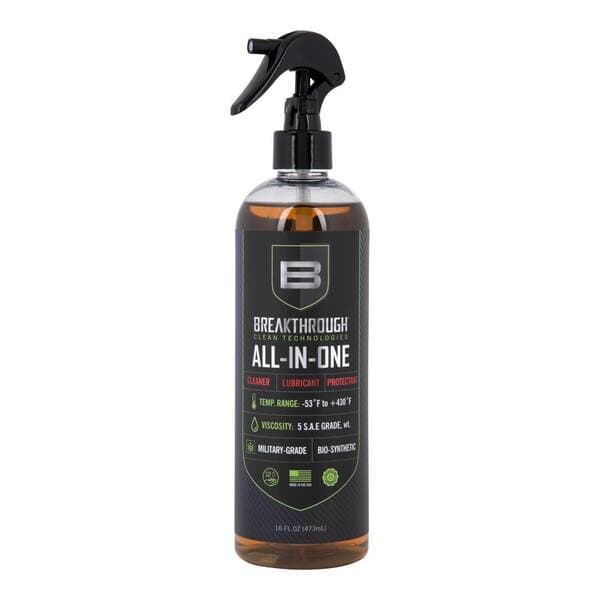
Breakthrough Clean Military-Grade Solvent
Best apartment-safe solvent for host firearm cleaning
- +Odorless, non-toxic formula safe for indoor use
- +pH neutral, safe on all firearm finishes including Cerakote
- +150 F flashpoint, classified non-flammable
- −Higher cost per ounce than traditional petroleum solvents
- −Not as aggressive as ammonia-based copper removers
- −Less widely available than Hoppe's at local shops
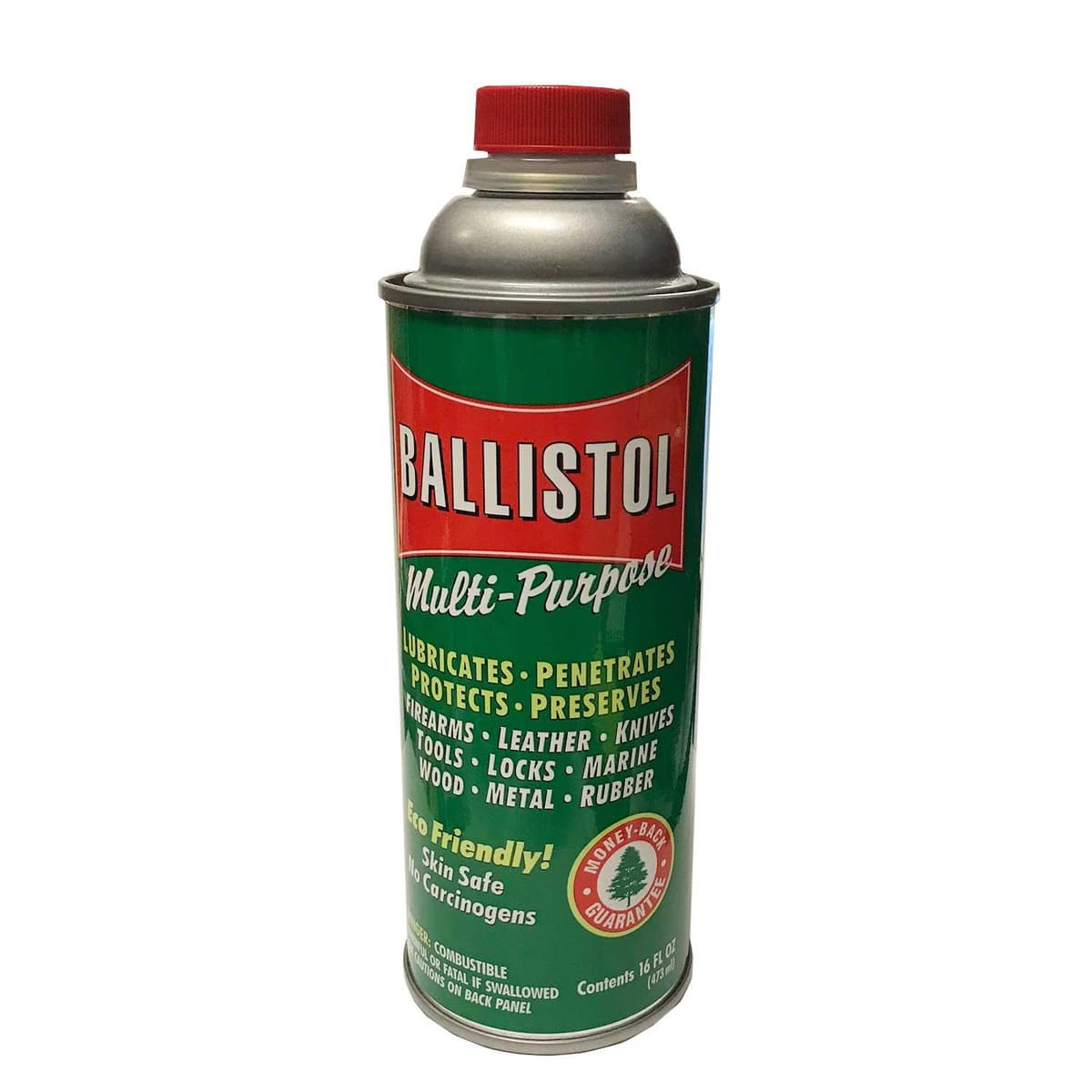
Ballistol Multi-Purpose Lubricant
Best post-clean preservative and thread lubricant
- +Slightly alkaline (pH 8.5) neutralizes acidic carbon residues
- +USDA H1 listed for incidental food contact
- +Safe on stainless, titanium, aluminum, and polymer end caps
- −Distinctive anise odor that some find overpowering
- −Lighter viscosity needs more frequent reapplication
- −Not a heavy-duty bore solvent on its own
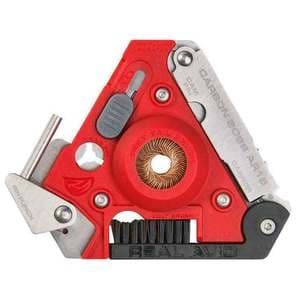
Real Avid Carbon Boss AR-15
Best scraper for host BCG and direct-thread mount surfaces
- +10 hardened-steel scraping profiles match AR-15 BCG geometry
- +Removes baked-on carbon that solvents and brushes cannot
- +Cuts BCG carbon scraping from 20 minutes to about 5
- −AR-15 specific, does not fit AK or AR-10 platforms
- −Steel scrapers can mark polished or DLC-coated surfaces if used aggressively
- −Does not replace solvents or brushes
Affiliate links - purchases support this site at no extra cost to you. (?)
Signs Your Can Needs Cleaning
The earliest indicator of fouling is weight gain. A clean Dead Air Mask 22 HD weighs 6.6 ounces; after 800 rounds of dirty bulk-pack 22 LR it can hit 8 to 9 ounces. Track the factory weight when the can is new and reweigh every 500 to 1,000 rounds on a kitchen scale. A 1 oz gain on a rimfire can means it is time to disassemble and clean. On a sealed rifle can, 2 to 3 ounces over factory weight is the trigger.
The second indicator is degraded suppression. Lead and carbon accumulating between baffles changes the internal volume that gas expands into, which raises the decibel reading and shifts the tone of the report. Shooters with meters notice this first; shooters without notice it as the host suddenly "getting louder." First-round pop also changes character as carbon builds, because the baffles trap more oxygen during initial ignition.
The third indicator is harder to ignore: baffles that visibly clog with carbon and lead. On a serviceable can, pull it apart every 1,000 rounds or so and look. If the baffles look like the factory finish with some discoloration, you are fine. If they are coated in soft gray lead deposits or dark baked-on carbon rings, clean now. Lead in particular will continue to deposit on top of itself, and the longer you wait, the harder it is to get off.
On a host with a thread mount, the canary in the coal mine is installation torque. A clean direct-thread can spins onto the muzzle threads smoothly to a hand-tight stop. If you are suddenly fighting it on or off, carbon has built up in the thread interface. Stop, address the thread with the maintenance steps below, and clean the baffles while you have the can off the host.
The Cleaning Process, Step by Step
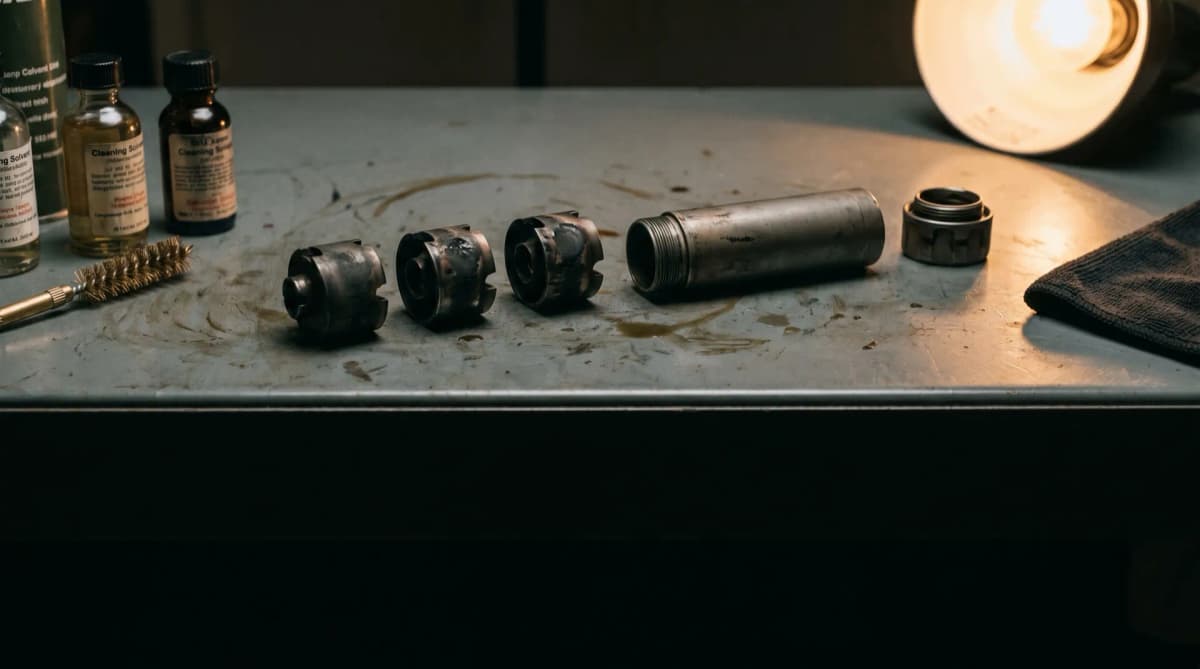
For a serviceable rimfire or 9mm can, the process is: disassemble, soak, scrub, rinse, dry, reassemble. Start by removing the can from the host and unscrewing the front cap with the manufacturer-supplied tool. On the Dead Air Mask 22 HD, the baffles push out in sequence through the front; on the SilencerCo Sparrow, the rear unscrews and the entire baffle stack pushes out the front as two aluminum shells separate. Note the orientation of every baffle as it comes out, because reversing them will degrade suppression.
Pour the cleaning solvent into the soaking tube included with the Breakthrough or Otis kit, or use the dedicated container from a HUXWRX Suppressor Sauce kit. Submerge the baffles and end caps, set a 15 to 30 minute timer for routine cleaning, or 45 to 60 minutes for heavy fouling. Walk away; the chemistry does the work that brushes alone would take an hour to do. For aluminum baffles, double-check that the solvent is ammonia-free; for stainless or titanium, anything in the kits ranked above is fine.
Scrub each baffle individually with the appropriate brush: bronze on stainless and titanium for carbon, nylon on aluminum and polymer end caps, stainless wire brush only on stainless baffles with heavy lead deposits. Rinse with hot water to remove residual solvent and dissolved fouling. Dry thoroughly using compressed air or a low-heat setting on a hair dryer; residual moisture inside the baffle stack will cause flash rust on stainless within hours. Reassemble in the original orientation, apply a thin film of Ballistol or anti-seize to the threads, and reinstall on the host.
For a sealed centerfire rifle can on the rare occasion it needs attention, skip the disassembly steps. Drop the entire can into a large container with HUXWRX Suppressor Sauce activated per the included instructions, let it soak for the full cycle, drain, rinse with hot water, and dry thoroughly with compressed air. The closed-system chemistry pulls fouling out without needing to access the baffles directly. Do not run patches through the bore. Do not cut the welds. The manufacturer would rather you sent the can back for service than damaged it trying to clean it.
Ultrasonic, The Dip, and What to Avoid
Ultrasonic cleaners and "The Dip" (sodium hydroxide solution, also called lye dip) are the two aggressive cleaning methods that come up in every suppressor forum thread. Both work, both have specific material restrictions, and both can destroy aluminum baffles in minutes if applied wrong. Ultrasonic tanks use cavitation to physically lift fouling off metal surfaces, which is great on stainless and titanium and actively damaging to aluminum monocores like the older SilencerCo Sparrow 22. The Dip is a stronger version of the same problem: lye will strip lead and carbon off stainless fast, and will dissolve aluminum even faster.
The decision tree is simple. Stainless or titanium baffles from a serviceable can: ultrasonic with Simple Green, Dawn dish soap, or a dedicated ultrasonic solution is fine for 20 to 30 minutes. The Dip is also fine on stainless; never on aluminum or titanium. Aluminum baffles or anything you cannot confirm the material of: stick with chemical soaks using HUXWRX, Breakthrough BT-SCK, or Otis FG-SUP-CLN. Sealed cans: chemical only, manufacturer-approved products only, no ultrasonic, no Dip, no exceptions.
The other category to avoid: anything that requires you to cut into a sealed can, drill the welds, or otherwise circumvent the manufacturer's construction. The internet is full of clever ideas for opening sealed cans that all end with a destroyed suppressor, a voided warranty, and an angry owner. If a sealed can has accumulated enough fouling to affect performance and closed-system chemistry will not handle it, send it back to the manufacturer for service. SilencerCo, SureFire, Dead Air, and Q all offer factory cleaning and maintenance for their products.
On the host firearm side, the carbon and copper buildup on the barrel and BCG is a separate cleaning problem with its own tools. For AR-15 hosts, the AR-15 cleaning kit guide breaks down which bore solvents, rods, and scrapers belong on the bench. For the chemistry side of choosing oils and CLPs for both host and suppressor thread maintenance, see the gun oils and CLPs guide.
Get Suppressor Cleaning Tips and Maintenance Guides
Baffle cleaning guides, solvent picks, and thread care updates for centerfire and rimfire cans. Sent when we publish.
Mount and Thread Maintenance
Mount and thread maintenance prevents the single most expensive failure mode in suppressor ownership: a can seized onto a muzzle device. Every time you clean the baffles, clean the threads too. On a direct-thread mount, that means running a brass or stainless brush along the male threads on the can and the female threads on the muzzle device (or vice versa, depending on the mount style). Carbon, lead, and copper from the bullet jacket accumulate here every shot, and left untreated will eventually weld the can to the host.
After brushing, wipe the threads down with Ballistol or another thread-safe lubricant to displace any moisture and remove cleaning residue. Apply a thin film of high-temperature anti-seize (copper or nickel-based, automotive parts stores carry both) before reinstalling. The anti-seize prevents the next cleaning cycle from being a fight; without it, every install-and-shoot cycle bakes the two metal surfaces closer to becoming one piece. SureFire, SilencerCo, and several other manufacturers recommend copper-based anti-seize in their cleaning literature.
On QD mounts (KeyMo, Plan B, Surefire SOCOM, ASR), the same principle applies, but the cleaning surface is the QD interface rather than threads. Wire brush the interlocking features on the mount, wipe down with Ballistol, apply anti-seize to the bearing surfaces, and reinstall. QD mounts are more forgiving than direct-thread because they do not torque against each other under fire, but they still benefit from regular maintenance to prevent rotational play.
For shooters running the can across multiple hosts, this maintenance becomes even more important. Each thread interface has slightly different tolerances, and a can that has been installed dozens of times across different muzzle devices picks up wear faster than one that lives on a single host. Brush, lube, anti-seize, every cleaning cycle. Five minutes of work prevents an afternoon of trying to break a stuck can free with a strap wrench. Any time you move the can to a different muzzle device or host, treat it as a new assembly and re-run a concentricity check; the suppressor alignment rod guide covers the gage that catches a mount sitting off-axis before it strikes a baffle.
For 5.56-specific picks, the best 5.56 suppressors guide ranks 12 cans by PEW score. Browse the full catalog for individual products.
Frequently Asked Questions
▶What is the best cleaner for suppressors?
▶How often do suppressors need to be cleaned?
▶Can a suppressor be cleaned?
▶Can you use Dawn dish soap to clean suppressors?
▶Will ultrasonic cleaning damage aluminum suppressor baffles?
▶How do you clean a sealed rifle suppressor?
▶What solvent damages aluminum suppressor baffles?
▶Which .22 suppressor should I buy if I am cleaning rimfire cans this often?
▶Do I need to clean the threads on my suppressor mount?
Bottom Line
For a serviceable rimfire or 9mm can, buy the Breakthrough Clean BT-SCK kit ($69.99) for the first cleaning.
It is the complete package: 16 oz of ammonia-free water-based solvent, a soaking tube, brushes, and a cleaning tray. The 16 oz bottle covers many cleaning cycles before needing a refill, which as a rough rule of thumb lasts the average rimfire owner a couple of years.
For sealed centerfire rifle cans or mixed-material baffle stacks, buy HUXWRX Suppressor Sauce ($59). It is manufacturer-rated safe on aluminum, titanium, Inconel, and stainless, and the closed-system soak approach works on welded cans without voiding the warranty. The single-use packaging costs more per cleaning than bulk solvent, but the chemistry justifies it on sealed cans where Breakthrough or Otis cannot reach.
For tightest budgets, the Otis FG-SUP-CLN kit ($29) is the right entry point. The three-brush AP set covers every baffle material, the concentrate cleaner stretches across multiple cleanings, and the price gets you out of improvising with dish soap and dental picks. Upgrade to the Breakthrough or HUXWRX kits when fouling starts winning.
Whatever kit you pick, the rules do not change: ammonia-free cleaners on aluminum, no patches through the bore, weigh the can to track fouling, clean the threads every cycle. The expensive failure modes (etched aluminum baffles, seized direct-thread mounts, lodged-patch obstructions) are all preventable with the right product on the bench.