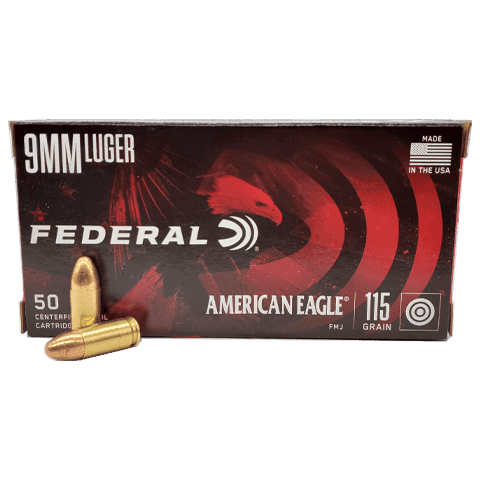
Ammunition • $13.99
Federal American Eagle 9mm 115gr FMJ
- 115 grain FMJ
- 9mm Luger
$13.99
Shop at KYGUNCO
Average your chronograph readings, get your power factor, and check it against the current USPSA, IDPA, and Multigun floors. The margin readout shows exactly how many fps of headroom your load has over the floor, or how many it needs.
Power factor floor 125. Minor scoring only.
Enter bullet weight and at least one chrono reading to calculate power factor.
Steel Challenge has no minimum power factor in any division; its PCC divisions cap velocity at 1,600 fps. Floors above: USPSA Competition Rules 2026-03, Appendix D.
Power factor is bullet weight in grains times muzzle velocity in fps, divided by 1,000, with everything right of the decimal dropped. A 147gr 9mm at 900 fps scores 132; a 124gr load needs 1,009 fps to match it. In USPSA the number does two jobs: it gates whether your scores count at all (125 minor floor in every division), and it sets your scoring tier where major exists. Major turns C hits from 3 points into 4 and D hits from 1 into 2, while A hits score 5 either way, which is why Limited and Open shooters accept the extra recoil of a 165+ load. Production, Carry Optics, Limited Optics, and PCC are scored minor no matter what you feed them, so the only goal there is clearing 125 with the softest load you can shoot fast. To see what those zone values do to a real run, score one with the USPSA stage scorer. Picking a gun first? Our competition pistol guide breaks down the top picks by USPSA division.
IDPA uses a single pass/fail floor per division instead of scoring tiers, and the floors differ more than most shooters expect: 125 for SSP, ESP, and Carry Optics, but 165 for CDP, 135 for PCC, and just 105 for Compact Carry Pistol, Stock Revolver, and Back-Up Gun. Steel Challenge drops the requirement entirely; there is no minimum power factor or velocity in any SCSA division, only a 1,600 fps cap in the PCC divisions. If you handload to hit a floor precisely, price the load with our reloading cost calculator and stock up using the 9mm range ammo guide if factory minor is the cheaper path.
Every floor below comes from the current rulebooks: USPSA Competition Rules 2026-03 (Appendix D), IDPA Rulebook 2026.2 (rule 8.3.4), and USPSA Multigun Rules 2026-03 (Appendix D).
| Division | Minor / Floor | Major | Notes |
|---|---|---|---|
| USPSA: Open | 125 | 165 | Major also requires a 112gr minimum bullet weight. |
| Limited | 125 | 165 | Major requires .40 cal / 10mm / .357 SIG minimum. |
| Limited Optics | 125 | N/A | Minor scoring only. |
| Limited 10 | 125 | 165 | Major requires .40 cal / 10mm / .357 SIG minimum. |
| Production | 125 | N/A | Minor scoring only. |
| Carry Optics | 125 | N/A | Minor scoring only. |
| Single Stack | 125 | 165 | Major requires .40 cal / 10mm / .357 SIG minimum. |
| Revolver | 125 | 165 | |
| PCC | 125 | N/A | Minor scoring only. |
| IDPA: SSP (Stock Service Pistol) | 125 | N/A | |
| ESP (Enhanced Service Pistol) | 125 | N/A | |
| CO (Carry Optics) | 125 | N/A | |
| CDP (Custom Defensive Pistol) | 165 | N/A | |
| CCP (Compact Carry Pistol) | 105 | N/A | |
| Stock Revolver | 105 | N/A | |
| Enhanced Revolver | 155 | N/A | |
| BUG (Back-Up Gun) | 105 | N/A | |
| PCC (Pistol Caliber Carbine) | 135 | N/A | |
| USPSA Multigun: Handgun (all divisions) | 125 | 165 | |
| Rifle (all divisions) | 150 | 320 | |
| Steel Challenge (all divisions) | None | N/A | No PF or velocity minimum; PCC divisions capped at 1,600 fps. |
USPSA majors collect eight rounds of your match ammo, pull and weigh one bullet, then fire three rounds over the official chronograph and compute power factor from the average of those three velocities (Appendix C2). If that average misses your declared floor, additional rounds are fired one at a time, up to six total, using the average of the top three. Fail major and your entire match is rescored minor; fail minor and you finish the match for no score. IDPA runs a three-round check from your own gun and passes you if two of the three rounds make the division floor, and you may point the muzzle vertical before each shot to settle the powder against the case head.
This is why the margin readout matters more than the raw number. Velocity falls in cold, dense air, chronographs disagree unit to unit by 1-3%, and powder lots drift. A load that averages 127 PF on your backyard chrono in July is a genuine gamble at a winter major. Load 5+ PF points of margin, then verify your splits are actually faster with the softer load using the shot timer video annotator and compare felt recoil between loads with the recoil calculator. Not sure which division's floor applies to your gun in the first place? The USPSA division checker places it and cites the rule. Once the load passes, plan how many rounds and reloads each stage takes with the stage reload planner.
Most factory 115gr and 124gr 9mm clears the 125 minor floor with comfortable margin, but chrono your specific lot from your specific barrel before a major; short pistol barrels give up real velocity against published specs. Browse the full ammunition catalog for more options.
Affiliate links (?)
Power factor is bullet weight in grains multiplied by muzzle velocity in feet per second, divided by 1,000. A 147 grain 9mm bullet at 900 fps makes a 132 power factor. USPSA and IDPA use it to set an ammunition floor, and USPSA also uses it to split scoring into minor and major.
125 power factor is the minor floor in every USPSA division under the 2026 rules (Appendix D). Ammunition below 125 fails the chronograph stage; you may keep shooting the match, but not for score or match recognition.
165 power factor makes major in Open, Limited, Limited 10, Single Stack, and Revolver. Production, Carry Optics, Limited Optics, and PCC are scored minor only, so major does not exist there. Open major also requires a bullet of at least 112 grains, and Limited-style divisions require .40 caliber or larger for major.
Under the 2026 IDPA rulebook (rule 8.3.4): SSP, ESP, and Carry Optics require 125 power factor; CDP requires 165; Compact Carry Pistol, Stock Revolver, and Back-Up Gun require 105; Enhanced Revolver requires 155; and PCC requires 135. IDPA has no major scoring, each division is a single pass/fail floor.
No. The Steel Challenge (SCSA) rules state there are no minimum power factor or velocity requirements in any division. The only ammunition velocity rule is a 1,600 fps maximum for the Pistol Caliber Carbine divisions.
USPSA (Appendix C2) collects eight rounds, pulls and weighs one bullet, then fires three over the chronograph and calculates power factor from the average of the three velocities; on a failure, extra rounds are fired one at a time (up to six total) using the average of the top three. Failing major rescores your whole match as minor; failing minor means you shoot for no score. IDPA fires three rounds from your own gun and requires two of the three to meet the floor.
Load at least 5 power factor points over the floor, which is roughly 30 to 40 fps of velocity headroom on a typical 9mm load. Chronographs disagree unit to unit, velocity drops in cold weather, and lot-to-lot powder variance is real. A 128 power factor load that passes your home chrono can fail the match chrono; a 132 to 135 load will not.
Use the Configurator to spec a division-legal setup, from the platform down to the trigger, optic, and magazine capacity your ruleset allows.
Launch Configurator