Crimson Trace LS-250G Lasersaddle (Mossberg 500/590/Shockwave)
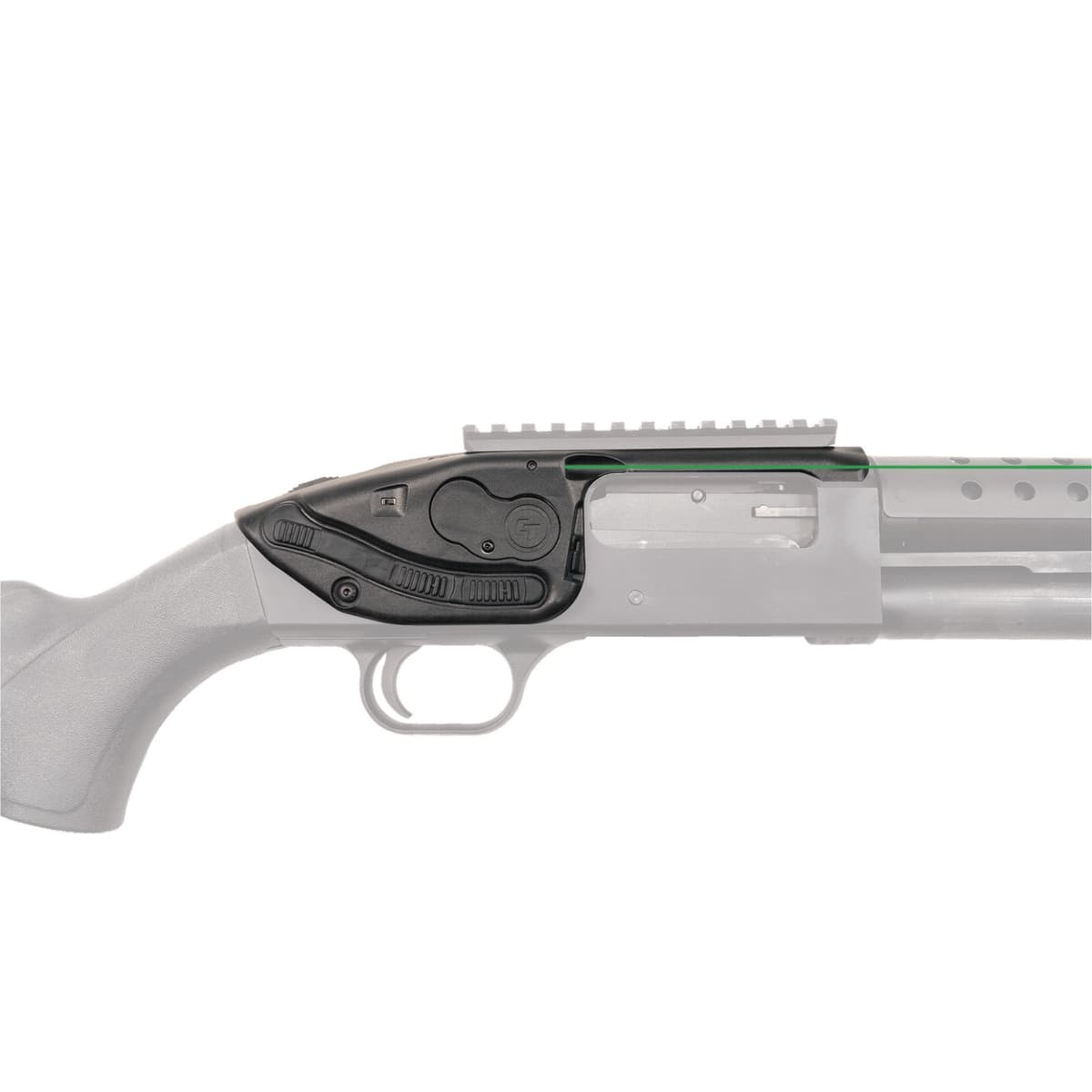
Green laser sight that mounts to Mossberg 500/590/Shockwave receiver holes, providing instinctive aiming for hip-fire and heads-up shooting without an optic.
- Price
- $230
- Brand
- Crimson Trace
- Category
- Lasers
Featured in
Features
- •Green laser (5mW peak, 532nm, Class 3R)
- •Mounts to factory drilled & tapped receiver holes
- •Multiple ambidextrous activation pads
- •Four CR2016 batteries (3 hours runtime)
Capability Boosts
Recommended For
+14 more
Where to Buy
Compare current prices and availability from retailers we work with.
Crimson Trace LS-250G Lasersaddle Green Laser Sight for Mossberg 500 & 590 Series Shotguns & Shockwave, 01-7820
Laser Saddle For Mossberg 500 And 590(R) - Red Mossberg 500/590 Lasersaddle
Price History
90-day low $174.95More shotgun guides & articles
Guides


Overview
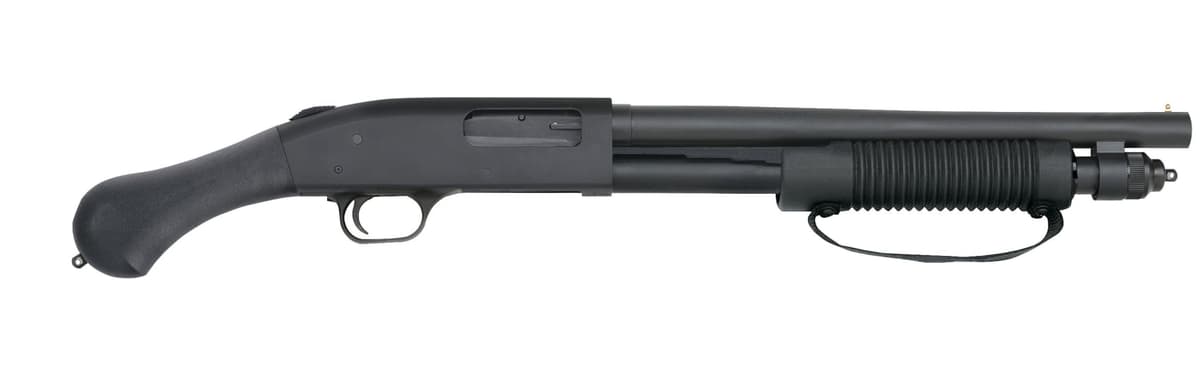
The Crimson Trace LS-250G Lasersaddle is a purpose-built green laser sight for drilled-and-tapped Mossberg 500, 590, and 590 Shockwave 12- and 20-gauge receivers. It bolts to the receiver and gives the shooter multiple ambidextrous activation pad points without blocking most side-saddle or top-rail setups. On a Shockwave with no stock and no cheek weld, a laser is the fastest path to aimed fire from nontraditional shooting positions.
The LS-250G uses a 5mW peak, 532nm Class 3R green laser with an approximate 0.5-inch dot at 50 feet. The ambidextrous activation pads sit along the receiver where the firing hand naturally indexes, and a master on/off switch lets the user power the system down for storage. Crimson Trace lists 3 hours of battery life from four included CR2016 batteries.
The Lasersaddle uses the receiver interface, so verify compatibility with any receiver-mounted optic rail or side-saddle hardware before ordering. Crimson Trace specifically excludes .410-bore models, Mossberg 590M receivers, and the 500 ATP with the provided screws. For full-size 500/590 owners with a stock, a receiver rail plus a red dot provides more precision at the cost of more bulk and money.
Key Features
- 5mW peak, 532nm Class 3R green laser
- Mounts to drilled-and-tapped Mossberg 500/590/Shockwave receivers
- Multiple ambidextrous activation pad points
- 3 hours runtime on four CR2016 batteries
- Master on/off switch for storage
Pros
- +Purpose-built for Mossberg 500/590/Shockwave receiver geometry
- +Enables aimed fire from hip without stock or cheek weld
- +Green laser visible in daylight at defensive distances
- +Simple bolt-on installation to factory receiver holes
Cons
- −Occupies same receiver holes as Aridus CROM optic mount
- −Green version is more expensive than red LS-250
- −Four CR2016 cells are less convenient than one common CR123A or AA
- −Laser dot washes out past 40 feet in bright sunlight
- −Does not fit .410, 590M, or 500 ATP with the provided screws
Setup & Operation
Step-by-step procedures for setting up, operating, and maintaining the Crimson Trace LS-250G Lasersaddle (Mossberg 500/590/Shockwave).
Install the Lasersaddle on the Receiver
The Lasersaddle replaces hardware rather than clamping to anything. It uses the trigger housing pin hole in the lower rear of the receiver plus the four drilled and tapped holes on top, so the unit becomes part of the receiver instead of riding a rail that a Shockwave does not have.
Everything needed ships in the box: a replacement trigger housing pin, two #6-32 button head cap screws, four #8-40 low head cap screws, and the hex L-keys to drive them. The sequence matters, because the pin and the top screws have to align before anything gets torqued.
- • Both Crimson Trace hex L-keys (supplied)
- • Punch or the supplied L-key to press out the trigger housing pin
- 01
Clear the shotgun
Make sure the firearm is unloaded. Open the receiver and double check that the chamber is empty before any tool touches the gun.
- 02
Press out the trigger housing pin
Using the hex L-key wrench provided, press out the trigger housing pin located on the lower rear area of the receiver.
- 03
Remove the four top screws
Remove the four screws on top of the receiver. These are the factory plug screws in the drilled and tapped holes the Lasersaddle uses.
- 04
Fit the Lasersaddle and check alignment
Set the Lasersaddle on top of the receiver and confirm that all of its holes align with both the trigger housing pin hole and the holes on top of the receiver. If the holes do not line up, stop; forcing a screw here is how a receiver gets a cross-threaded hole.
- 05
Install the pin and the two #6-32 screws
Push the supplied trigger housing pin into place and tighten it with the provided #6-32 button head screws, running both screws at the same time with the two hex L-keys.
- 06
Install the four #8-40 top screws
Being careful not to cross thread, install the provided #8-40 low head cap screws into the top of the receiver and tighten the Lasersaddle into place with the provided hex L-key.
The two screw sizes are not interchangeable. The #6-32 button head screws carry the trigger housing pin at the rear, and the #8-40 low head cap screws go into the top of the receiver.
Load the Four CR2016 Batteries and Power Up
The green LS-250G runs on four CR2016 lithium cells rather than the two CR2032s the red LS-250 uses, and they stack two per compartment. That is the single detail most likely to be gotten wrong on a first install, because the red-model diagram in the same instruction sheet looks nothing like the green one.
Crimson Trace rates three hours of illumination from a set. The unit also carries a master on/off switch, which is what you use to shut the laser down for storage rather than relying on nobody touching an activation pad.
- • Four CR2016 lithium batteries (supplied in the accessories pack)
- • Crimson Trace supplied battery cover screw and hex key
- 01
Open the battery cover
Remove the battery cover and take the batteries out of the accessories pack.
- 02
Stack two cells per compartment
Insert the four CR2016 cells as shown in the instruction sheet's green-laser diagram, two stacked per compartment. The red-laser layout in the same sheet uses two CR2032 cells and does not apply to the LS-250G.
- 03
Seat the cover at an angle
Insert the battery cover at an angle rather than pressing it straight down, then screw it into place using the Crimson Trace supplied screw.
- 04
Switch the master on
Slide the master ON/OFF switch to the forward ON position. The laser will not respond to an activation pad with this switch back.
- 05
Confirm the laser fires
Push an activation pad to turn the laser on and off. If nothing happens with the master switch forward, re-check the cell orientation and the stacking before assuming a dead unit.
Use the Three Ambidextrous Activation Pads
The Lasersaddle carries three activation pad location points spread across the unit, which is what makes it ambidextrous and what makes it usable on a Shockwave held at the hip rather than at the shoulder. Any pad turns the laser on and off; pressing one again turns it back off.
The master on/off switch sits separately from the pads and is the actual power cut. Leave it forward in the ON position for a staged shotgun so the pads work, and slide it back for storage or transport so a bumped pad cannot run the cells down.
Crimson Trace rates the LS-250G at three hours of illumination on a set of four CR2016 cells, and it ships with a three-year full warranty plus Free Batteries for Life.
Sight In the Lasersaddle
Crimson Trace sights the Lasersaddle in at the factory at 50 feet, which is the reason most installs need nothing at all. The projected dot is approximately half an inch in diameter at that distance, so the dot itself is the practical limit on precision, not the adjustment mechanism.
If the unit does need fine-tuning, the windage and elevation adjustment points are on the body of the Lasersaddle and the adjustment tool stores on the unit itself, in the windage and elevation tool storage location. Keeping the tool on the gun is the point: you are not looking for a hex key in a range bag to chase a dot.
The factory 50 foot zero is measured with the shotgun, not a fixture, so confirm it on paper at the distance you actually intend to use before adjusting anything. A dot that looks off at 7 yards may simply be the mounting offset from the bore.
Apply the Required Laser Safety Labels
The LS-250G ships with two warning labels that could not be affixed to the product at the factory and have to go on the firearm during installation. Crimson Trace states the requirement plainly: laser products must only be operated with the safety label applied to the firearm.
This is the step people skip because the gun works without it. Do it while the receiver is already apart and the instruction sheet is already open.
- • The aperture and danger warning labels supplied in the box
- 01
Apply the aperture label
Attach the aperture warning label with the arrow pointing at the laser aperture.
- 02
Apply the danger label
Attach the danger warning label to the outside of the firearm where it is visible.
The LS-250G is a Class 3R laser product with a 5 mW peak output at 515 to 532 nm. Use caution when activating the laser to avoid direct eye exposure, which can result in permanent eye damage. Follow all precautions outlined by the firearm manufacturer, and keep this and all firearm-related products locked and secured from children and other unauthorized users.
Detailed Specifications
- laserType
- Green 532nm, 5mW peak, Class 3R
- dotSize
- Approx. 0.50 inch at 50 feet
- activation
- Multiple ambidextrous activation pads plus master on/off
- battery
- Four CR2016 lithium batteries, 3 hours runtime
- compatibility
- Mossberg 500, 590, and 590 Shockwave 12/20 gauge receivers that are drilled and tapped
- exclusions
- Does not fit .410 bore, 590M receivers, or 500 ATP with provided screws
- sku
- 01-7820-1 (green) / 01-7820 partner SKU / 01-7810 (red)
- warranty
- Three-year full warranty; Free Batteries for Life per installation sheet
Pairs Well With
Top matches
Similar Products
Compatible Platforms
Compatibility Tags
Build Your Custom Configuration
Add the Crimson Trace LS-250G Lasersaddle (Mossberg 500/590/Shockwave) to your build and see how it enhances your platform.