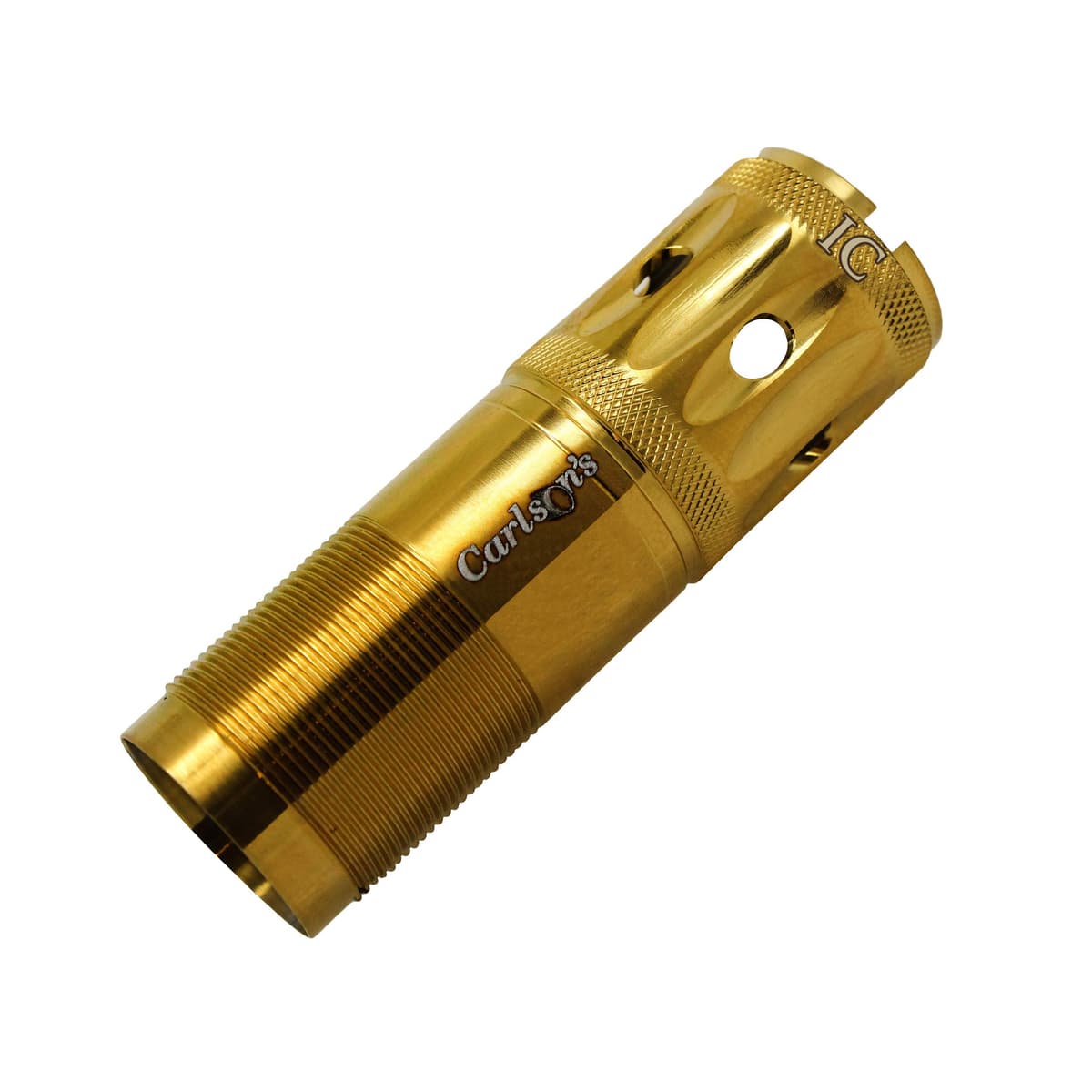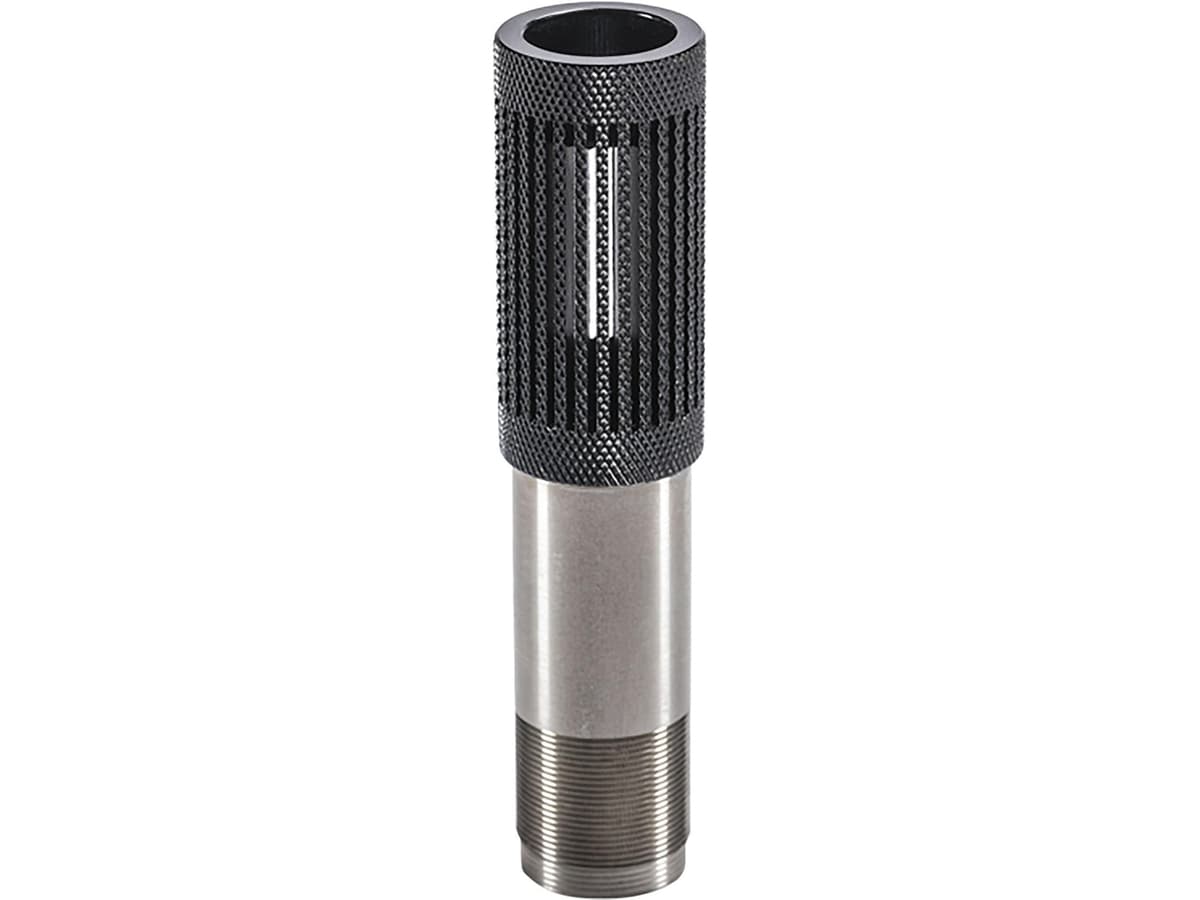
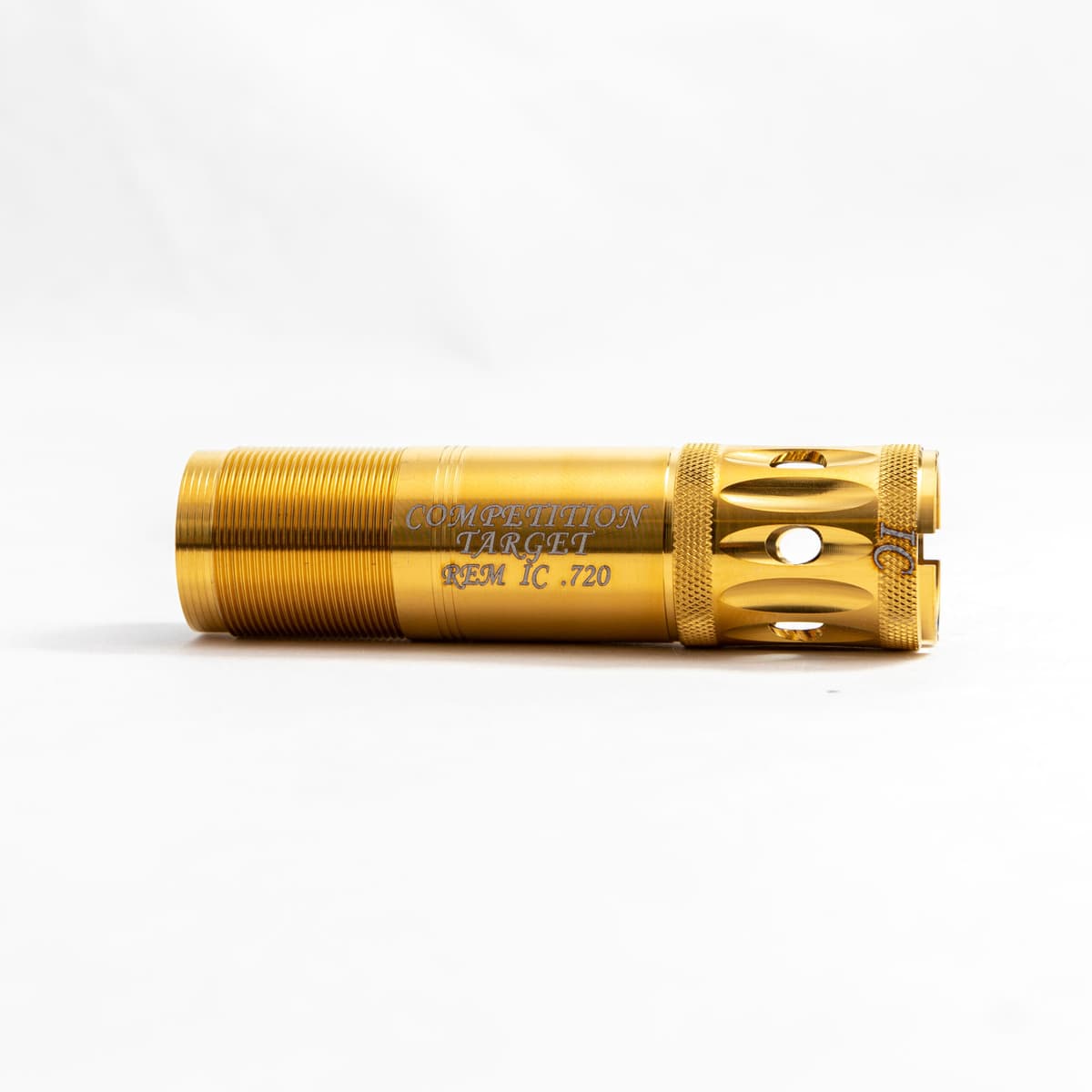
Carlson's Remington Gold Competition Target IC Choke
- Carlson's identifies item 13491 as 12-gauge Remington Improved Cylinder
- Manufacturer lists a .720-inch exit diameter
- Ported extended body with a 25 percent longer parallel section

Choke names are only a starting point. This guide maps the major thread systems, shows source-scoped constriction and 40-yard pattern ranges, and gives you a repeatable way to pattern buckshot, birdshot, turkey loads, and slugs.
Affiliate links (?)
Shotgun chokes explained in one sentence: the choke is the last stretch of bore before the muzzle, and squeezing the bore there holds the shot column together longer, which tightens the pattern downrange. The part that trips people up is that the name on the tube is not a dimension. Briley publishes Full as .035 inch of constriction while Carlson's and Trulock publish .030 inch, and Browning says its Invector-DS labels are based on delivered pattern rather than measured inside diameter alone. This guide gives you a shotgun choke chart with the source attached to every number, maps the thread systems so the tube you order actually threads into your barrel, and then hands the decision to the only test that settles it, which is patterning your gun with your load.
A choke changes pattern density, and pattern density is what sets your useful range. It does that by narrowing the bore over the last portion of the barrel so the shot column is squeezed before it leaves the muzzle. Tighter constriction keeps more pellets inside a given circle further out. Looser constriction spreads them sooner. That is the mechanism in shorthand, and makers tune taper and parallel-section geometry around it. Everything else on this page is about the fact that they measure and label the result differently.
Constriction is expressed in thousandths of an inch of bore reduction. Cylinder is nominally .000, Improved Cylinder .010, Modified .020, Full .035 under Briley's labels. Those numbers are a scale, not a specification you can carry across brands. Carlson's and Trulock publish .030 inch as Full, five thousandths more open than Briley at the same stamped name, and Browning states outright that its Invector-DS designations are based on delivered pattern rather than measured inside diameter alone. Two tubes stamped Full can be two different tubes.
The parallel section matters too. Behind the taper, a choke tube carries a straight length that the shot column travels through before it exits, and makers tune it. Carlson's builds its Gold Competition Target line with a parallel section 25 percent longer than its own standard flush tubes. That is a design difference inside one brand at the same nominal constriction, which is another reason a stamped label is a starting point and not an outcome.
None of this predicts what a specific shell will do. Browning publishes a patterning procedure precisely because you have to look at where the pattern lands and how dense it is inside a measured circle, with the gun, tube, and shell you actually own. A pattern percentage is an expected range for the test conditions the maker cites, not a guarantee for another shell, another bore, another distance, or another choke maker.
Here is the shotgun choke chart with its sources named. The nominal constriction column is Briley's 12-gauge labeling from its Understanding Chokes reference. The pattern columns are Browning's, and Browning scopes them tightly: the first is the expected percentage of the load inside a 30-inch circle at 40 yards from 12-gauge Standard Invector and Invector-Plus barrels using 2.75-inch lead loads in 3-inch chambers. The second column is Browning's separate Invector-DS dataset, which it does not publish for Cylinder or Extra Full.
| Choke | Nominal Constriction (Briley) | 40-Yard Pattern, Standard Invector / Invector-Plus (Browning) | 40-Yard Pattern, Invector-DS (Browning) |
|---|---|---|---|
| Cylinder (CYL) | .000 in | 15 to 45% | Not published |
| Skeet (SK) | .005 in | 20 to 45% | 35 to 40% |
| Improved Cylinder (IC) | .010 in | 25 to 55% | 40 to 45% |
| Light Modified (LM) | .015 in | 30 to 60% | 45 to 55% |
| Modified (M) | .020 in | 35 to 65% | 55 to 65% |
| Improved Modified (IM) | .025 in | 45 to 75% | 65 to 75% |
| Light Full (LF) | .030 in | 50 to 70% | 70 to 75% |
| Full (F) | .035 in | 55 to 85% | 75 to 80% |
| Extra Full (XF) | .040 in | 75 to 85% | Not published |
Read the two pattern columns as two different measurements, not as a discrepancy. Browning built the Invector-DS numbers around delivered pattern, which is why Improved Cylinder shows a tight 40 to 45 percent band there and a wide 25 to 55 percent band in the older system. The wide bands are honest: the same tube throws different percentages with different shells.
Keep the source label visible whenever you quote a constriction. Full is .035 inch to Briley and .030 inch to Carlson's and Trulock, so a tube swap between brands at the same stamped name is a real change in constriction. Sources for this chart: Briley, Understanding Chokes and Browning, Shotgun Choke Patterns.
Constriction tells you what a tube does. The thread system tells you whether it will thread into your barrel at all, and the two are unrelated. Buying by shotgun model name is where people lose money, because several makers ship more than one system under one model family and at least one major maker sells three similar-sounding systems that do not interchange.
Even the makers disagree about where the lines sit, which is the strongest argument on this page for reading your own barrel. Mossberg's 12-gauge Accu-Choke page states its tubes interchange with Win-Choke and Browning Invector models. Winchester says Invector-Plus, WinChoke, and Standard Invector tubes are not interchangeable with one another. Both statements are official and they do not agree, so follow the maker of your barrel, not the maker of the tube you happen to be holding. Winchester's warning explicitly includes Invector-Plus, and Browning says an Invector-DS tube fits only barrels marked Invector-DS.
Beretta splits the same way. Mobilchoke tubes belong only in Mobilchoke barrels, and Beretta keeps original Optima-Choke, Optima-Choke Plus, and Optima-Choke HP separate from each other. Beretta limits HP tubes to barrels marked for Optima-Choke HP and warns that wrong-system use can damage the barrel, which is the sharpest version of why this section exists.
Benelli is the naming trap. Benelli's current M4 page calls the M4 tubes Standard, and Benelli's own catalog calls its other system Crio. The Crio Plus label you see on aftermarket tubes is a tube-maker label, and Benelli does not publish a Crio-to-Crio Plus interchange statement, so a Crio Plus tube is not automatically a Crio tube. Carlson's puts an even sharper warning on the pairing: Beretta Optima Plus and Benelli Crio Plus can share exterior dimensions while using different bores, and the same is true of Beretta Optima and Benelli Crio. Do not interchange either pair on the strength of how the tube looks.
Gauge is a hard gate on top of all of this. A system name shared between a 12-gauge and a .410 barrel is not a statement that the tubes cross, and Savage's 301 FAQ is a good example: the .410 models use a Short Invector pattern that its separate 12- and 20-gauge wording does not cover.
Here is where the shotguns in our catalog land. Every row is sourced to the firearm maker rather than to a choke-tube interchange chart, because the firearm maker is the one who knows what it cut into the barrel. If you are still choosing a gun, pump shotguns and tactical semi-autos split hard on this: some ship threaded, some ship fixed, and the spec sheet is worth reading before the tube catalog is.
| Shotgun | Gauge | Thread System | What the Maker Publishes |
|---|---|---|---|
| Beretta 1301 Tactical Mod.2 | 12 gauge | Beretta Optima-Choke HP | Beretta's semiautomatic manual says 1301 barrels accept only Optima-Choke HP tubes. |
| Beretta A300 Ultima Patrol | 12 gauge | Beretta Mobilchoke | Beretta says A300 Ultima barrels accept only Mobilchoke tubes, and the accessory page lists the A300 Ultima Patrol. |
| Beretta A300 Ultima Turkey | 12 gauge | Beretta Mobilchoke | The A300 Ultima family rule in Beretta's manual is Mobilchoke only. |
| Benelli M4 Tactical | 12 gauge | Benelli Standard | Benelli's current M4 page identifies SKU 11707 and its supplied and optional tubes as Standard choke tubes. |
| Benelli M2 Tactical | 12 gauge | Benelli Crio System | Benelli's 2023 workbook lists legacy SKU 11052 with Crio Improved Cylinder, Modified, and Full tubes. |
| Mossberg 940 Pro Tactical | 12 gauge | Mossberg Accu-Choke | Mossberg identifies SKU 85152 and calls its barrel Accu-Choke compatible. |
| Mossberg 500 Turkey | 12 gauge | Mossberg Accu-Choke | Mossberg's 52280 page identifies the threaded turkey setup, and its 12-gauge Accu-Choke page says threaded 500 barrels use Accu-Choke and states the Standard Invector / WinChoke interchange. |
| Remington 870 Express Tactical | 12 gauge | Unknown until you read the barrel | The current 870 manual explains removable choke use but does not identify this legacy Tactical variant. Remington sold both fixed-cylinder and Rem Choke tactical barrels. |
| Stoeger M3K 3-Gun Freedom Series | 12 gauge | Stoeger Semi-Auto & Pump | Stoeger's workbook lists SKU 36038FS with screw-in Cylinder, Improved Cylinder, and Modified tubes, and Stoeger's store groups M3000 / M3K tubes under Semi-Auto & Pump. |
| Winchester SXP Turkey Hunter | 12 gauge | Browning Invector-Plus | Winchester says SXP shotguns use Invector-Plus and the Turkey Hunter ships with an Invector-Plus Extra Full tube. |
| Stevens 301 Turkey (.410) | .410 bore | Short Invector (.410) | Savage's 301 FAQ says .410 301 models use Short Invector-pattern chokes. |
| PSA 570 18.5-inch | 12 gauge | Fixed Cylinder (no screw-in tube) | PSA's 18.5-inch product page specifies a fixed Cylinder barrel. |


Affiliate links - purchases support this site at no extra cost to you. (?)
Pick your shotgun and your load. The picker returns the thread system the manufacturer publishes for that gun, the starting constrictions each maker actually recommends for that load, and the patterning procedure that settles it. Where the evidence stops, so does the answer.
Patterning is the step that turns a choke label into a number you can trust, and the procedure changes with the load. Three makers publish the four different procedures below, and the target size, round count, and scoring circle are not interchangeable between them. Run the one that matches what is in the gun.
Procedure published by Browning
Procedure published by Trulock
Procedure published by Federal
Notice how far apart these are. Browning counts pellets inside a 30-inch circle on a 40- to 50-inch board at 40 yards across 3 to 4 targets. Trulock uses ten rounds of buckshot on paper at least three feet wide and scores a 20-inch circle. Federal works a turkey gun from 10 through 50 yards against a 10-inch circle, because the question there is the distance at which the pattern still puts enough pellets into a head and neck. Browning and Trulock both average repeated patterns rather than judging one shot, and that averaging is the part shooters skip.
There is no universal buckshot choke, and the two most-cited pieces of guidance point in different directions because they are answering different questions. Mossberg recommends Modified or Full for buckshot and still tells the owner to test the actual load. Federal LE says its tactical FLITECONTROL loads perform well from Cylinder-bore barrels and directs the shooter to select the choke that produces the desired pattern. Neither statement is a rule for the other maker's gun or the other maker's shell.
The wad generation is the detail that decides whether a ported tube is even in play. Federal says FLITECONTROL FLEX works through all waterfowl chokes, including ported tubes. Trulock says original FLITECONTROL should not be used with its ported tubes while FLEX may be used. Read the box, identify which wad you have, and keep the attribution attached, because the tube maker and the ammunition maker are each speaking about their own product.
Dedicated buckshot tubes are their own category with their own limits. Carlson's markets a Beretta and Benelli Mobil buckshot tube at a .695 product-specific exit diameter for 00 and 000 buckshot, and publishes its own shot-material, shot-size, and velocity limits for it. That is a tube-level specification, not a constriction class, which is why it does not appear on the chart above.
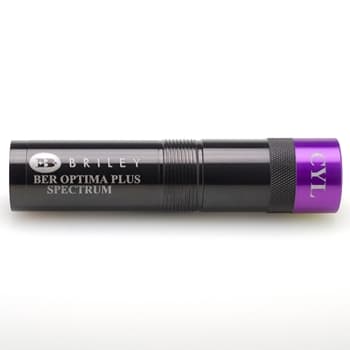
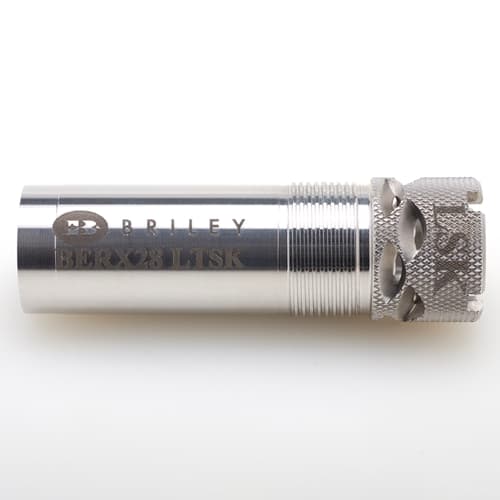
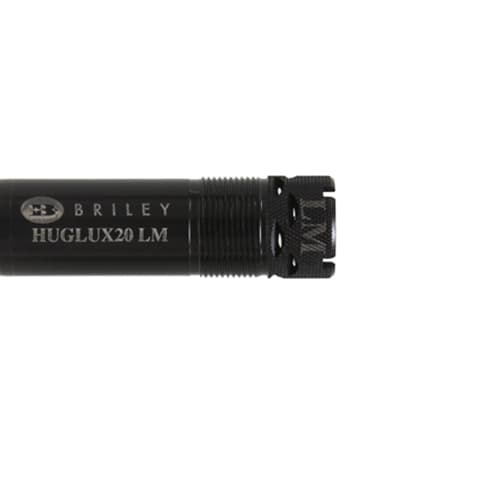
If your barrel is independently verified for Briley's Benelli Crio Plus pattern, the three Briley tubes above give you a clean constriction ladder to test with: Cylinder at .000 nominal, Improved Cylinder at .010, Light Modified at .015. Run the same shell through all three and let the paper rank them. That is a deliberate test sequence for a verified Crio Plus barrel, not a recommendation for any particular Benelli, because Benelli's own M2 literature says Crio rather than Crio Plus.
Score it Trulock's way: ten rounds, paper at least three feet wide, a 20-inch circle, and an average rather than a verdict from one lucky target. Ten rounds of buck is the price of knowing. For the guns this testing usually happens on, see our home defense shotgun guide, and for the short, weather-beaten pump that lives behind a seat, the truck gun guide covers the same trade in a different package.
Turkey chokes are the tightest constrictions most shooters will ever thread in, and tungsten super shot is where the usual shortcuts break down hardest. Federal says its HEAVYWEIGHT TSS load with the FLITECONTROL FLEX wad works through standard and ported turkey chokes, and it deliberately does not prescribe one universal constriction. That is the ceiling of what the shell maker will tell you: the rest comes from the tube maker and from your own pattern board.
Tube-specific limits are strict and worth reading in full. Carlson's optimizes its .640 Rem Choke TSS tube for Federal HEAVYWEIGHT TSS in #7 through #9, and prohibits steel larger than #4, slugs, sabots, rifled slugs, and 00 or 000 buckshot through that tube. Those are the tube maker's own restrictions for its own product, and they do not transfer to the next brand of turkey choke.
Indian Creek publishes a fitment table organized by choke family and sells separate model numbers and constrictions inside it, so the family name is never the order. Indian Creek allows lead and hybrid heavy loads in shot sizes #2 through #10, and on TSS specifically it tells you to consult the shell manufacturer. Pick the exact host variant and constriction off its table, then pattern it.
Do not carry steel-shot restrictions over to TSS by analogy. They are different materials with different hardness and different maker guidance, and the only correct move is to use the exact shell maker and choke maker statements for the two products you are actually combining.

Premium 30-port extended turkey choke with a tight constriction built for the densest TSS patterns.
Affiliate links - purchases support this site at no extra cost to you. (?)
Then pattern it Federal's way: test the exact gun and choke from 10 through 50 yards and compare hits inside a 10-inch circle, which gives you a practical distance derived from your pattern instead of from a marketing claim. If you are still building the gun around that tube, our turkey shotgun guide covers the platforms whose factory choke systems feed this decision.
For clays, two makers publish starting choices and they do not agree, which is fine as long as you do not blend them. Browning's game-selection chart gives Full, Improved Modified, or Modified for trap and Skeet for skeet. Beretta publishes Cylinder or Improved Cylinder for skeet and Modified or Improved Modified for trap. Pick one maker's starting point, shoot it, and let the board decide, rather than averaging the two into a chart neither of them published.
Steel is where a wrong assumption gets expensive, and every rule worth having is attached to a name. Beretta marks Cylinder, Improved Cylinder, and Modified Mobilchoke constrictions steel-compatible in the A300 manual and does not recommend Full or Improved Modified for steel there. Benelli recommends no tighter than Modified with steel, with Modified for pass shooting and Improved Cylinder or Cylinder over decoys. Winchester generally says no tighter than Modified unless the exact tube is marked for tighter steel use.
Browning accepts current factory steel loads in current Standard Invector, Invector-Plus, and Invector-DS systems, does not recommend Standard Invector Full or Extra Full with steel, and publishes exclusions for older guns. Mossberg allows steel with the proper Accu-Choke or Accu-Mag steel-rated tube and does not recommend steel through its Extra-Full turkey tube. Five makers, five separate statements, and no universal answer about Full and steel.
Aftermarket tubes publish their own material ratings on top of the gun maker's. Carlson's rates its Gold Competition Target line for lead, copper-plated, nickel, Hevi-Shot, bismuth, and tungsten loads, and its steel guidance is product-specific: the restriction on steel larger than BB applies to tubes tighter than Full. The two Carlson's Improved Cylinder tubes above, one cut for Rem Choke and one for Invector-Plus, are the clays and pattern-comparison end of that line, with listed exit diameters of .720 inch and .730 inch respectively.
Verify all of it on paper with Browning's general procedure: a 40- to 50-inch board at 40 yards or at the distance you actually shoot, 3 to 4 fresh targets, a 30-inch circle around the densest portion, hits divided by the shell's pellet count, and the targets averaged.
Slugs are the clearest case where two manufacturers publish conflicting boundaries, so the answer has to be your gun's maker. Benelli recommends Cylinder, limits rifled slugs in its smoothbore field barrels to Cylinder or Improved Cylinder, calls anything tighter than Improved Cylinder unsafe, and reserves sabot slugs for fully rifled barrels. Remington says rifled slugs or buckshot may be used through any smoothbore choke and generally identifies Improved Cylinder as best. Both statements are correct about the guns their authors built. Neither is a universal rule, and running a Benelli on Remington's wording is exactly the mistake this section exists to prevent.
Mossberg lands near Remington in practice with a hard exception: Improved Cylinder for slugs, and 835 or 935 overbored vent-rib barrels require a dedicated slug barrel rather than a tube change. Winchester identifies Cylinder and Improved Cylinder WinChokes for rifled and sabot-type slugs in guns covered by its Model 1300 manual, and requires that a tube stay installed in a choke-threaded barrel at all times.
Dedicated rifled choke tubes are a separate product class with their own permissions. Carlson's permits slugs, rifled slugs, and sabots through its rifled choke tubes while prohibiting all of them through its turkey tubes. Those two lines come from the same maker and say opposite things, which is the cleanest illustration on this page that a limit belongs to a specific tube rather than to a constriction class.
Slug work is sighted in rather than patterned. Federal's method is to sight in from a rest that reproduces the support and fore-end pressure you will actually use, then verify point of impact from alternate support positions, because the support method moves impact. Photograph the group and measure the point-of-impact shift between positions instead of eyeballing it. A dot makes that shift easier to see and easier to correct, which our shotgun red dot guide covers in detail.
The SilencerCo Salvo 12 mounts through the choke interface using an Echo Choke Mount rather than through a threaded muzzle, so it attaches using the same thread system this guide has been mapping. That makes your choke system a suppressor decision as well as a pattern decision, and it is one more reason to confirm the marking on the barrel rather than the model name on the receiver. Our shotgun suppressor guide covers which cans mount to which systems.
Choke systems, defensive loads, turkey rigs, and shotgun optics, sent when we publish something worth reading.
The Bottom Line
Read the marking on your barrel, take the starting constriction from the maker who built the gun or the tube, then let the pattern board make the final call.
A choke chart is a map, not a measurement. Briley and Carlson's disagree by five thousandths on Full, Browning publishes two different pattern datasets for its own systems, and the interchange questions that feel like trivia are the ones that damage barrels. Confirm the thread system first, take the starting constriction from the maker who published guidance for your exact gun, tube, and load, and then shoot the combination onto paper using the procedure that matches the shell.
Two rows on this page get no answer at all, and that is the point. An unmarked 870 Tactical barrel and a fixed-Cylinder PSA 570 are both cases where the responsible output is a question rather than a product, because a tube that does not belong in your barrel is worse than no tube at all.

Avid shooter with 10+ years of experience including competition shooting, an associate member of the Professional Outdoor Media Association (POMA), and a member of the National Shooting Sports Foundation (NSSF). Built 10+ AR-pattern rifles and several handgun platforms for home defense, competition, and suppressed night shooting.
This page contains affiliate links. Purchases through these links support the site at no extra cost to you. Read the affiliate disclosure
Continue exploring with these related resources

Every accessory ranked here actually fits the Kel-Tec KSG bullpup pump: an enclosed red dot for the top rail, a KSG light-and-handstop mount for the bottom rail, the QD pin the factory gun lacks, a slip-on recoil pad, a vertical grip, backup sights, and the Salvo 12 suppressor adapter.

Best Benelli M4 upgrades and accessories in 2026. Complete upgrade guide covering magazine tube extensions, red dot optics, bolt releases, charging handles, stocks, and shell carriers ranked by impact and value.

Best Maverick 88 upgrades and accessories for 2026. Magpul SGA stock, OPSol mini-shell adapter, Streamlight TL-Racker forend light, Mesa SureShell sidesaddle, and optic mounts ranked by impact. Includes Maverick 88 specific compatibility warnings for forend, magazine, and optic upgrades.
Related articles and industry updates

Derya Arms launched the MAX, an all-new magazine-fed 12-gauge semi-auto built in Jacksonville, Florida. Proprietary magazines with metal feed lips, a self-cleaning curved gas piston, and the MAX Brake progressive compensator. Factory Exclusives are $2,499 with a D-TAK red dot and six magazines, shipping September 2026.

Beretta's A400 Solo is a 12-gauge hunting semi-auto built on the new B-LINK Pro gas system, rated 36% faster and 46% cleaner, with Kick-Off Plus recoil reduction, a Steelium barrel with an 80mm forcing cone, a 3-inch chamber and 7.5 lb weight. Eight finishes, 26/28/30-inch barrels, $1,549 black and $1,649 camo.

The Civilian Marksmanship Program announced it will sell surplus M14 rifles, permanently and irreversibly converted to semi-automatic before transfer, with first order fulfillment expected late 2026 to early 2027. Pricing, purchase limits, and the order process are not yet published. The eligibility rules that decide who gets one already are.