Optics & Sighting • $986
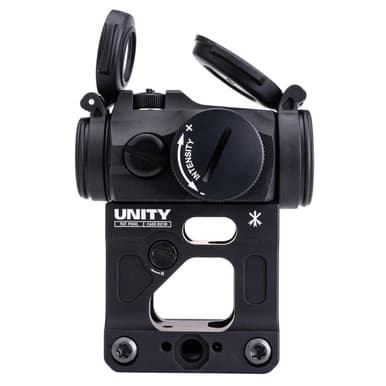
Aimpoint Micro T-2
- 2 MOA dot
- 50,000 hour battery
$986.00
Shop at MidwayUSA
An LED low in the housing shines onto a coated curved lens, the coating reflects the red light back toward your eye as a parallel beam, and the dot appears out at infinity on top of the target. Move your head across the beam or back along the rail, switch between a tube dot and a pistol open emitter, and knock the LED out of focus to see where parallax comes from.
The housings on the bench are traced from an Aimpoint Micro T-2 and a Trijicon RMR Type 2; the optics inside them are a generic teaching model built from an ideal reflector, not either maker's optical design.
A red dot sight is a reflex collimator. An LED sits low in the housing, below your line of sight, and shines forward onto a curved surface of the front lens. That surface carries a coating tuned to the LED's red: it reflects that narrow band back toward your eye and lets the rest of the view through, so you see the target through the glass with the dot on top of it. Aimpoint says its band-pass coating reflects the selected red at almost 100% while passing nearly all near-infrared light, which is why night vision works through the same lens.
The LED sits at the focal point of that curved surface, so the rays it reflects leave the lens parallel. Parallel light reaches your eye as if it came from infinitely far away, which is why the dot looks like it sits out on the target rather than on the glass. Nothing lands on the target itself; only you see the dot. The dot's size comes from a tiny aperture in front of the LED. In the cutaway, the red rays start at the LED, bounce off the coated lens and run parallel into the eye.
The dot stays on target because parallel light enters your eye at the same angle wherever your eye sits inside the beam. Move your head and the dot moves in the window, but it stays on the same spot of a distant target. That is the ideal case, and it is what the Ideal focus setting above shows. "Parallax free" on a spec sheet, such as Aimpoint's "operationally parallax free, no centering required" for the T-2, is an operational claim: the residual parallax is small, not zero.
It comes from two places. The dot is at infinity and the target is not, so even a perfect sight puts the dot one eye offset away from your aim point: an eye 8 mm off center shifts it 8 mm, about 1.2 MOA at 25 yards and half that at 50. And no real sight is perfectly focused; emitter position, lens shape and assembly tolerance leave the dot's direction changing slightly as your eye moves off axis, most near the edges. An independent 2017 test clamped sights and swept the view from one edge of the window to the other at 25, 50 and 100 yards: an Aimpoint T-2 averaged 4.5 MOA of dot movement, EOTech EXPS models under 2 MOA, and several other sights more than 12 MOA. The Typical setting above is tuned to reproduce that T-2 figure; drag the eye to the edge of the window to watch it. Practice keeping the dot centered and check your zero in the optic zeroing simulator.
A red dot's MOA rating is the angle the dot covers. One minute of angle is 1/60 of a degree, about 1.05 inches at 100 yards, so a 2 MOA dot covers about 2.1 inches at 100 yards and half that at 50. Pick the dot size in the view through the sight above and the chip on the stage converts it for the target distance.
| Dot | 25 yd | 50 yd | 100 yd |
|---|---|---|---|
| 1 MOA | 0.26 in | 0.52 in | 1.05 in |
| 2 MOA | 0.52 in | 1.05 in | 2.09 in |
| 3 MOA | 0.79 in | 1.57 in | 3.14 in |
| 6 MOA | 1.57 in | 3.14 in | 6.28 in |
A 2 MOA dot suits a carbine you will shoot at 100 yards and beyond, where a bigger dot starts to hide a small target; 3 to 6 MOA dots are faster to find on a pistol at typical handgun distances. Brightness changes the picture too: Aimpoint notes that turning the intensity up makes a dot look bigger than its rating. Compare dot sizes across rifle picks in the best AR-15 red dot guide.
A tube dot and a pistol open emitter work the same way; the difference is the housing. A tube sight like the Micro T-2 seals the LED and the coated lens inside a tube with glass at both ends. An open emitter like the RMR Type 2 mounts one lens in a hood and leaves the LED on the open deck behind it, so lint, rain or mud can block the light path. The RMR packs this into a 22 x 16 mm window on a sight 1.8 inches long; the T-2 has an 18 mm clear aperture. Switch the bench to the pistol emitter above to see the shorter layout.
A shorter sight has a shorter focal length, so the same focusing error tilts its beam more. In this model a 0.2 mm error in the LED's position moves the pistol sight's dot more than three times as far as the tube's. Measurements do not show open emitters as a class to be worse: the one open emitter in the 2017 test, a Burris FastFire 3, was among the four sights that stayed under 2 inches of movement at 25 yards, with the T-2 and two EOTech EXPS models. Compare sealed and open designs in the best pistol red dot guide and the enclosed emitter guide, then set yours up with how to zero a pistol red dot.
A red dot reflects an LED off a coated lens; a holographic sight uses a laser diode to light a hologram of the reticle, which rebuilds the whole reticle image out in front of the sight. That is how an EOTech draws a 68 MOA ring around a 1 MOA dot, and why EOTech says the dot stays 1 MOA behind a magnifier instead of growing with it. The costs are power and weight: the EXPS3 runs 1,000 continuous hours on a CR123 at its nominal setting and weighs 11.2 oz, against 50,000 hours for a Micro T-2.
Holographic sights are not parallax free either. EOTech's own help center says every optic has some parallax and lists up to 4 ±3 MOA at the edge of its window, 14 MOA across the whole window, at 71 °F. In the 2017 test the EXPS models moved least of all. In November 2015, EOTech and its parent L-3 paid $25.6 million to settle a federal False Claims Act suit over holographic sights sold to the Defense Department, Homeland Security and the FBI; the government alleged that EOTech knowingly sold sights that failed in cold and humid conditions and delayed disclosing the defects. In the settlement the companies admitted that EOTech knew by 2006 that its sights lost zero with temperature changes, found parallax error growing in cold weather in 2007 (12 MOA edge to edge at 32 °F and more than 20 MOA at 5 °F), learned in 2009 that moisture entering the sights could dim the reticle, and kept selling to the government without disclosing each problem, for more than a year in the case of cold weather parallax and for several years for thermal drift and moisture. Compare current models in the best holographic sights guide.
Red dots have unlimited eye relief: Aimpoint lists it that way for the T-2. Because the dot's light is parallel, it looks the same with your eye 2 inches or 2 feet behind the sight. Drag the eye back along the rail with Ideal focus set and the dot does not move; only the window looks smaller. A magnified scope is different: its exit pupil sits at one distance behind the eyepiece, which the 3D scope cutaway traces.
Shoot a red dot with both eyes open and your focus on the target. With no magnification and the dot at infinity, your brain lays the dot over what the other eye sees, so you keep your full field of view. Aimpoint's drill for it: close the front lens cap, look at the target with both eyes, and bring the rifle up; the dot still appears on the target. Run it against a timer in the combat course simulator.
The lowest brightness settings on a night vision compatible dot are too dim to see with the naked eye; they show only through a night vision device. The T-2 has 12 settings, the bottom 4 for night vision; the RMR Type 2 has 8, with settings 1 and 2 for night vision, plus an automatic mode. Drop the brightness slider under the view through the sight to a night vision setting and the dot disappears in daylight.
In daylight, run the lowest setting that shows a crisp dot against the target. A dot turned up too far blooms and looks bigger than its rating, and the highest settings drain the battery fastest. See where a dot fits against an LPVO or prism in the optic selection matrix.
Tube dots, a holographic sight, and open and enclosed pistol emitters, including the two sights modeled on the bench.
Affiliate links - purchases support this site at no extra cost to you. (?)



Affiliate links (?)
There is no hard limit, because the dot is seen inside the sight rather than projected onto the target; Aimpoint names the quality of your eyesight as the biggest factor. What changes with distance is how much target the dot covers: a 2 MOA dot covers about 1 inch at 50 yards, 2.1 inches at 100 and 6.3 inches at 300. The practical limit is seeing and identifying the target, which a 3x magnifier behind the dot helps with.
Yes. A red dot has no magnification and puts the dot at optical infinity, so your brain lays it over the target your other eye sees, and you keep your full field of view. Aimpoint's one rule for its sights is to keep both eyes open and focus on the target, not the dot. To practice, close the front lens cap, look at the target with both eyes, and bring the rifle up: the dot still appears on the target.
Many do. Holosun's Shake Awake and Sig's MOTAC switch the dot off after a period without movement and back on when the gun moves; a Sig ROMEO3MAX shuts off after 2 minutes still and comes back at the last brightness setting. Others stay on: an Aimpoint Micro T-2 has a rotary switch and is built to be left on for years. The Trijicon RMR Type 2 powers up in automatic brightness mode with a button press and returns to automatic after 16.5 hours in manual.
On one battery, often years of continuous use. Aimpoint rates the Micro T-2 at 50,000 hours on a CR2032 at daylight setting 8, over five years left on. Holosun rates the HE512T at 50,000 hours at setting 6, and Trijicon rates the RMR Type 2 at more than four years of continuous use at setting 4 of 8. Higher brightness and extreme cold shorten those figures. Holographic sights draw far more power: EOTech rates the EXPS3 at 1,000 continuous hours on a CR123 at its nominal setting.
Yes, a little. A perfectly focused red dot would put the dot on the same spot of a distant target wherever your eye sits, but real sights are never perfectly focused, so the dot drifts slightly as your eye moves off center, most at the edges of the window. An independent 2017 test that swept the view from edge to edge measured an average of 4.5 MOA for an Aimpoint T-2 and under 2 MOA for EOTech EXPS models, while several other sights averaged more than 12 MOA. Parallax free on a spec sheet means small enough not to matter with the dot near center.
A red dot shines an LED onto a coated lens that reflects the red light back to your eye as a parallel beam, so the dot appears at infinity. A holographic sight, such as an EOTech EXPS3, uses a laser diode to light a hologram of the reticle, which rebuilds the whole reticle, a 68 MOA ring and a 1 MOA dot, out in front of the sight. The hologram allows complex reticles and keeps the 1 MOA dot 1 MOA behind a magnifier; the LED dot is simpler, lighter and runs about 50 times longer on a battery. Neither is parallax free: EOTech lists up to 14 MOA of parallax across its full window.
MOA, minute of angle, is 1/60 of a degree, and a red dot's MOA rating is the angle the dot covers. One MOA spans about 1.05 inches at 100 yards, so a 2 MOA dot covers about 2.1 inches at 100 yards and 1 inch at 50, and a 6 MOA pistol dot covers about 3.1 inches at 50 yards. Smaller dots cover less of a distant target; bigger dots are faster to find. Turning the brightness up also makes a dot look bigger than its rating.
Pick a rifle or pistol, add a red dot and a mount in the configurator, and check that every part fits before you buy.
Launch Configurator