Optics & Sighting • $329.49
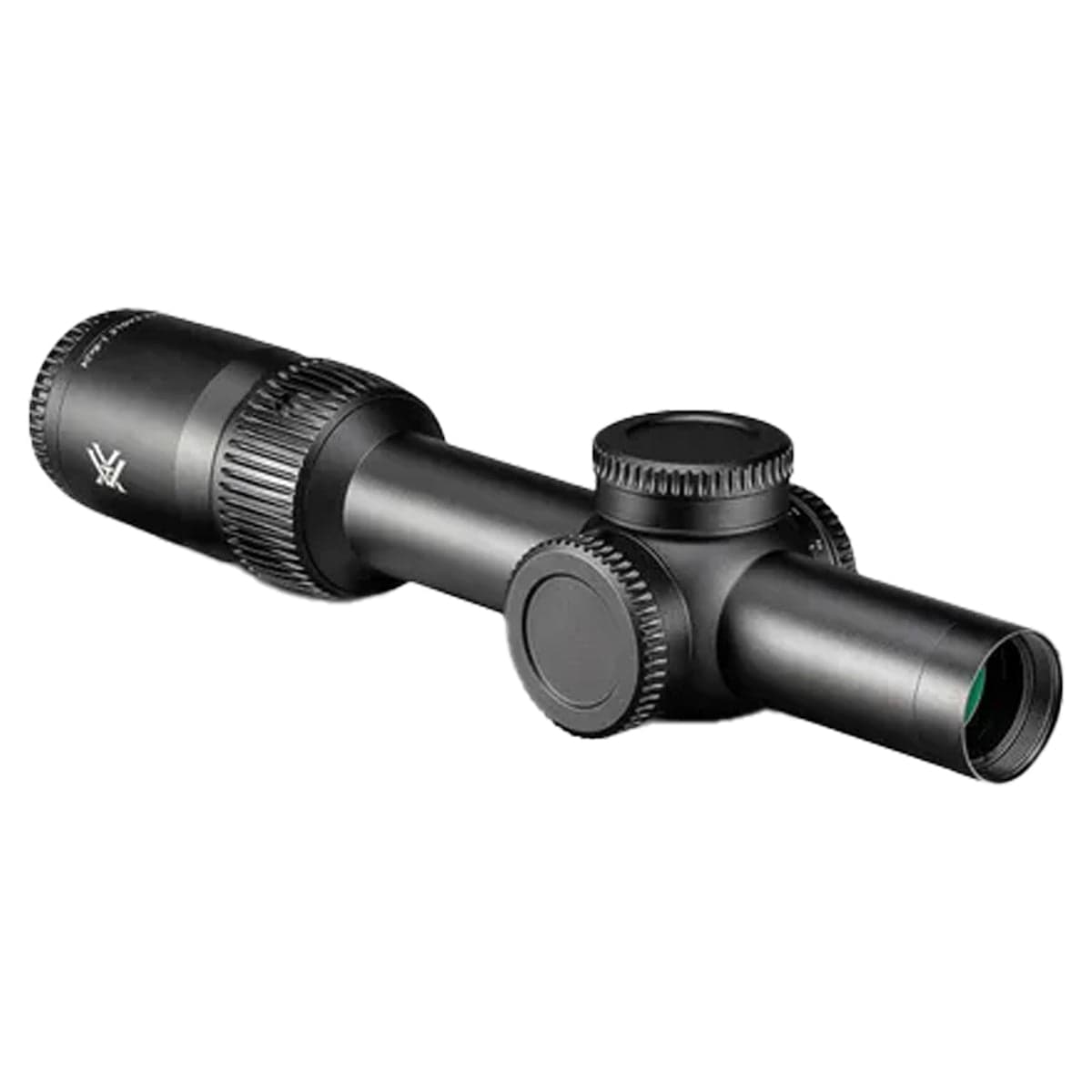
Vortex Strike Eagle 1-8x24
- 1-8x magnification
- AR-BDC3 SFP reticle
$399.00
View at OpticsPlanet
Light enters the objective, forms an upside-down image at the first focal plane, gets flipped and magnified by the erector, lands upright on the second focal plane, and leaves the eyepiece as a beam no wider than the exit pupil. Turn the magnification ring, move the reticle between the first and second focal plane, and dial the elevation turret to see what each one moves inside a 1-8x LPVO.
The scope on the bench is a generic 1-8x24 built from ideal thin lenses to show how the parts work; it is not any manufacturer's optical design.
A riflescope is a chain of lenses that builds two images inside the tube. The objective lens at the front focuses the target into a real image at the first focal plane, and that image is upside down and reversed. The erector, a set of lenses riding in a tube in the middle of the scope, flips it back upright and relays it to the second focal plane. The ocular, or eyepiece, then turns that image into the parallel light your eye focuses on.
The erector is also where the zoom happens. Its two moving lens groups change how much they enlarge the image while keeping it on the second focal plane, so the picture stays sharp at every power. In the cutaway the arrow at each focal plane shows the image flipping, and the traced rays show the objective bundle narrowing down to the exit pupil behind the eyepiece.
The difference between first and second focal plane scopes is which image the reticle is laid over. A first focal plane reticle sits ahead of the erector, so the erector magnifies it along with the target: it grows as you zoom in, and a 2 MOA mark covers 2 MOA of target at 1x, 4x or 8x. A second focal plane reticle sits behind the erector, so it never changes size, and its marks only match their printed values at the one power the maker calibrated, usually the highest.
Set the power to 4x on the bench above and press Compare under the eyepiece. The FFP view shows the crosshair shrinking with the target; the SFP view shows the same crosshair at full size, with each 2 MOA mark now spanning 4 MOA of the target. At 8x the two views match.
Choose FFP if you hold over, range or measure wind at in-between powers, because the marks stay true from 1x to 8x; the Army's Direct View Optic (SIG TANGO6T 1-6x24) and the XM157 fire control on a 1-8x30 LPVO are both first focal plane. Choose SFP if you shoot mostly at 1x and use holds only at maximum power: an SFP reticle keeps a big, readable center at 1x, and SFP is the more common layout on LPVOs.
The FFP catch on an LPVO is 1x. The whole reticle shrinks to a small cluster in the middle of a wide field, as the 1x eyepiece view above shows once you switch its lit center off, so a first focal plane LPVO works like a red dot only when its center is illuminated brightly enough to find fast. A true red dot has no erector or focal plane at all; see why its dot sits at infinity in the 3D red dot cutaway. Compare picks in the best LPVO guide and the best budget LPVO guide, or see where an LPVO fits against dots and prisms in the optic selection matrix.
The exit pupil is the diameter of the beam leaving the eyepiece, and at high power it equals the objective diameter divided by the magnification: a 24 mm objective at 8x gives 3 mm. At low power an aperture inside the erector usually sets the pupil instead, which is why a 1-8x24 does not deliver 24 mm at 1x; Nightforce lists 7.9 mm at 1x and 3.0 mm at 8x for its NX8 1-8x24, and the traced model above lands close to both.
Eye relief is how far behind the eyepiece that pupil sits, around 95 mm (3.7 in) on the NX8. A wide pupil at 1x forgives a sloppy head position; a 3 mm pupil at 8x has to line up with your own pupil, so the eye box shrinks and your head position has to repeat more precisely. Get the scope where your eye lands with the scope ring height calculator and the LPVO mount guide.
Elevation and windage turrets work by tilting the erector tube. They press on its front end, which pivots at its rear inside the scope, against a spring on the opposite side. Tilting the erector changes which part of the first-focal-plane image it relays to the center of the view, so the reticle lands on a different spot on the target while staying centered in the eyepiece.
Dial the elevation turret up and the reticle moves down on the target: turrets move the point of impact, so once you put the reticle back on the target the barrel points higher. The cutaway exaggerates the tilt six times so it is visible; in this model a 20 MOA dial moves the front of the tube less than half a millimeter. Practice the result in the zeroing simulator and hold or dial at distance in the range simulator.
The magnification ring turns a cam sleeve around the erector tube. Each erector lens group rides a pin that runs in a straight guide slot in the erector tube and a curved cam slot in the sleeve, so turning the sleeve slides both groups forward or back by different amounts. The cam curves are cut so the image stays on the second focal plane at every power; optical designers call this a mechanically compensated zoom.
Drag the magnification ring or pick a power and watch the two groups in the cutaway: both travel toward the objective as the power rises, one of them reversing briefly near the low end, while the pins stay lined up with the cam slots. That same ring setting decides whether SFP holdover marks read true; drill holds at the right power in the holdover trainer.
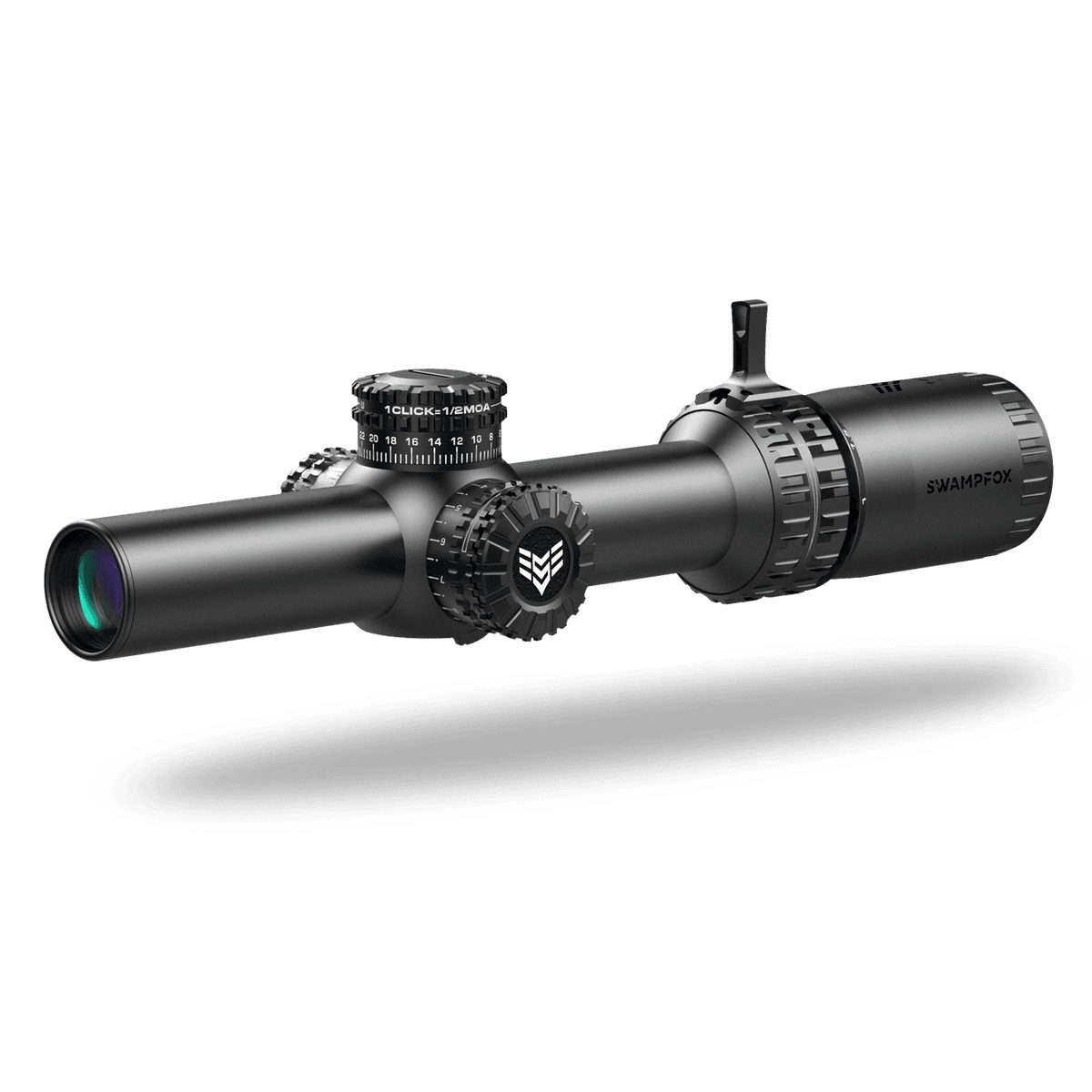
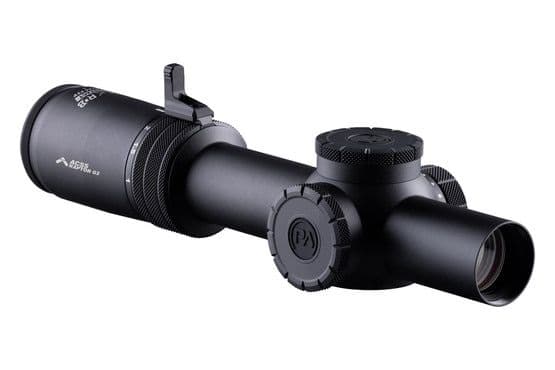
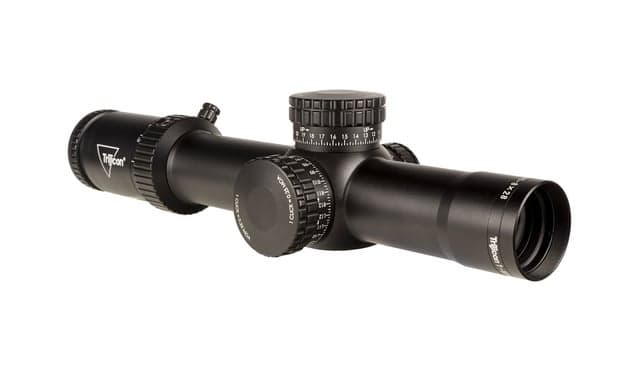
Real 1-8x24 and 1-8x28 scopes in both reticle layouts; check each one's focal plane on its product card.
Affiliate links - purchases support this site at no extra cost to you. (?)
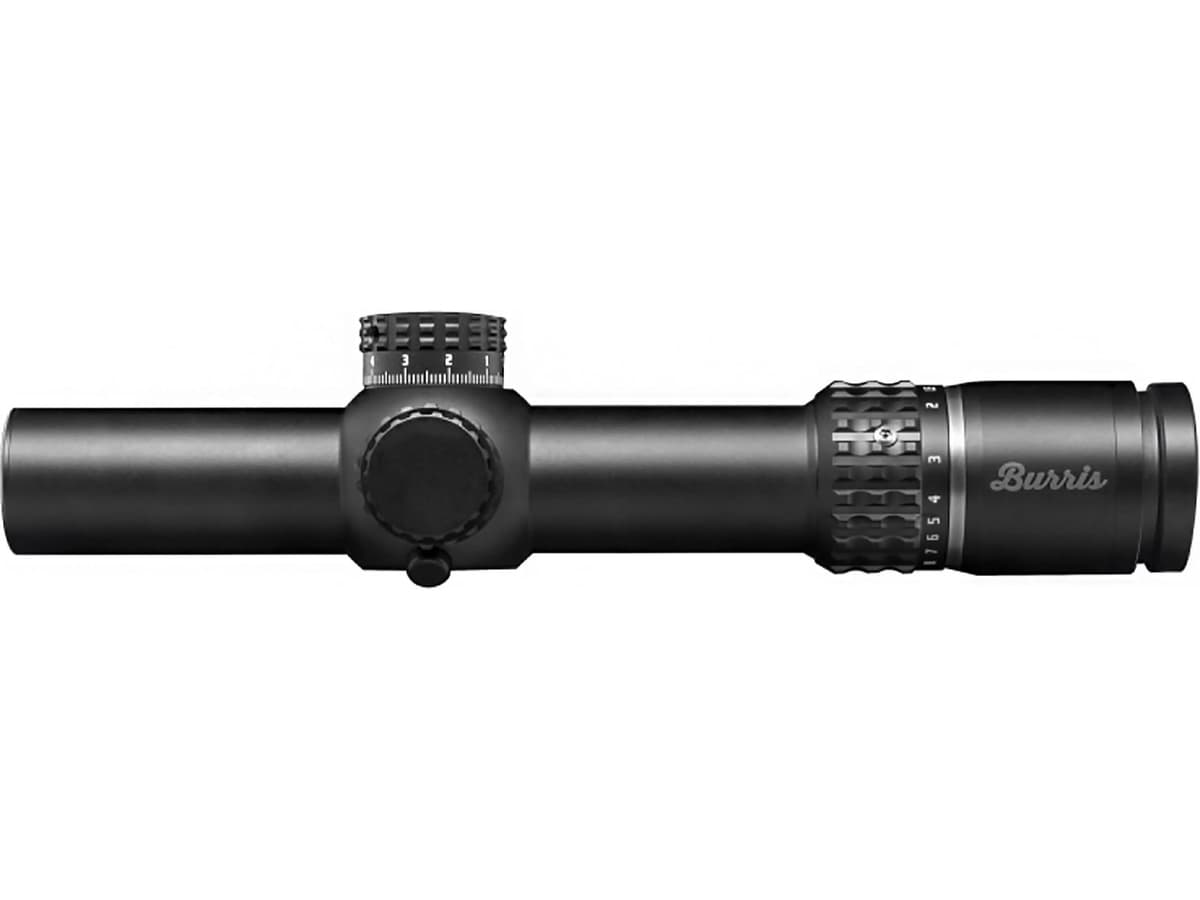
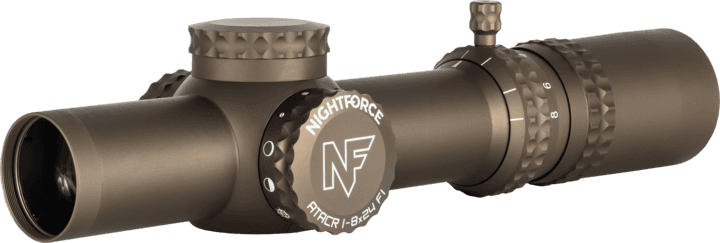
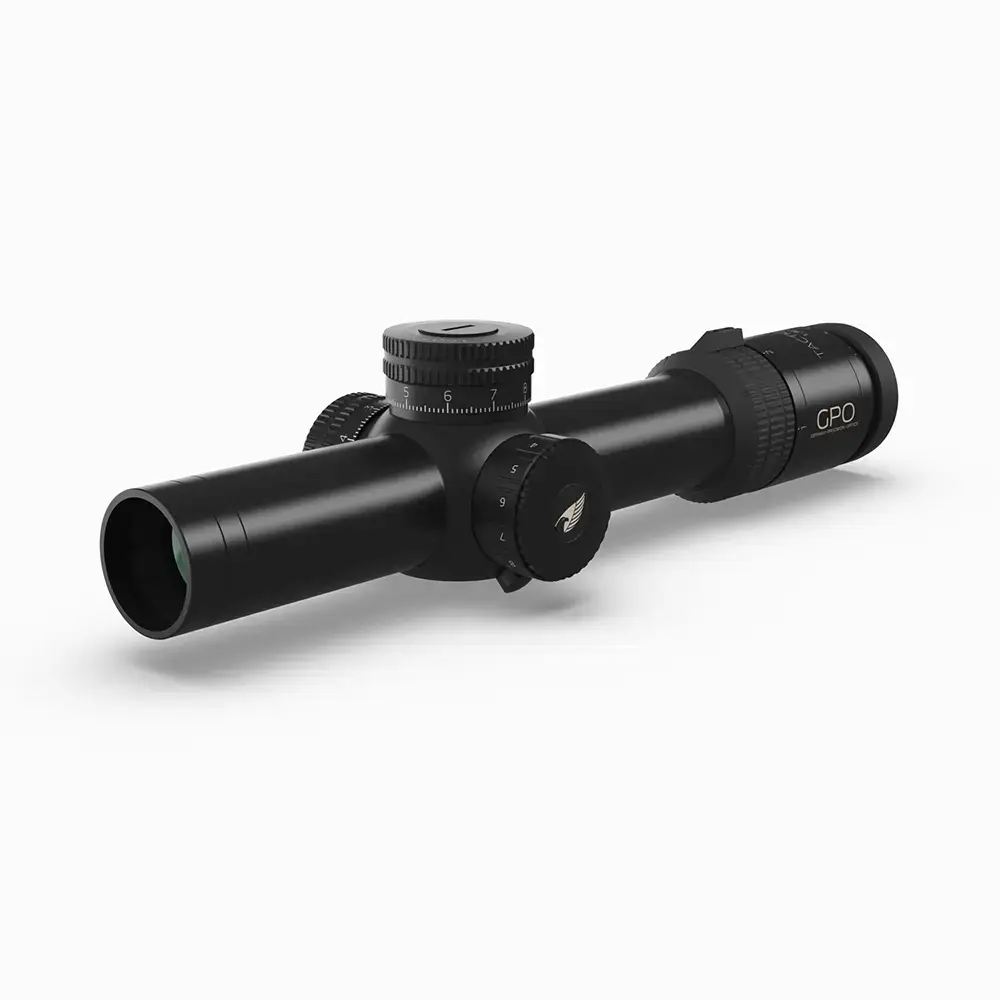
Affiliate links (?)
Where the reticle sits. A first focal plane (FFP) scope puts the reticle ahead of the zoom erector, so the reticle is magnified along with the target and its MOA or MIL marks are correct at every power. A second focal plane (SFP) scope puts it behind the erector, so the reticle looks the same size at every power and its marks are only correct at one calibrated power, usually the highest.
The reticle changes size with the magnification. On a low-power variable it can be too small to pick up quickly at 1x, especially in low light, so FFP LPVOs lean on a bright illuminated center. At high power the same reticle grows thicker and can cover a small target. FFP scopes also usually cost more than comparable SFP models.
Long-range precision shooters overwhelmingly run first focal plane scopes, because they hold and range with the reticle at whatever power they are on. Precision Rifle Blog's survey of top PRS competitors finds nearly all of them using FFP, and the Army's Direct View Optic for the M4A1, the SIG TANGO6T 1-6x24, is FFP as well. SFP is not gone from service: SOCOM's Squad-Variable Powered Scope program included a SIG TANGO6 1-6x24 SFP element alongside a Nightforce FFP element.
Pick FFP if you will hold over or range at in-between powers, since the marks stay true from 1x to 8x; the Army's XM157 fire control is built on a 1-8x30 FFP LPVO. Pick SFP if you mostly run the scope at 1x for close work and at maximum power for holds, because an SFP reticle keeps a large, easy center at 1x. SFP is the more common design on LPVOs, and on a 1-8x SFP scope the holdover marks read correctly only at 8x.
The objective lens forms a real image that is upside down and reversed at the first focal plane. The erector lenses in the middle of the tube flip it back and relay it to the second focal plane right side up, and they also provide the variable magnification. Without the erector a riflescope would show the target upside down.
The exit pupil is the beam of light that leaves the eyepiece, and its diameter is the objective diameter divided by the magnification at high power: 24 mm / 8 = 3 mm on a 1-8x24. At low power an aperture inside the erector usually limits it instead, so a 1-8x24 does not give a 24 mm pupil at 1x; Nightforce lists 7.9 mm at 1x and 3.0 mm at 8x for its NX8 1-8x24. A smaller pupil is harder to line up with your eye, which is why the eye box feels tight at 8x.
Turrets move the point of impact, not the point of aim. Dialing up tilts the erector so the reticle points lower on the target, and when you bring the reticle back onto the target the rifle is angled higher, so the bullet lands higher. In a modern scope the reticle stays centered in the view and the whole picture shifts behind it.
They are off by the ratio of powers. An SFP reticle calibrated at 8x has marks worth twice their printed value at 4x and eight times at 1x, because the reticle stays the same size while the target shrinks. Either use the holds at the calibrated power or multiply by maximum power divided by the current power.
Pick a rifle, add a 1-8x scope and a mount in the configurator, and check that every part fits before you buy.
Launch Configurator