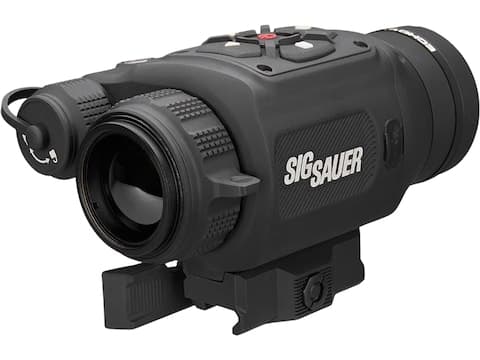
Thermal Optics • $4,499.99
Sig Sauer Echo CV25 Clip-On Thermal
- 640x512 sensor (12um, 50Hz, 20mK)
- 25mm objective, 17 deg FOV
$4499.99
Shop at MidwayUSA
A thermal scope turns heat into a picture: a germanium lens focuses the long-wave infrared a coyote gives off onto a grid of microbolometers, the electronics map each pixel's temperature to a shade, and a small display shows it. Change the scene, run a NUC, switch palettes and turn the day optic's power ring to see each step, down to the pixels reaching your eye.
The housing on the bench is traced from SIG Sauer's drawing of the ECHO CV25 and runs on its published sensor numbers; the lens, sensor and display inside it are a generic teaching model, not SIG's design.
A thermal scope measures heat, not light. Every object radiates infrared according to its temperature, and at everyday temperatures most of that energy sits in the long-wave band from 8 to 14 micrometers, about a third of a room-temperature object's total emission. The scope's lens focuses that band onto a focal plane array, a grid of heat-sensing pixels; each pixel warms a little more or less, the electronics read the difference and paint it on a display as a brighter or darker shade. Nothing is lit up and nothing is amplified, which is why thermal works in total darkness.
What reaches the sensor is not a thermometer reading. A surface emits only a share of what a perfect emitter would at its temperature, its emissivity, and reflects the rest from its surroundings. Grass and skin sit near 0.98 and look close to their true temperature; cardboard, about 0.81, also reflects a cold night sky and reads colder than it is. The stage's scene computes that for every surface on the range.
Ordinary glass stops transmitting infrared at around 2.5 micrometers, so to an 8 to 14 micrometer sensor a glass lens is a black wall. Germanium is the opposite: opaque to your eye, it looks like a dark mirror, but it passes long-wave infrared readily and bends it strongly, which keeps thermal lenses short. That is why a thermal objective looks metallic, why a glass cover or lens cap blocks the picture, and why thermal cannot see through a window.
The lens sets how much each pixel sees. The ECHO CV25 spreads its 640 pixel columns across a 17.6 degree field behind a 25 mm objective, which works out to a 24.8 mm focal length and a pixel angle of 0.48 milliradians, 1.66 MOA. The field is 14.1 degrees tall across the 512 rows.
Each pixel of an uncooled thermal sensor is a microbolometer: a thin membrane suspended over the readout chip whose electrical resistance changes as absorbed infrared warms it. Read tens of thousands of them fifty times a second and you have thermal video; the CV25 reads 327,680 of them at 50 Hz. Its sensitivity, the NETD, is 20 mK: two surfaces closer than 0.02 °C are lost in the sensor's own noise.
No two pixels respond exactly alike, and their offsets drift as the camera warms, which shows up as faint streaks. A non-uniformity correction (NUC) fixes it: a shutter drops a uniform surface in front of the sensor, the camera measures each pixel's offset, and the shutter opens again. That is the click. SIG's CV25 runs one automatically about every 3 minutes with a 5 second countdown, and a long press runs one on demand. Set the stage to 10 minutes since the last NUC, then press NUC to watch the streaks clear.
The palette is only a lookup from temperature to color. White hot draws the warmest surfaces white, black hot inverts it, and color palettes such as Arctic, Rainbow and Sepia spread the same values across a color ramp; the CV25 carries 8 palettes, and the view above has five of them, with colors approximated since SIG does not publish its color tables. None of them adds information, but a different palette can make a small warm target easier to pick out against a busy background.
Automatic gain control decides which temperatures the palette spans. It stretches the scene's coldest to warmest pixels, minus a sliver of outliers, from black to white, so a cold night with a 15 °C gap between a coyote and the grass looks crisp while the same animal at crossover, about 1 °C off the grass, washes into the background. The color bar under the view on the stage shows the span AGC is using right now. The CV25's image contrast setting adjusts the same dynamic range by hand.
A clip-on turns your day optic into a thermal sight without touching its zero. The clip-on's eyepiece is a collimator: the display sits at its focal plane, so every point on the display leaves as a parallel beam, the way light arrives from a distant target. The day optic behind it cannot tell the difference, keeps its own reticle and zero, and magnifies the display with its own power. SIG builds the CV25's eyepiece for parallax-free clip-on use, shrinks its menu in Clip-on mode so it can be read at 3x, and provides a Clip-on Alignment feature in the BDX app to remove any point of impact shift.
The clip-on itself adds no magnification, so the day optic magnifies the thermal pixels along with the scene. The table below is the stage's model: a CV25 in front of a generic 1-8x24 LPVO. At 1x the LPVO sees the whole display with a dark rim around it; by 8x it sees only 92 of the 640 columns, each about 13.3 minutes of angle across, against the roughly 1 minute 20/20 vision resolves. More power makes a small target bigger without adding detail. For high-magnification riflescopes and objectives larger than 24 mm, SIG sells an aperture-stop adapter that keeps the picture crisp. Compare clip-ons in the best clip-on thermal for AR-15 guide.
| LPVO power | One pixel in your eye | Sensor columns in view |
|---|---|---|
| 1x | 1.7 arcmin | 640 |
| 2x | 3.3 arcmin | 367 |
| 4x | 6.7 arcmin | 183 |
| 6x | 10.0 arcmin | 122 |
| 8x | 13.3 arcmin | 92 |
Range comes down to pixels on target. Each CV25 pixel covers about 1.7 inches at 100 yards and twice that at 200, so the pixels across a coyote halve every time the distance doubles. The usual rule of thumb, the Johnson criteria, calls for about 1.5 pixels across a target to detect it, 6 to recognize what it is and 12 to identify it, each at roughly even odds. For a coyote's 57 cm shoulder that is detection to about 859 yards, recognition to 215 and identification to 107.
| Range | One pixel covers | Pixels on the coyote | Johnson task |
|---|---|---|---|
| 50 yd | 0.9 in | 25.8 | Identify |
| 100 yd | 1.7 in | 12.9 | Identify |
| 200 yd | 3.5 in | 6.4 | Recognize |
| 300 yd | 5.2 in | 4.3 | Detect |
A longer lens puts more pixels on the same animal and narrows the field; a finer pixel pitch does the same with less glass. That tradeoff between search field and reach is the core of choosing a thermal: the best thermal scope guide ranks units by detection range, and the clip-on vs dedicated thermal scope comparison weighs the two setups for coyote hunting.
Thermal senses heat an object gives off; night vision amplifies light an object reflects. An image intensifier catches faint starlight, moonlight or near-infrared on a photocathode, multiplies the electrons and shows them on a phosphor screen, so it needs some light and shows a natural-looking scene with the detail to read shapes and identify what you are looking at. Thermal needs no light at all, sees warm animals against cool ground from far off, and sees through the darkness, haze and light brush that stop night vision.
The trade runs the other way on detail and on glass: night vision works through a windshield and shows texture, while thermal stops at a window and flattens anything at the same temperature into one shade. Follow the light through a PVS-14 in how night vision works, and see how the two fit on a rifle in the AR-15 night vision setup guide.
Thermal crossover is the stretch, usually around dawn and dusk, when the background passes through the same temperature as the animal you are looking for. On a cold night the stage's coyote reads about 15 °C warmer than the grass, hundreds of times the sensor's 20 mK NETD. At crossover the gap is about 1 °C: still above the NETD, but the grass, soil and rocks all sit inside the same narrow band, so the coat blends in and only the warmer face stands out. In the warm afternoon scene the sun has heated the berm and the rock past the animal, and it reads darker than the sun-baked berm behind it in white hot.
A lower NETD shortens that blind window; otherwise it passes on its own as the ground keeps warming or cooling past the animal.
The CV25 also works without a day optic. SIG gives it two operating modes: Clip-on mode, for use in front of a day optic, and Sight mode, which turns it into a stand-alone thermal optic with its own reticles (Large Circle Dot, Small Circle Dot, Fine Quadplex and a Digital Ballistic reticle built in the BDX app), zeroing and zoom. Its objective is fixed, so the 1 to 8x is digital: zoom crops the sensor and draws each pixel larger, which is why the view on the stage spans 80 of the 640 columns at 8x. Switch the view to CV25 alone to compare it with optical magnification through the LPVO.
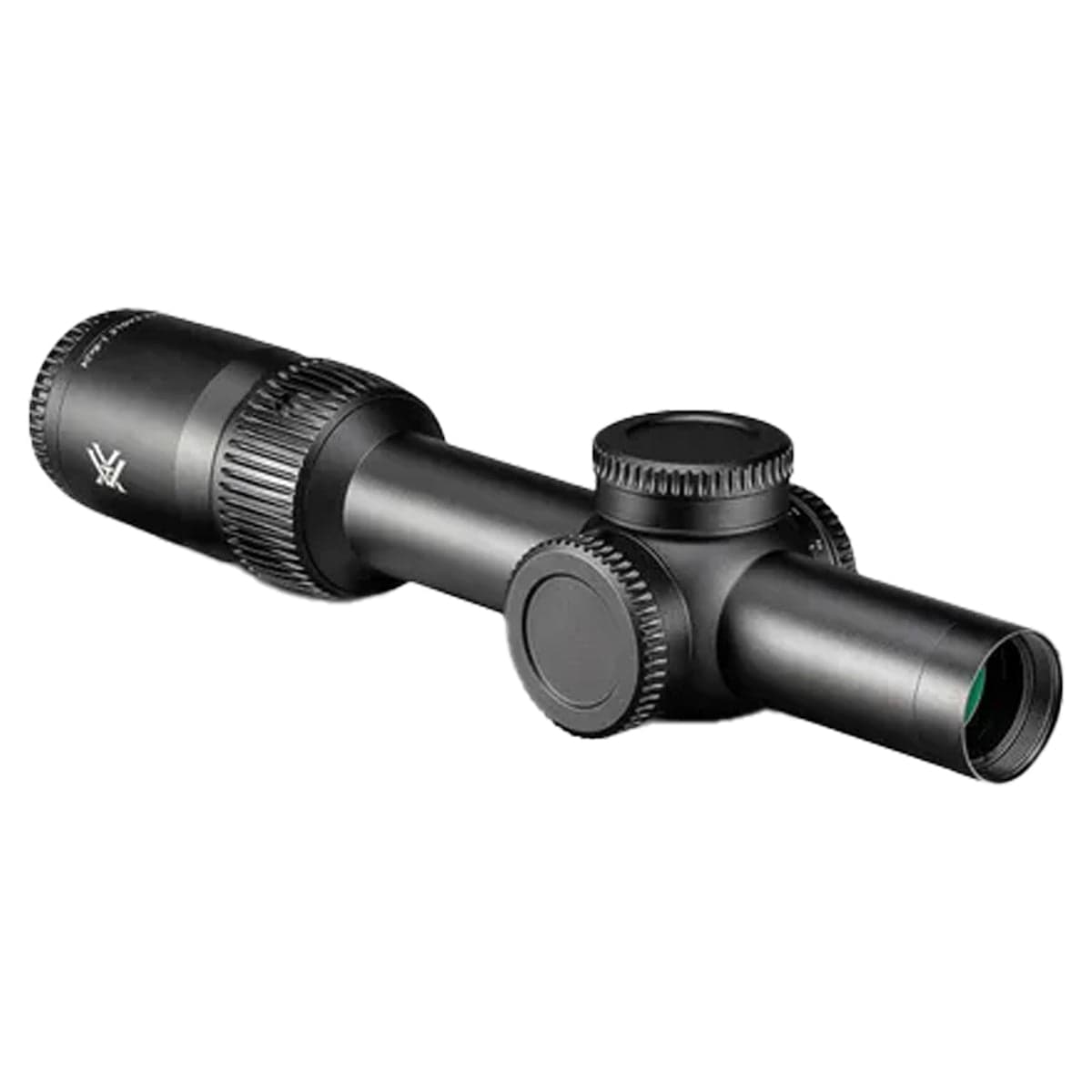
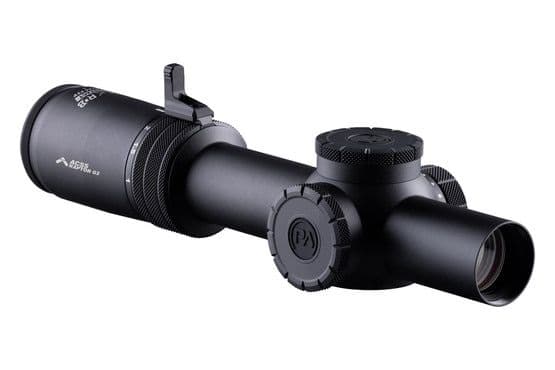
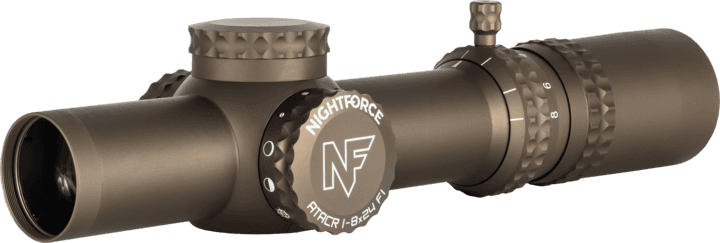
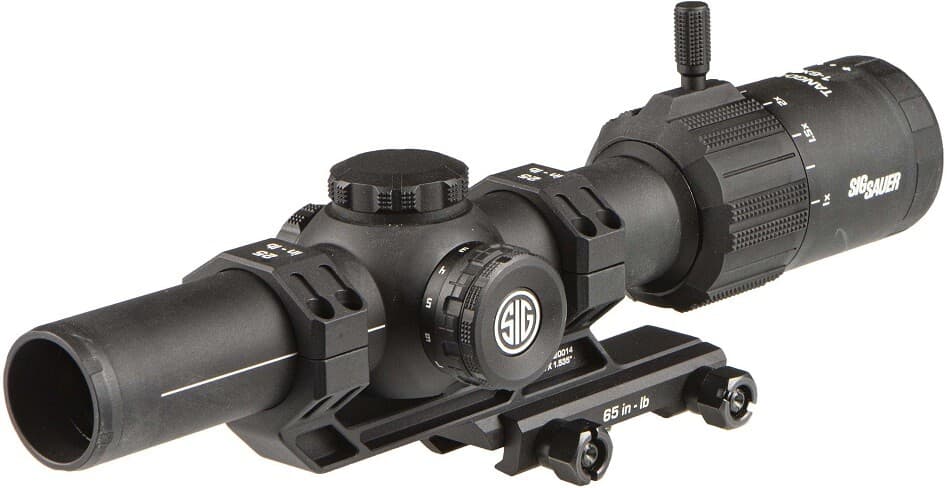
The clip-on modeled on the stage and 1-8x24 LPVOs like the day optic behind it on the bench.
Affiliate links - purchases support this site at no extra cost to you. (?)
Affiliate links (?)
Everything warmer than absolute zero gives off infrared radiation, and objects at everyday temperatures give off most of it at long wavelengths, roughly 8 to 14 micrometers. A thermal scope focuses that radiation with a germanium lens onto a grid of microbolometers, tiny membranes whose electrical resistance changes as they warm. The electronics read each pixel's resistance, turn the pattern into temperature differences and draw them on a small display. The SIG Sauer ECHO CV25 does this with 640 x 512 pixels on a 12 micron pitch, refreshed 50 times a second.
A thermal scope sees heat at any distance; how far it can pick out an animal depends on how many pixels land on it. With a 640 x 512, 12 micron sensor behind a 25 mm lens, like the ECHO CV25, each pixel covers about 1.7 inches at 100 yards, so a coyote's 57 cm shoulder spans about 12.9 pixels there. By the Johnson rule of thumb (1.5 pixels to detect, 6 to recognize, 12 to identify), that is detection to about 859 yards, recognition to about 215 and identification to about 107. A person, 0.75 m across, stretches those to about 1,130, 283 and 141 yards. Longer lenses put more pixels on target and narrow the field of view.
A thermal image is low resolution next to glass optics: a 640 x 512 sensor has about a third of a megapixel, so fine detail and identification at distance are limited, and magnifying the picture makes the pixels bigger without adding detail. Thermal cannot see through window glass, which blocks long-wave infrared. Contrast collapses during thermal crossover, around dawn and dusk, when the ground reaches an animal's temperature. Dense fog, smoke and heavy foliage still degrade the image. The sensor needs a NUC every few minutes, which freezes the picture for a moment, and the whole unit runs on a battery: SIG rates the CV25 at 9 hours on one 18650 cell.
No for glass and walls, partly for fog. Ordinary glass is opaque to the 8 to 14 micrometer band a thermal scope uses, so a window shows its own surface temperature, not what is behind it, and a wall shows only its surface, warmed or cooled by what is on the other side. Thermal does see through darkness, haze and light brush that stop night vision, but dense fog, smoke and heavy foliage still absorb and scatter enough infrared to soften or hide a target.
They see different things. Thermal senses the long-wave infrared heat objects emit, so it works in total darkness and makes warm animals stand out against cooler ground, which is why hunters use it to find game. Night vision (image intensification) amplifies faint reflected light, starlight, moonlight or near-infrared, so it needs some light but shows a natural-looking scene with the texture and detail to identify what you are looking at and to see through a windshield. Thermal is the better detector; night vision shows the detail to identify what it finds.
A clip-on adds no magnification of its own: its eyepiece collimates the display, sending each point out as a parallel beam, so the day optic behind it sees the display as if it were the scene and its own power sets the magnification. That also magnifies the thermal pixels: through a 1-8x LPVO, one ECHO CV25 pixel grows from about 1.7 minutes of angle at 1x to about 13.3 at 8x. Because the day optic keeps its reticle and zero, a well-aligned clip-on does not need rezeroing; SIG makes the CV25's eyepiece for parallax-free clip-on use and provides a Clip-on Alignment feature in its BDX app to remove any point of impact shift.
The click is the shutter closing for a non-uniformity correction (NUC). Every microbolometer pixel responds slightly differently, and the offsets drift as the camera warms, which shows up as streaks and blotches. The shutter drops a uniform surface in front of the sensor so the camera can measure each pixel's offset and correct it. SIG's ECHO CV25 runs an automatic NUC about every 3 minutes with a 5 second countdown on screen, and a long press runs one manually; the picture freezes for a moment while it happens.
It is the sensor's thermal sensitivity, its NETD (noise equivalent temperature difference): the smallest temperature difference it can tell apart from its own noise, here 20 millikelvin, 0.02 °C. A lower number separates objects closer in temperature, which matters most in low-contrast scenes such as rain, humidity or the crossover hours around dawn and dusk. A difference smaller than the NETD is lost in the noise.
Yes. A thermal scope reads emitted heat, not light, so it works the same way at noon as at midnight. Daytime contrast is often lower, though, because the sun heats rocks, soil and dark surfaces, sometimes past an animal's temperature. Never point a thermal scope at the sun: SIG warns that it will damage the CV25's thermal sensor.
Thermal optics are not NFA items in the United States: there is no tax stamp, Form 4 or registration to own one. Taking one out of the country can need an export license, since thermal devices fall under the Export Administration Regulations or, for higher-performance units, ITAR. Hunting at night with thermal is a separate question set by each state, and it varies by species and season, so check your state wildlife agency's rules before you hunt with one.
Pick a rifle, add a day optic and a thermal clip-on in the configurator, and check that every part fits before you buy.
Launch Configurator