Night Vision • $3,995
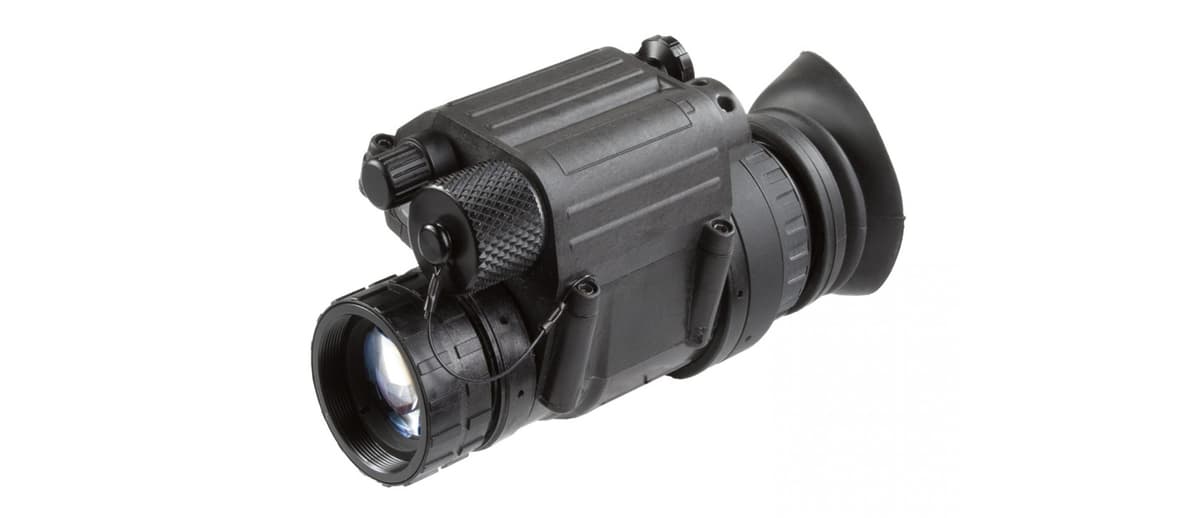
AGM PVS-14 3AL1
- Gen 3 image intensifier, green phosphor
- Level 1 tube selection (top AGM green grade)
$3995.00 Catalog
Shop at KYGUNCO
A night vision tube catches the little light a dark night offers, turns it into electrons, multiplies them thousands of times and paints the result on a glowing screen. Dim the sky from a full moon to overcast starlight, switch between green and white phosphor, turn on an IR laser, and look through a red dot the way you would with a PVS-14 on your helmet.
The monocular on the bench is sized from AGM's published PVS-14 dimensions and the red dot is traced from an Aimpoint Micro T-2; the lenses and image tube inside are a generic teaching model, not any maker's design, and the gain, grain and halo figures come from that model.
Night vision goggles amplify light rather than create it. The objective lens gathers the moonlight, starlight and near-infrared light reflected off the scene and focuses it onto a photocathode at the front of the image tube. The photocathode turns photons into electrons, a microchannel plate multiplies those electrons, and a phosphor screen at the back of the tube turns them into visible light again. The eyepiece lets your eye focus on that screen.
A PVS-14 does this at 1x, so the world looks life-size, across a 40 degree field, and focuses from 0.25 meters out to infinity. The objective flips the image upside down as any camera lens does, so the tube has to turn it back: in the model, the 40 degree field lands on the photocathode as an upside-down picture about 19 mm across, and a twisted bundle of glass fibers behind the screen rotates it upright before the eyepiece. Watch the two amber arrows in the cutaway: one points down at the photocathode, the other up at the tube's output.
That 40 degree circle is all the tube shows. Around it the tube eye sees the black inside of the eyecup, and your other eye sees the night as it is, near black on a moonless night, which is why looking through night vision feels like looking down a tube. The view from the eye above draws the circle at its true size in an 80 degree view, with the naked eye's dark range around it; switch it to the enlarged aim point to look at the dot and the grain up close.
The photocathode decides what the tube can see. A Gen 2 tube uses a multialkali photocathode; a Gen 3 tube uses gallium arsenide, which converts more of the light into electrons and is more sensitive to near-infrared light between 800 and 900 nanometers, just past what your eye can see. That extended red response is why an IR illuminator lights up the scene in the tube while the naked eye sees nothing, and why an IR laser draws a bright beam and spot only through night vision.
It is also why night vision is not magic in the dark. The tube needs something to amplify: AGM rates its PVS-14 for overcast starlight to moonlight, and its built-in IR source covers only close range, up to about 3 meters. For a room, a treeline or a target past that, you carry an IR illuminator; compare options in the IR illuminator guide.
The microchannel plate is a thin glass disc full of tiny channels; an electron entering one knocks loose more electrons from the walls, and those knock loose more, so one electron in becomes a cloud out. AGM's PVS-14 gain knob runs the whole system from about 25 to more than 3,000 times. On a bright night the tube does not use it all: its automatic brightness control turns the gain down to hold the screen at a comfortable level, which is why a full moon and a quarter moon look almost the same through the tube above.
A light in the field spreads into a halo on the screen and lights the ground around it. Because the control averages the whole screen, a small light barely moves the gain, and an auto-gated tube switches itself on and off faster than your eye can see to hold the picture, so the target stays readable; turn on the light in view above and compare Gen 3 with the non-gated Gen 2+. A white weapon light on the target is different: it fills much of the picture, so the gain drops and everything outside the beam goes dark, and unlike an IR illuminator, anyone can see it with the naked eye. Point a PVS-14 at daylight or a lit room and it shuts itself off after about 70 seconds to protect the tube.
Night vision is green because of the phosphor screen. The electrons from the microchannel plate hit a screen that glows where they land; traditional tubes use a P43 phosphor that glows yellow-green, and white phosphor tubes use P45, which glows close to white and gives a black and white picture. The amplification is the same, so switching the phosphor above changes only the color.
Which to pick is comfort and preference: many users read the white picture more easily over long periods, while green is the traditional look. AGM lists PVS-14 builds with both screens, such as the green 3AL1 and white phosphor Gen 3 builds. See how the tube options compare in the PVS-14 buyer's guide.
The grain that crawls across a night vision picture is photon noise. On a dark night only a few photons reach each spot on the photocathode, and their random arrival makes the picture sparkle; a quarter as much light makes the grain twice as strong. Step the sky down to overcast starlight above and the grain crawls across the picture, though the target, trees and sign still read; turn on the IR illuminator and it settles.
Tube spec sheets rate this with a signal-to-noise ratio measured at a fixed low input of about 108 microlux on the photocathode, roughly what an F/1.2 lens gathers from a clear starlit field, and combine it with limiting resolution, the finest line pattern the tube can separate, into a figure of merit: resolution in line pairs per millimeter times SNR. The model on this page starts from a typical spec-sheet SNR for each generation at that input and scales it with the square root of the light.
| Resolution | SNR | FOM |
|---|---|---|
| 64 lp/mm | 25 | 1,600 |
| 64 lp/mm | 28 | 1,792 |
| 72 lp/mm | 30 | 2,160 |
FOM is a useful shorthand, not the whole story: halo size, blemishes in the picture and phosphor color all matter to how a tube looks.
The simplest way to aim with a helmet-mounted PVS-14 is passive aiming through a red dot: the monocular sits in front of your eye, you look through the dot's window with it, and the dot appears on the target in the tube's picture. The dot comes out the phosphor's color, not red, because the tube sees it like any other light. It has to be dim: an Aimpoint Micro T-2 has 4 night vision compatible settings below its 8 daylight settings, and a daylight setting overloads the tube and blooms into a blob that hides the target. Slide the red dot setting above past 4 to watch it happen.
Active aiming uses an IR laser instead: the rifle puts an invisible near-infrared beam on the target, and through the tube you see the beam and the spot, so you can aim without getting your head behind the sight. Mounting heights, lasers and illuminators for an AR-15 are covered in the AR-15 night vision setup guide, and how the dot itself works is in the 3D red dot cutaway.
Night vision and thermal see different light. An image intensifier amplifies light reflected off the scene: starlight, moonlight and near infrared from an illuminator. Thermal imaging senses long-wave infrared that everything emits as heat, so it needs no light at all and makes a warm body stand out against cool ground.
That difference sets what each is good at. Night vision shows detail, texture and your surroundings well enough to walk and shoot at 1x, and it sees IR lasers and illuminators; it goes blind when there is no light to amplify. Thermal finds heat in total darkness and through light haze, but it shows heat rather than reflected detail and does not show an IR laser the way a tube does. Follow the heat through a clip-on thermal in how a thermal scope works.
The light a tube has to work with falls by a factor of a thousand from a full moon to an overcast, moonless night. These are the levels the sky control above uses:
Under a full moon the tube has light to spare; under overcast starlight it is working at the bottom of its range, which is where Gen 3 and an IR illuminator earn their keep.
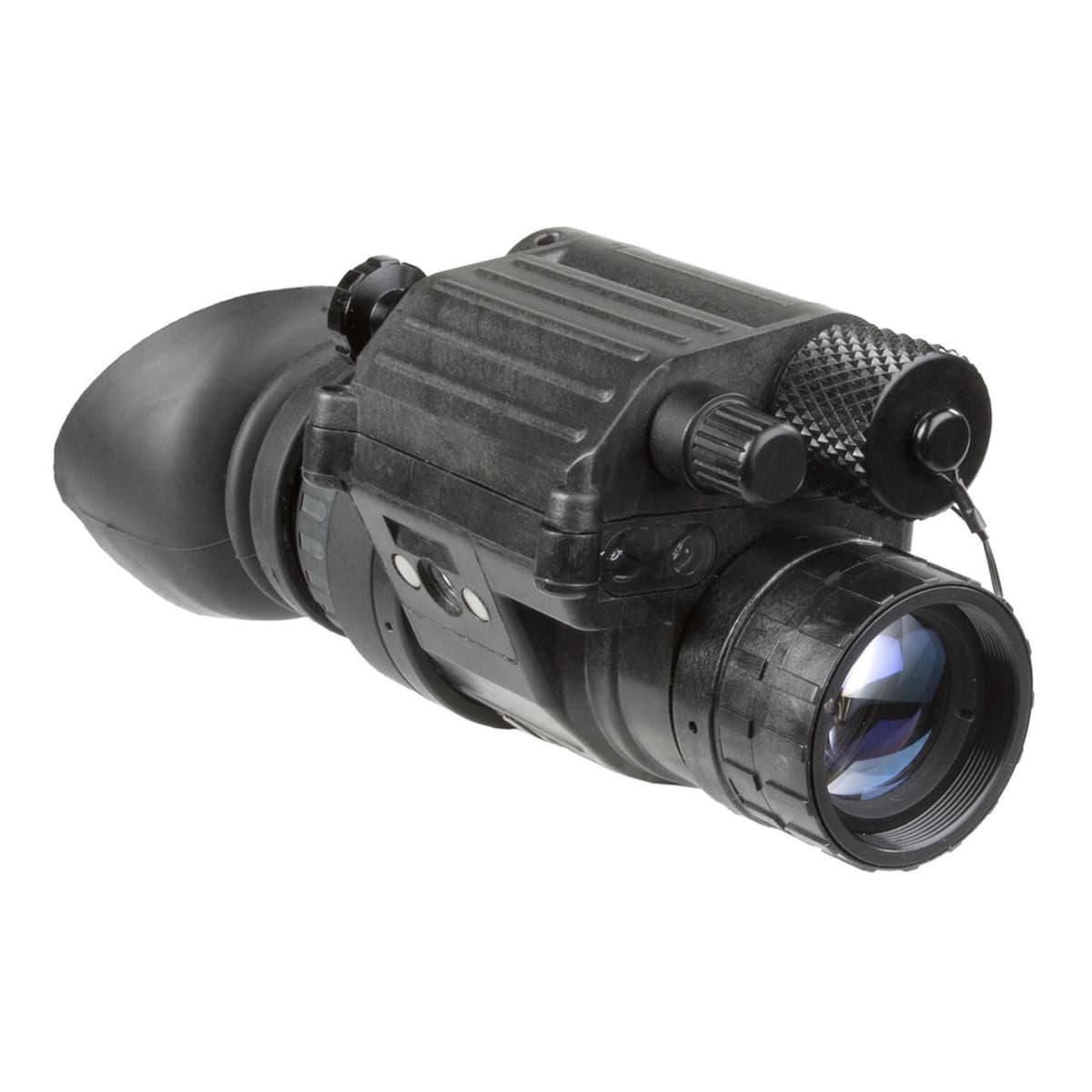
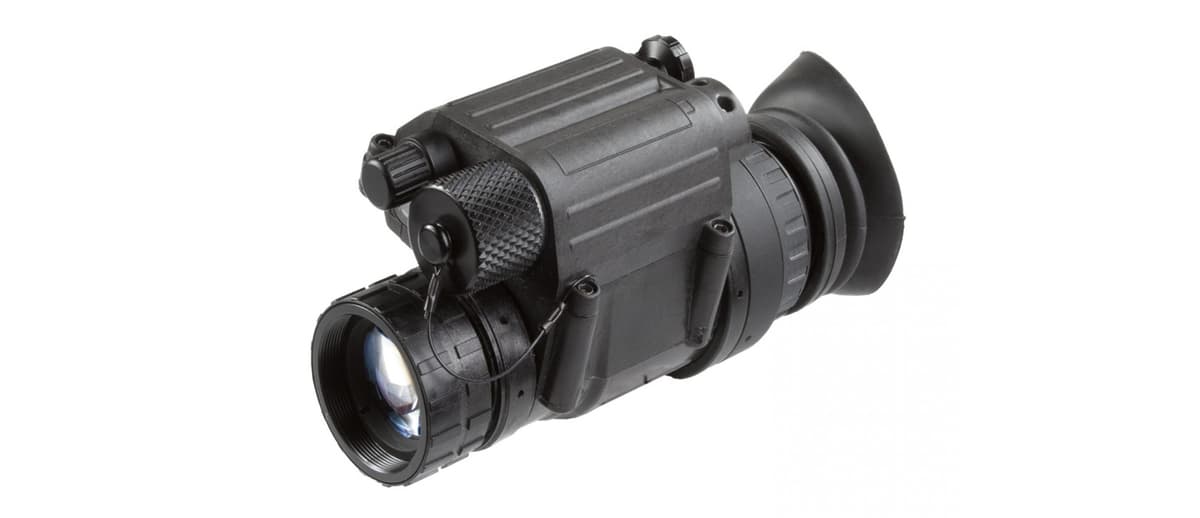
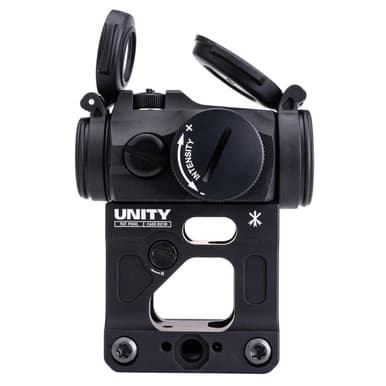
AGM PVS-14 builds in Gen 3 green, Gen 3 white and Gen 2+ green, and the Micro T-2 modeled on the bench.
Affiliate links - purchases support this site at no extra cost to you. (?)
Affiliate links (?)
An image intensifier amplifies light you cannot see well. The objective lens focuses the faint scene onto a photocathode, which turns each photon into an electron; a microchannel plate multiplies those electrons thousands of times; and a phosphor screen turns them back into visible light, which you view through an eyepiece. A PVS-14 does this at 1x magnification across a 40 degree field. Because the photocathode also responds to near-infrared light, night vision shows IR illuminators and IR lasers that are invisible to the naked eye.
No, not on its own. An image intensifier amplifies light that is already there, so it needs some moonlight, starlight or sky glow; AGM rates its PVS-14 for overcast starlight to moonlight. In total darkness, such as indoors or in a cave, you add an infrared illuminator: its near-infrared light is invisible to your eye but the tube sees it. The PVS-14's built-in IR source covers close range, up to about 3 meters, and a weapon or helmet illuminator reaches farther.
Because of the phosphor screen at the back of the tube. Electrons hit the screen and make it glow, and traditional tubes use a P43 phosphor that glows yellow-green. White phosphor tubes use a P45 phosphor that glows close to white, so the picture looks black and white. The amplification is the same; only the screen's color changes, and many users find the white picture easier to read over long periods.
Yes. With a helmet-mounted monocular like a PVS-14 in front of your eye, you look through the red dot's window with the tube and see the dot on the target, which is called passive aiming. The dot has to be on a night vision setting: at a daylight setting it is far brighter than the scene and blooms into a glowing blob that hides the target. An Aimpoint Micro T-2 has 4 night vision compatible settings below its 8 daylight settings.
Night vision amplifies light: moonlight, starlight and near-infrared light reflected off the scene, so it shows detail and texture but needs some light or an IR illuminator. Thermal imaging senses long-wave infrared that objects emit as heat, so it works in total darkness and makes warm bodies stand out, but it cannot see an IR laser or illuminator the way a tube does, and it shows heat, not the reflected detail night vision shows.
Figure of merit is a single number for tube quality: the tube's limiting resolution in line pairs per millimeter times its signal-to-noise ratio. A tube resolving 64 lp/mm with an SNR of 25 has an FOM of 1,600; one at 72 lp/mm and SNR 30 scores 2,160. Higher resolution means finer detail, and higher SNR means a cleaner, less grainy picture in low light. FOM leaves out other things that matter, such as halo size, blemishes and phosphor color.
Gen 3 is a generation of image intensifier tube with a gallium arsenide photocathode, which is more sensitive than Gen 2's multialkali photocathode, especially to near-infrared light between 800 and 900 nm. Both use a microchannel plate to multiply electrons. AGM's Gen 3 PVS-14 builds are auto-gated while its NL1 Gen 2+ build is not; Gen 3 pulls a cleaner picture out of dark nights and shows IR illuminators and lasers brighter.
It depends on where the light is. A white weapon light on the target lights it up for the tube and for everyone's naked eye: the lit area goes bright and clean, and because it fills much of the picture, the automatic brightness control turns the gain down and the rest of the scene goes dark. A light elsewhere in the field, such as a porch light or headlight, glows with a halo and lights the ground around it; a modern auto-gated tube switches itself on and off faster than you can see to hold the picture, so the rest of the scene stays usable and only the area right around the light washes out. Non-gated tubes show a bigger halo. In daylight or a lit room, a PVS-14 shuts itself off after about 70 seconds to protect the tube.
In the United States, yes: night vision devices are not NFA items, so there is no tax stamp or registration. Exports are regulated, so taking a device out of the country or selling it abroad can require a license; AGM marks its PVS-14 as not exportable outside the United States. State hunting rules on using night vision to take game vary by state, species and season.
Pick a rifle, add a red dot, an IR laser and a mount in the configurator, and check that every part fits before you buy.
Launch Configurator