Holosun ARO vs Sig Romeo 5 Gen 2 2026: Enclosed vs Open Emitter Red Dot Compared
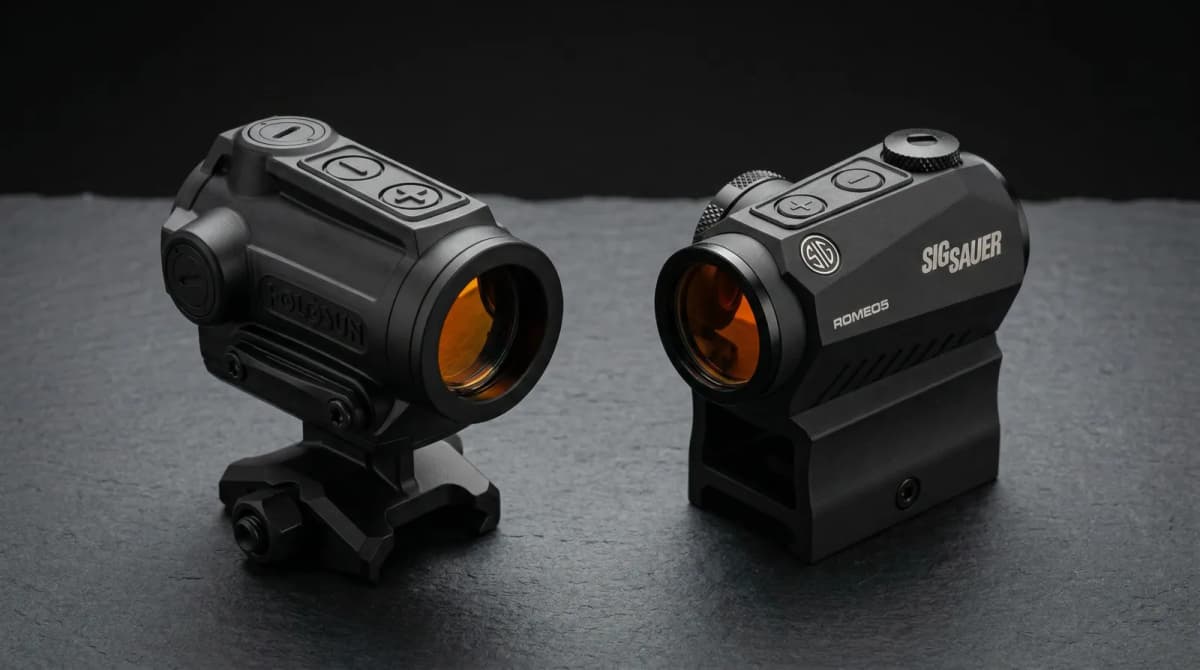
The Holosun ARO ($144) and Sig Romeo 5 Gen 2 ($152) are two of the most recommended budget red dots for AR-15 builds, and they are closer than most buyers realize. Both are enclosed-emitter micro dots with a 2 MOA reticle, motion-activated wake, and the Aimpoint Micro T1/T2 footprint, so weather reliability is a wash and the same mounts fit either one. The ARO is lighter, runs 50,000 hours per battery, and has a marginally larger 22mm optical window; the Romeo 5 Gen 2 counters with SIG's lifetime warranty and refined Gen 2 glass. This guide breaks down the real differences and names a pick for each use case.
Quick Verdict
Best overall for most buyers: The Holosun ARO ($144). It is the lighter optic at roughly 3.4 oz, runs 50,000 hours per CR2032, ships with both a lower-1/3 and a low mount, and costs a few dollars less than the Romeo 5 Gen 2. For a lightweight enclosed-emitter dot, it is the value leader.
For SIG's warranty and glass: The Sig Romeo 5 Gen 2 ($152). Its refined Gen 2 lens coatings clean up the blue tint the original Romeo 5 was known for, and SIG's Infinite Guarantee is a no-fault lifetime warranty subject to its published exclusions. The 40,000-hour runtime trails the ARO but still spans years of normal use.
If you want solar backup: Skip both and buy the Holosun ARO EVO (about $220 street, $259 MSRP). It adds Solar Failsafe and a larger 26mm window over the standard ARO, still on a single 2 MOA dot. It costs more than either optic here, but it is the move if a dead battery in storage is your top concern.
Holosun ARO vs Sig Romeo 5 Gen 2: Specs Compared
Spec Sheet
Holosun ARO
Sig Romeo 5 Gen 2
- Reticle
- 2 MOA red dot
- 2 MOA red dot
- Emitter Type
- Enclosed
- Enclosed (tube)
- Battery
- CR2032
- CR2032
- Battery Life
- 50,000 hours (advantage)
- 40,000 hours
- Motion Wake
- Yes (Shake Awake)
- Yes (MOTAC)
- Solar Failsafe
- No (ARO EVO adds this)
- No
- NV Compatible
- Yes (2 NVD settings)
- Yes (2 NVD settings)
- Brightness Settings
- 12 total
- 12 total
- Mount Pattern
- Aimpoint Micro (T1/T2)
- Aimpoint Micro (T1/T2)
- Included Mounts
- Lower-1/3 + low mount
- I-BEAM mount (low mount on select SKUs)
- Waterproof Rating
- IP67
- IPX-7
- Window / Objective
- 22mm optical window (advantage)
- 20mm objective
- Weight
- ~3.4 oz (advantage)
- 5.5 oz
- Length
- 2.7 in
- 2.7 in
- Adjustment
- 0.5 MOA/click
- 0.5 MOA/click
- Adjustment Range
- ±50 MOA
- ±50 MOA
- Material
- 7075-T6 aluminum (advantage)
- Aluminum
- Warranty
- Holosun limited lifetime
- SIG Infinite Guarantee (advantage)
- Street Price
- ~$144 (advantage)
- ~$152
Both Are Enclosed Emitters: Why Weather Reliability Is a Wash
The Holosun ARO and Sig Romeo 5 Gen 2 are both enclosed-emitter red dots, so neither has the exposed-LED vulnerability that defines open-emitter pistol sights. The ARO uses a purpose-built enclosed housing. The Romeo 5 Gen 2 is a sealed tube sight in the Aimpoint Micro form factor, with glass at the front and rear and the emitter protected inside, which SIG describes as an enclosed aiming solution.
This matters because the failure mode buyers worry about, rain, snow, mud splash, pocket lint, or storage dust landing directly on the LED and blacking out the dot, applies to open-emitter optics like the Trijicon RMR or SIG Romeo Zero. It does not apply to either optic in this comparison. On both the ARO and the Romeo 5 Gen 2, the front lens can still pick up rain or dirt, but front-lens grime degrades the image gradually rather than killing the dot outright.
The practical takeaway: durability and weather resistance are close to a tie. The ARO carries an IP67 rating (dust-proof, submersible to 1 meter) and the Romeo 5 Gen 2 carries an IPX-7 rating (submersible to 1 meter for 30 minutes). For home defense and field use, both seal out the elements. Choose between them on the factors that actually differ: weight, battery life, window size, glass, and warranty.
Bottom Line
Both optics are weatherproof enclosed-emitter dots. Neither has an exposed LED. The decision comes down to the ARO's lighter weight and longer battery versus the Romeo 5 Gen 2's larger window and SIG's lifetime warranty.
Optical Quality: Glass Clarity and Dot Crispness
Both the ARO and Romeo 5 Gen 2 project a 2 MOA red dot, the standard for speed-focused micro red dots. At this price tier, neither optic matches the glass clarity of an Aimpoint T2 ($900+), but both are excellent for their respective price points.
The Romeo 5 Gen 2 improved significantly over the Gen 1. The blue tint that was the original Romeo 5's main criticism has been reduced through updated lens coatings. The Gen 2 glass approaches the clarity of optics costing 2-3x more. That said, a slight blue tint remains visible at certain angles and brightness settings.
The ARO's glass is clean with minimal tint, though some users report a faint blue tint at higher brightness settings. Its 22mm optical window is marginally larger than the Romeo 5 Gen 2's 20mm objective, so the ARO actually gives the slightly more forgiving sight picture during fast target transitions. With both eyes open the gap is small, and neither optic feels cramped. Where the Romeo 5 Gen 2 holds its own is the refined Gen 2 lens coating, which renders a clean image that competes with the ARO despite the smaller window.
Dot quality on both optics is crisp at lower-to-mid brightness settings. At maximum brightness, both show some dot bloom (the dot appears slightly larger and less defined), which is normal for LED red dots in this price range.
Durability and Construction
The ARO is built from 7075-T6 aluminum, the same alloy used in AR-15 upper receivers and Aimpoint housings. It carries an IP67 rating: fully dust-proof and submersible in 1 meter of water for 30 minutes. The operating temperature range spans -40C to 70C.
The Romeo 5 Gen 2 uses an aluminum alloy housing (Sig does not specify the grade) with an improved IPX-7 rating over the Gen 1: submersible in 1 meter for 30 minutes. The Gen 2 upgraded the gasket placement for better seal reliability. Operating temperature range is -40F to 140F (-40C to 60C).
Both optics handle the recoil of 5.56 NATO without issue. Neither is rated for shotgun or magnum recoil (for that, look at the best shotgun red dots). The ARO's 7075-T6 construction gives it a structural edge in drop testing and hard use, though the Romeo 5 Gen 1 already earned a reputation for surviving abuse well above its price point.
The Romeo 5 Gen 2 has the advantage of years of field data from the Gen 1 platform. Thousands of shooters have put 10,000+ rounds behind original Romeo 5 optics with no failures. The ARO, released in 2024, has a shorter track record, though Holosun's quality across their product line provides reasonable confidence.
Get Enclosed Emitter and Budget Optic Comparisons
New ARO, Romeo 5, and budget red dot comparisons delivered to your inbox.
Battery Life and Electronics
Battery life favors the ARO on paper: 50,000 hours on a CR2032 versus 40,000 hours for the Romeo 5 Gen 2. Both use the most common battery in the optics industry, available at any convenience store or gas station.
Both feature motion-activated power management. The ARO uses Holosun's Shake Awake, which powers down after 10 minutes of inactivity and reactivates instantly on motion. The Romeo 5 Gen 2 uses SIG's MOTAC (Motion Activated Illumination), which does the same with improved wake times in the Gen 2. Both systems last setting recall restores your preferred brightness when the optic wakes.
One caveat: MOTAC and Shake Awake can activate during vehicle transport or if the rifle is stored in a location with vibration. This is not a significant battery drain with either optic, but if you store the rifle in a vehicle for extended periods, consider turning the optic off manually.
Both optics offer 12 brightness settings: 10 daylight levels and 2 night vision compatible levels. For shooters running night vision setups, both optics provide usable NVD modes, though neither is marketed as a primary NVG optic.
Mounting Options and Compatibility
Both optics use the Aimpoint Micro T1/T2 footprint, the most widely supported mount standard in the red dot market, so any mount designed for the Aimpoint T1/T2 fits either one: Scalarworks LEAP/Micro, Unity Tactical FAST, Reptilia DOT, LaRue LT660, and dozens more. The Romeo 5 Gen 2 uses the Aimpoint Micro footprint; SIG's I-BEAM mount is its included Picatinny base, not a separate optic-to-mount standard, so the same aftermarket micro mounts work on both sights.
Both optics ship ready to mount with no extra purchase required. The ARO includes a 1.63-inch lower-1/3 co-witness mount and a 1.05-inch low mount in the box, covering the two heights most AR-15 shooters run. The Romeo 5 Gen 2 includes SIG's I-BEAM Picatinny mount, and select SKUs add a low mount; the I-BEAM mount delivers lower-1/3 co-witness over standard AR-15 iron sights.
One nuance when swapping a Romeo 5 Gen 2 onto an aftermarket T1 mount: the Romeo 5 body sits slightly taller than a bare Aimpoint T1/T2, so the absolute co-witness height a given mount produces can land a hair different than the spec stamped on the mount. The bolt pattern is identical, so the mount still bolts up; just confirm your co-witness after install. The included mounts on both optics are functional but basic, and a quality QD mount like the Scalarworks LEAP/Micro ($149) or Reptilia DOT ($99) adds repeatable return-to-zero and a faster optic swap on either sight.
For optic mounting details including co-witness heights and torque specs, see our mounting guide. Both optics zero with 0.5 MOA per-click windage and elevation adjustments.
Price and Value Analysis
These two optics sit within a few dollars of each other: the Holosun ARO runs about $144 and the Sig Romeo 5 Gen 2 about $152. Price is not the deciding factor, and the ARO being marginally cheaper despite carrying the longer battery and lighter housing is a quiet point in its favor. Both land near the top of every budget optic list for delivering enclosed-emitter protection on the Aimpoint Micro footprint under $160.
For roughly the same money you get two genuinely different optics. The ARO is the lighter, longer-running choice with the larger window: about 3.4 oz, 50,000 hours per battery, a 22mm optical window, and both mounts in the box. The Romeo 5 Gen 2 trades 2 oz of extra weight, 10,000 fewer battery hours, and a slightly smaller 20mm objective for SIG's Infinite Guarantee, a no-fault lifetime warranty subject to its published exclusions, plus its refined Gen 2 glass. For a full breakdown of how Holosun's enclosed lineup scales up from here, see our Holosun 510C alternatives comparison.
Because neither optic forces a meaningful budget tradeoff, the money you would have spent agonizing over the choice is better put toward the rest of a first $500 of upgrades. A Streamlight HLX weapon light ($120) and a Blue Force Gear Vickers sling ($65) do more for a defensive rifle than any difference between these two dots.
Value Verdict
At about $144, the Holosun ARO is the slightly better value: lighter, longer battery, a larger 22mm window, two mounts included, and a few dollars cheaper. The Romeo 5 Gen 2 ($152) earns its near-identical price through SIG's lifetime warranty and its refined Gen 2 glass. There is no wrong answer here, only a preference.
Which Red Dot for Which Use Case?
Lightweight Build
Holosun ARO
At about 3.4 oz, the ARO is roughly 2 oz lighter than the Romeo 5 Gen 2. On a lightweight or PDW-style carbine where every ounce up top matters, it is the clear pick.
Fast Transitions
Holosun ARO
The ARO's 22mm optical window is marginally larger than the Romeo 5's 20mm objective, so it gives the slightly more forgiving sight picture during rapid target-to-target work with both eyes open.
Home Defense / Field Use
Either
Both seal the emitter, so rain, dust, and storage lint cannot black out the dot. The ARO's longer 50,000-hour battery is a slight edge for a rifle that sits ready for months between range trips.
Warranty Peace of Mind
Sig Romeo 5 Gen 2
SIG's Infinite Guarantee is a no-fault lifetime warranty with no proof of purchase required. If you want the strongest warranty backing your sub-$160 optic, it is the Romeo 5.
Build your complete rifle with our rifle builder to see how each optic fits your build with compatibility checks and total pricing.
Red Dot Picker: ARO vs Romeo 5 Gen 2
Answer three questions. Get a recommendation.
Rankings: Holosun ARO vs Sig Romeo 5 Gen 2
Two enclosed-emitter micros at nearly the same price. Ranked by overall capability and value.
Red Dot Rankings
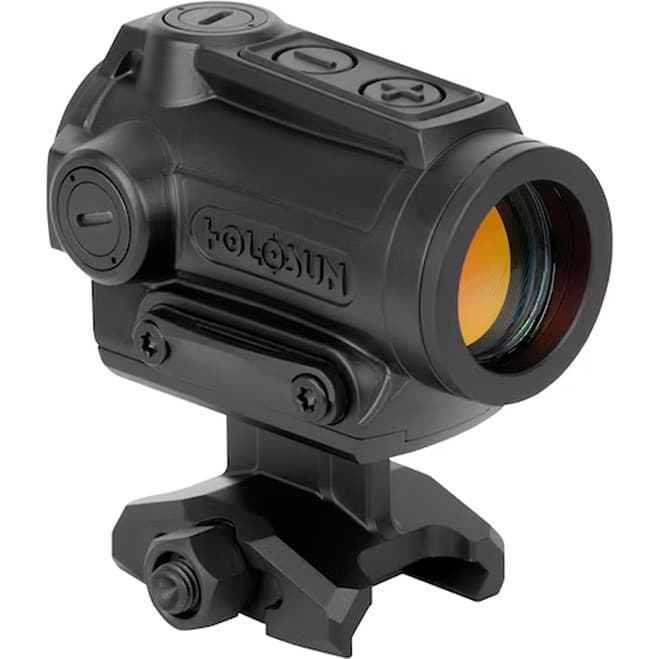
Holosun ARO
Best overall: lightest, longest battery, larger window, both mounts included
- +Lightest of the two at roughly 3.4 oz
- +50,000 hour battery life with Shake Awake
- +22mm optical window edges out the Romeo 5's 20mm objective
- −Single 2 MOA reticle, no multi-reticle option
- −No solar failsafe (ARO EVO adds this)
- −Shorter SIG-style warranty record than Sig Sauer
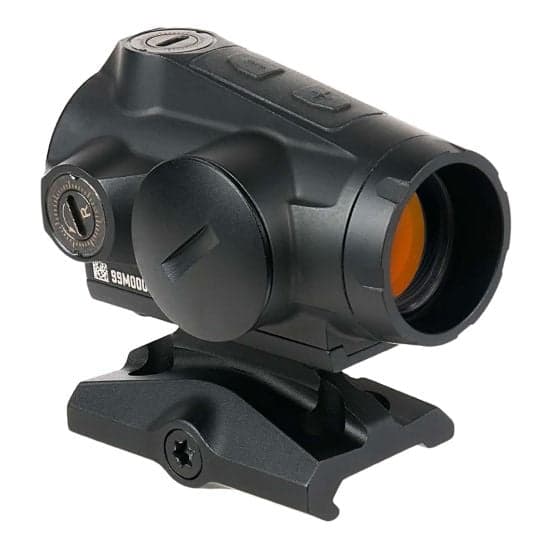
Sig Sauer Romeo 5 Gen 2
Best for SIG's lifetime warranty and refined Gen 2 glass
- +SIG Infinite Guarantee no-fault lifetime warranty
- +Improved Gen 2 glass clarity with reduced blue tint
- +Enclosed tube housing seals the emitter against weather
- −Heavier than the ARO at 5.5 oz
- −40,000 hour battery trails the ARO's 50,000
- −Slight blue tint remains (reduced from Gen 1)
Affiliate links - purchases support this site at no extra cost to you. (?)
Related Guides
- Best AR-15 Red Dots 2026 covers the full red dot market from Aimpoint to Holosun to EOTech.
- Best Holosun Optics 2026 ranks the entire Holosun lineup including the AEMS, 509T, and ARO EVO.
- Best Budget AR-15 Optics Under $200 compares the Romeo 5 Gen 2 against other sub-$200 options.
- Best Enclosed-Emitter Pistol Red Dots 2026 applies the same closed-emitter logic to carry pistols, ranking the EPS Carry, ACRO P-2, 509T X2, and RCR.
- Extar EP9 Upgrades & Accessories Guide covers optics, triggers, and accessories for the ultralight 9mm PCC that runs both the ARO and Romeo5.
Frequently Asked Questions
▶Is the Holosun ARO better than the Sig Romeo 5 Gen 2?
▶Is the Sig Romeo 5 Gen 2 an open or enclosed emitter?
▶Does the Holosun ARO or Sig Romeo 5 Gen 2 have solar backup?
▶Do the ARO and Romeo 5 Gen 2 use the same mounts?
▶Which red dot is better for a first AR-15 build, ARO or Romeo 5?
▶Is the Sig Romeo 5 Gen 2 good enough for home defense?
▶What battery life do the Holosun ARO and Sig Romeo 5 Gen 2 have?
Get Red Dot Deals and Reviews
We track prices on Holosun, Sig Sauer, and every optic in our catalog. Subscribe for price drops, new reviews, and build guides.
The Verdict
Best overall for most buyers: the Holosun ARO.