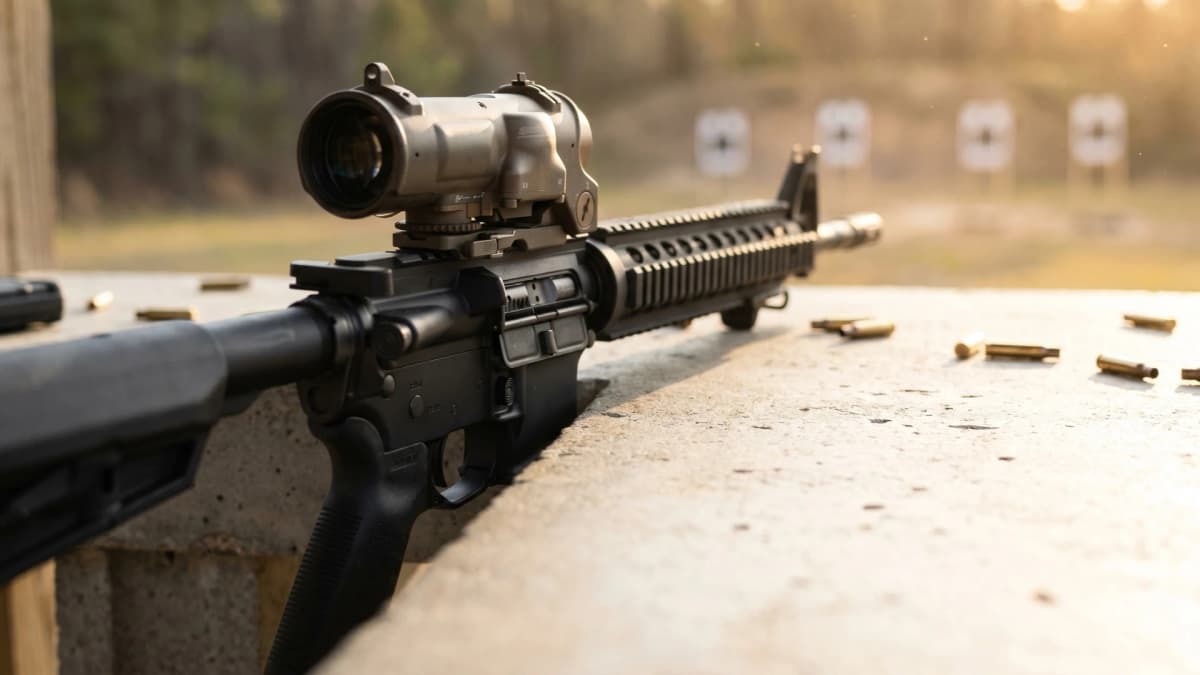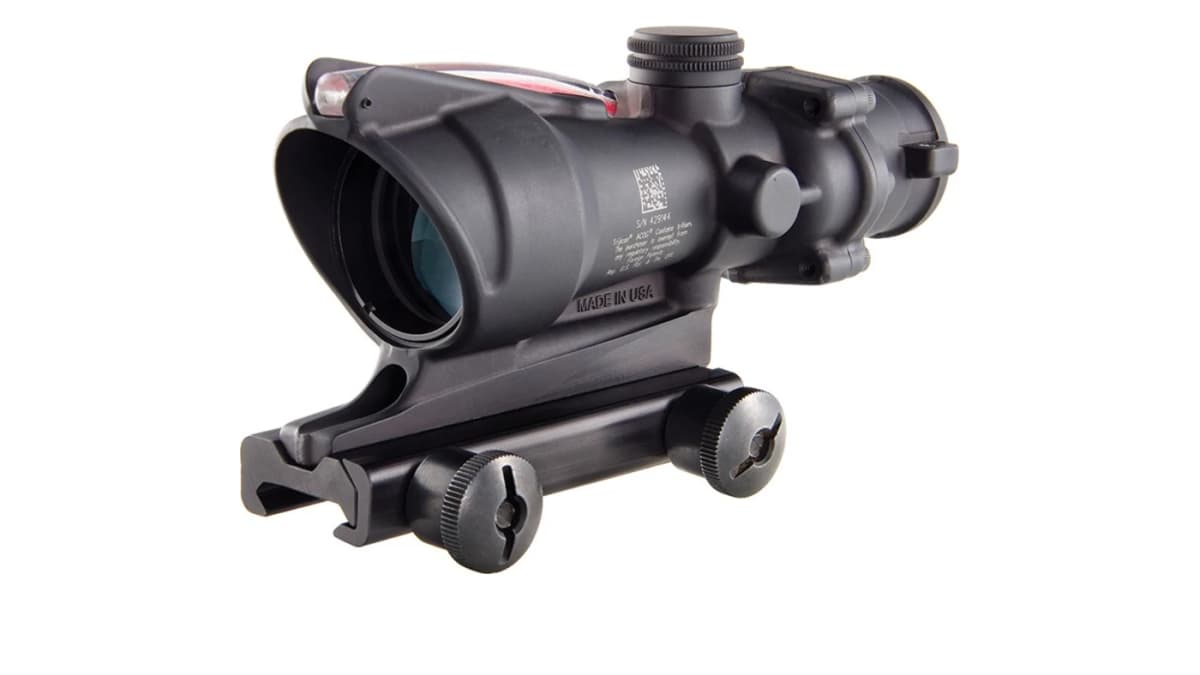
Key Takeaways
- →Announced October 14, 2026: Trijicon added MRAD reticles to the ACOG line in 4x32 and 3.5x35 bodies, each in a dual-illuminated and an LED version.
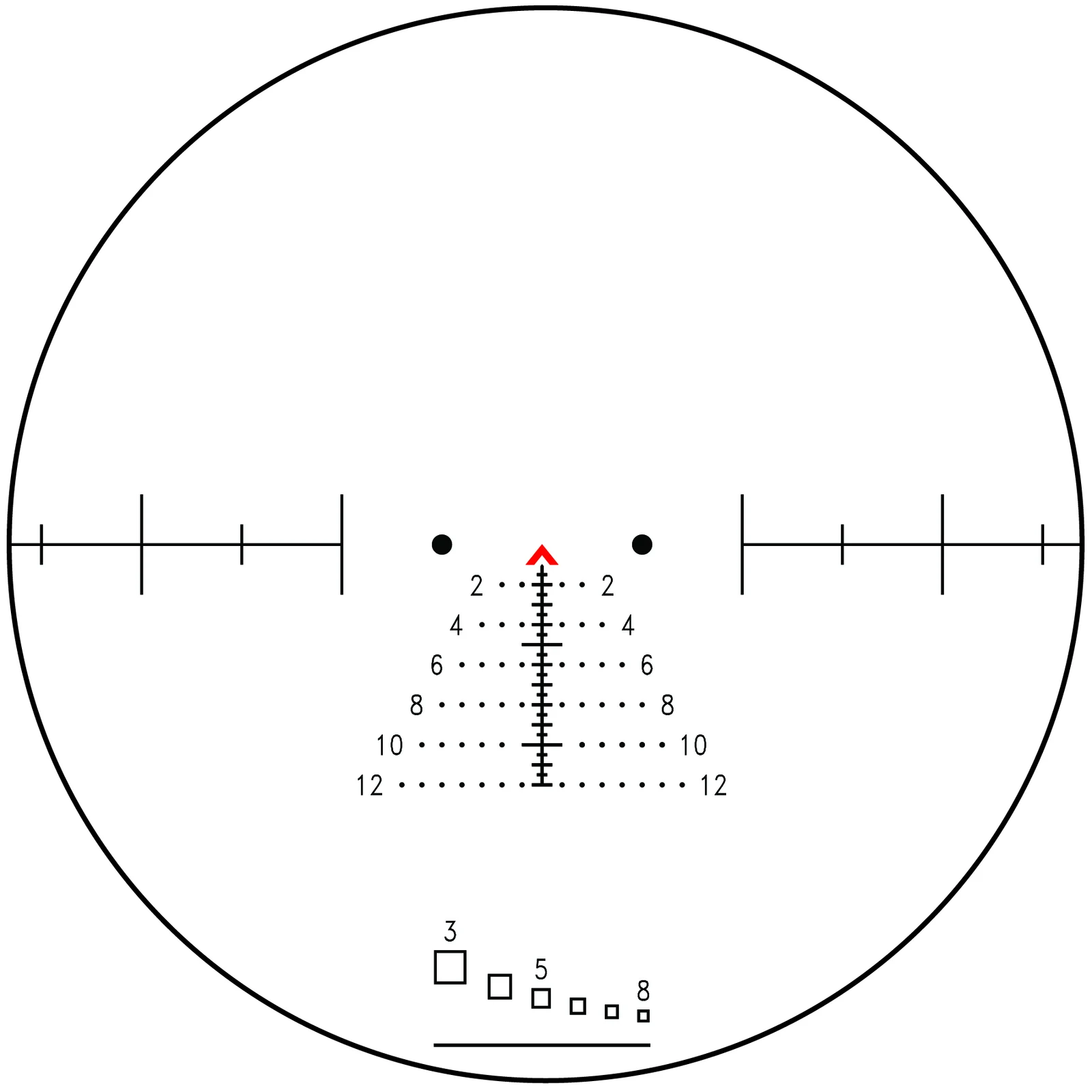
- →No caliber-specific BDC: the red MRAD chevron tree uses consistent mil subtensions, so you set holds from your own rifle and ammunition instead of a single calibrated load.
- →Four SKUs: TA31-C-100832 and TA02-C-100833 (4x32, 1.5 in eye relief) and TA11-C-100806 and TA110-C-100807 (3.5x35, about 2.4 in eye relief).
- →Illumination: fiber optic and tritium on the TA31 and TA11 with no battery; six-setting LED on one AA cell rated over 12,000 hours on setting 4 for the TA02 and TA110.
- →Price: the 4x32 dual-illuminated TA31-C-100832 runs $1,219; the LED 3.5x35 TA110-C-100807 is the most expensive at $1,359.
Trijicon ACOG TA31 4x32 MRAD
Battery-free 4x32 ACOG with mil-based holds for carbines that do not match a 5.56 BDC
Battery-free 4x32 ACOG with a red MRAD chevron tree reticle instead of a caliber-specific BDC
- +Mil holds work with any load once you record your own drops
- +No battery to fail or replace
- +Lightest and most compact of the four MRAD ACOGs
- −Short 1.5 inch eye relief demands consistent head position
- −You must build your own hold data; there are no printed ranges
- −Fiber optic can wash out or bloom against bright backgrounds
Affiliate links (?)
What Trijicon Changed: MRAD Instead of a BDC
The ACOG MRAD replaces the cartridge-specific bullet drop compensator with a red MRAD chevron tree reticle. Trijicon says the reticle is "not tied to a single cartridge or predetermined trajectory," and that its consistent MRAD subtensions let users set their own elevation and wind holds for their firearm and ammunition. The housings, illumination systems, and TA51 mount carry over from the existing ACOG models.
A traditional ACOG BDC is calibrated for one load and barrel. The TA31-D-100288, for example, is set up for M193 55 grain 5.56 from a 16 inch barrel, zeroed with the chevron tip at 100 meters, with holds out to 800 meters. That works well when your rifle matches the calibration. When it does not, from a short barrel, a heavier bullet, a suppressor, or a different cartridge, the printed range marks drift away from where the rounds actually land. The MRAD tree removes that mismatch: you zero the chevron, confirm where your load hits at distance, and assign those holds to mil marks.
Trijicon says the line came out of its Voice of Customer process, from users who wanted one aiming method across different firearms, calibers, and ammunition. For a broader look at where the ACOG sits among the company's optics, see our best Trijicon optics guide.
Who the ACOG MRAD Is For
The MRAD ACOG is for shooters whose rifle and ammunition do not match a factory BDC. Trijicon names three cases: switching between supersonic and subsonic ammunition, suppressed platforms, and intermediate-caliber carbines beyond the standard 5.56 setup.
300 Blackout is the clearest fit. Supersonic and subsonic loads leave the barrel at very different velocities, so their drops diverge quickly. Our 300 Blackout ballistics guide covers those trajectories. Trijicon already sells a 300 BLK BDC ACOG, the TA31-C-100413, whose merged aiming points cover supersonic loads to 600 yards and subsonic to 200 yards with 2 MOA diamonds. The MRAD tree is the alternative for shooters who would rather record exact holds for their own loads than accept an averaged reticle.
Shooters who already work in mils also benefit. A ballistic app or a drop chart that outputs corrections in MRAD maps directly onto the reticle, and the same method carries over to any mil-based LPVO or rifle scope in the safe. Confirm each hold on paper at known distances before relying on it: the mil scale is consistent, but where your load lands on it depends on your rifle and ammunition.
4x32 vs 3.5x35: Which ACOG MRAD Body to Pick
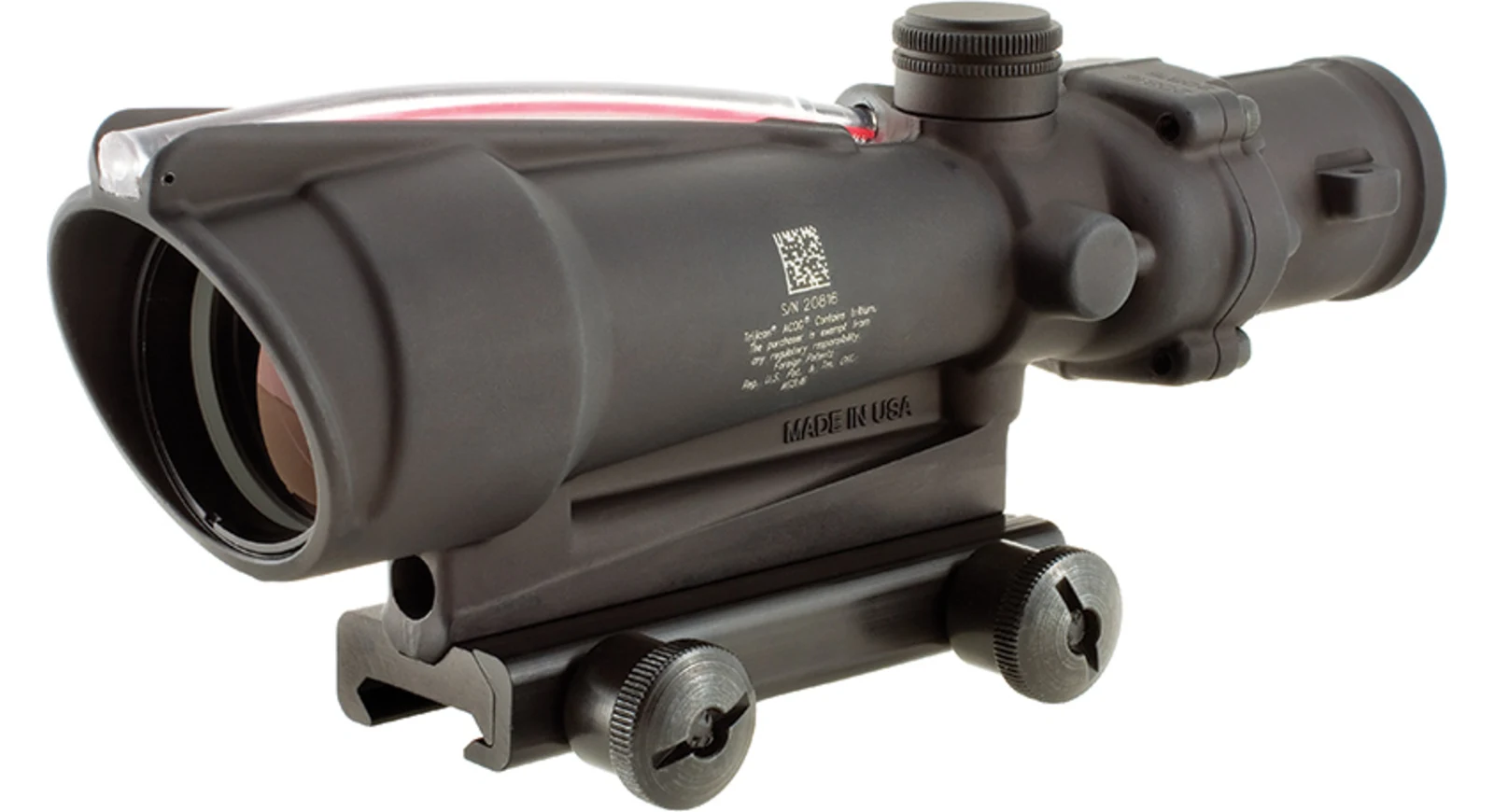
Pick the 4x32 for the smallest, lightest package and the widest view; pick the 3.5x35 for eye relief. The 4x32 MRAD models are 5.98 inches long with 1.5 inches of eye relief and a 7 degree field of view (36.8 feet at 100 yards). The 3.5x35 models are 8 inches long with about 2.4 inches of eye relief, a larger 9.91 mm exit pupil, and a 5.5 degree field of view (28.9 feet at 100 yards).
The 4x32's 1.5 inch eye relief is its main ergonomic cost: it rewards a consistent cheek weld and punishes awkward positions. The 3.5x35 gives up half a power and adds weight, from 17.6 ounces on the TA11-C-100806 to 20.8 ounces on the TA110-C-100807, but the extra 0.9 inch of eye relief gives more room for head position from barricades, prone, or under a helmet. Compare both against other fixed-power options in our prism scope guide.
Dual-Illuminated vs LED: Battery-Free or Adjustable
Choose dual illumination for zero batteries; choose LED for brightness control. The TA31-C-100832 and TA11-C-100806 light the chevron with fiber optics in daylight and tritium in the dark, with nothing to switch on. The TA02-C-100833 and TA110-C-100807 use an LED with six user-selected brightness settings, powered by one AA lithium or alkaline battery that Trijicon rates at over 12,000 hours on setting 4.
The tradeoff with fiber optics is that the reticle brightness follows the light on the fiber, not the light on the target. A shooter in shade looking into a bright field, or the reverse, can see the chevron wash out or bloom. The LED fixes that at the cost of a battery and extra weight: 2.6 ounces on the 4x32 (17.5 vs 14.9 ounces) and 3.2 ounces on the 3.5x35 (20.8 vs 17.6 ounces).
Shop the Trijicon ACOG MRAD Models
Affiliate links (?)
Trijicon ACOG MRAD Specifications
All figures below come from Trijicon's product pages for each SKU. Every model uses a red chevron tree reticle, red day and night reticle color, and a forged aluminum housing in matte black.
| Spec | 4x32 dual | 4x32 LED | 3.5x35 dual | 3.5x35 LED |
|---|---|---|---|---|
| SKU | TA31-C-100832 | TA02-C-100833 | TA11-C-100806 | TA110-C-100807 |
| Magnification | 4x32 | 4x32 | 3.5x35 | 3.5x35 |
| Illumination | Fiber optic + tritium | LED, 6 settings, AA | Fiber optic + tritium | LED, 6 settings, AA |
| Eye relief | 1.5 in | 1.5 in | 2.39 in | 2.4 in |
| Field of view | 36.8 ft @ 100 yd (7°) | 36.8 ft @ 100 yd (7°) | 28.9 ft @ 100 yd (5.5°) | 28.9 ft @ 100 yd (5.5°) |
| Exit pupil | 8.13 mm | 8.13 mm | 9.91 mm | 9.91 mm |
| Length x width x height | 5.98 x 2 x 2.3 in | 5.98 x 2 x 2.3 in | 8 x 2.1 x 2.9 in | 8 x 3 x 2.6 in |
| Weight | 14.9 oz | 17.5 oz | 17.6 oz | 20.8 oz |
| Mount | TA51 thumbscrew | TA51 thumbscrew | TA51 thumbscrew | TA51 thumbscrew |
Trijicon lists submersion to 66 feet (20 m) for both 4x32 MRAD models.
ACOG MRAD vs the Standard TA31 BDC
Buy the standard TA31 BDC if you run a 5.56 carbine with ammunition close to its calibration and want range-labeled holds with no data work. Buy the MRAD if you run anything else, change loads, or already think in mils. On the 4x32 versions the housing dimensions, eye relief, field of view, and TA51 mount match; the reticle is the difference.
The BDC's advantage is speed for a matched rifle: each hold corresponds to a set distance, and on the TA31-D-100288 the 5.5 MOA chevron base spans 19 inches at 300 meters for quick range estimation. The MRAD tree's advantage is honesty across setups: a mil is a mil on any rifle, so a suppressor change, a new barrel length, or a switch between supersonic and subsonic loads means updating a hold card instead of buying a different optic. LPVO search interest passed the ACOG in December 2020, as our optic search trend study shows, and mil reticles are common on current LPVOs. The MRAD ACOG lets a shooter keep that hold method on a fixed-power optic. To see either ACOG on a complete rifle, add it in the rifle builder.

Trijicon ACOG TA31
5.56 carbines that match the factory BDC calibration and want range-labeled holds
Fixed 4x combat optic with illuminated BDC reticle
- +Battle-proven reliability - decades of combat service
- +Battery-free dual-illumination system always works
- +Nearly indestructible forged aluminum construction
- −Fixed 4x magnification - no variable option
- −Limited 1.5 inch eye relief can be challenging
- −Premium price ($1,698-1,843 depending on model)
Affiliate links (?)
Stay Updated on New Optics
New optic launches, reticle changes, and verified deals on scopes and red dots, delivered weekly.