Streamlight ProTac HL-X
- ✓1,000 lumens
- ✓50,000 candela

Forged, billet, complete, ambi, polymer, matched set. Nine AR-15 lower receivers ranked by buyer use case, with FFL realities, M16-pocket SBR notes, and the trigger compatibility gotchas no one warns you about.
Affiliate links (?)
The AR-15 lower receiver is the only serialized part of the rifle and the one piece that legally requires an FFL transfer. Everything else, the upper, the barrel, the trigger, ships to your door. So the lower decision is two questions stacked: which forging or billet plate has the features you want, and which vendor will run the transfer cleanly. We ranked nine lowers for 2026 across stripped, complete, ambi, polymer, and matched-set use cases, with the FFL realities and the pocket-shelf notes that matter for Super Safety / FRT compatibility.
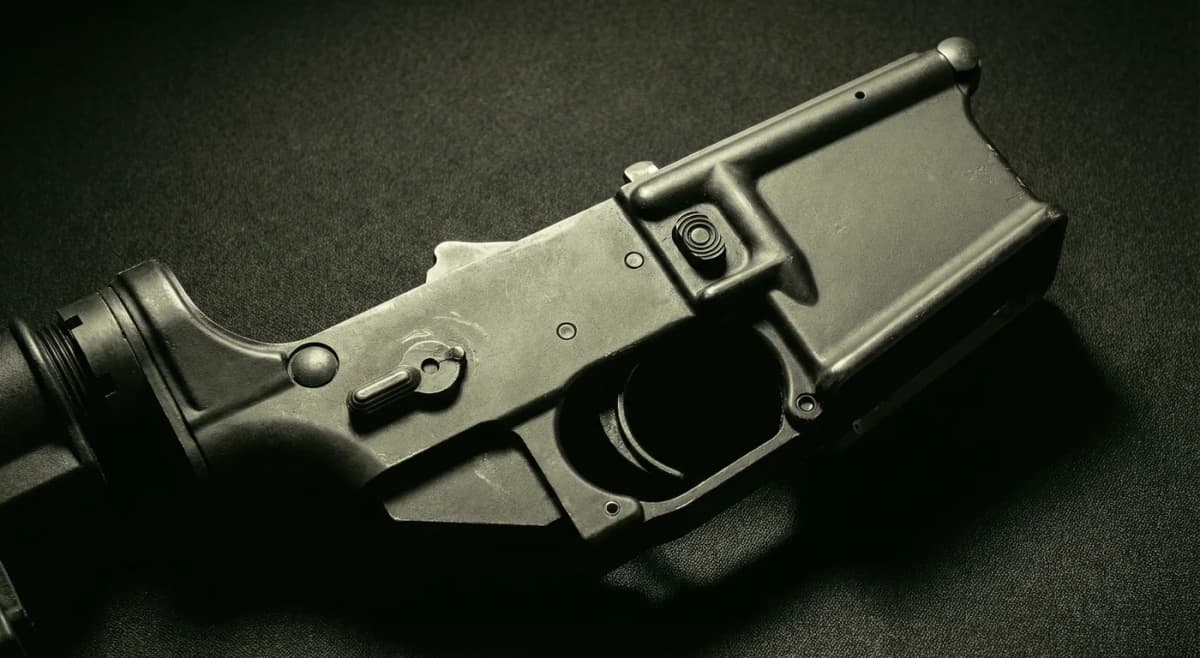
The AR-15 lower receiver is the chassis that holds the fire control group, the magazine well, the buffer tube interface, and the pivot/takedown pins that mate to the upper. It is the part the federal government considers the firearm under the GCA. Every other part in an AR build is just an accessory until you have a serialized lower.
Functionally, every mil-spec AR-15 lower does the same job. The differences between a $50 PSA Stealth and a $370 ADM UIC are ergonomics, manufacturing precision, ambi controls, magwell flare, and trigger guard geometry. None of those changes accuracy in any measurable way. They change the build experience, the parts compatibility ceiling, and the upgrade path.
Three buying paths: stripped lower (you assemble), complete lower (LPK + stock + buffer pre-installed, drop on an upper), or matched receiver set (upper and lower from the same anodizing batch). The right path depends on whether you own pivot pin and bolt catch tools and whether you want to pick your own trigger. See the first AR build guide for the full assembly process.
Sling, light, backup sights, and QD mounts, the upgrades most builders add first.
Affiliate links (?)
Nine lowers across the realistic buyer paths. The rank order is tuned for the volume buyer (forged enhanced lower for a first build), then expands into budget, complete, duty, SBR, ambi, billet, matched-set, and polymer use cases. Click any card to buy.
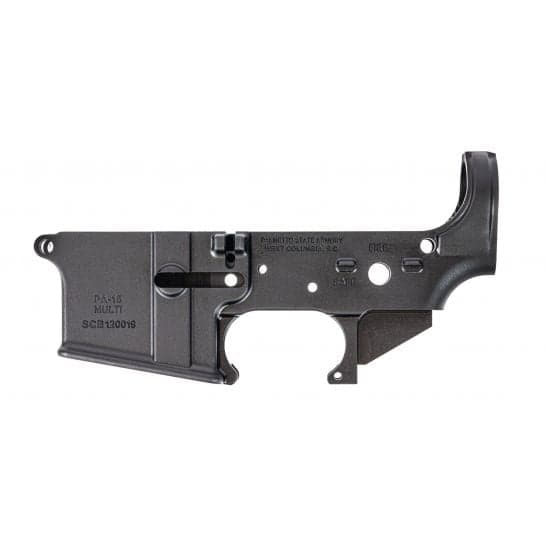
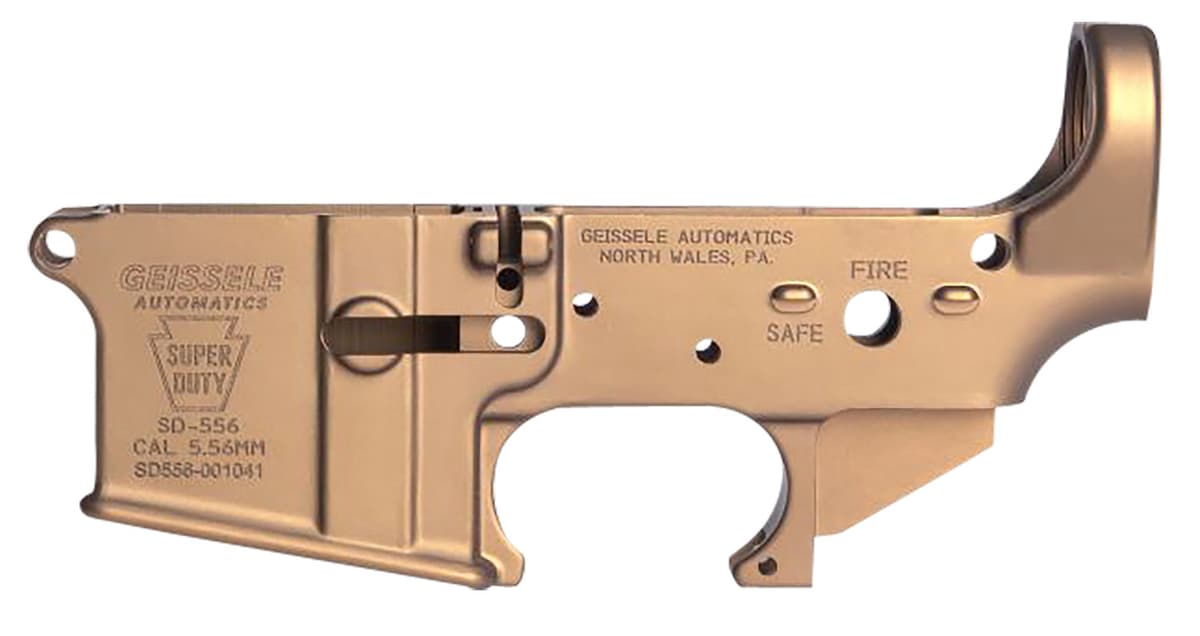
Best overall stripped lower / best first AR build
Best budget stripped / cleanest blank canvas for engraved builds
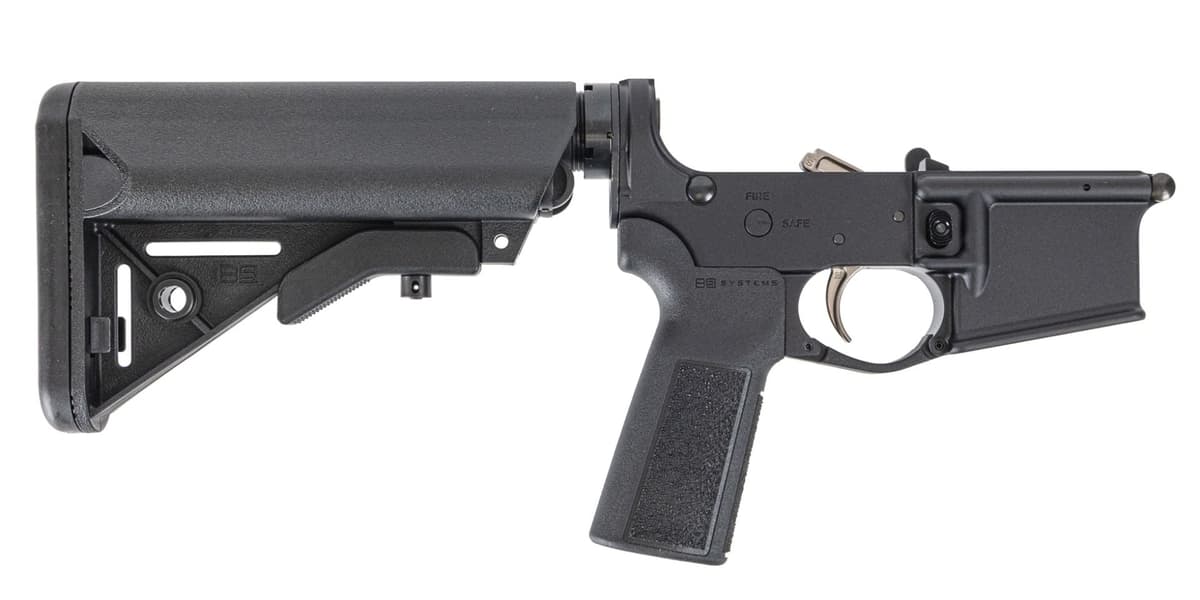
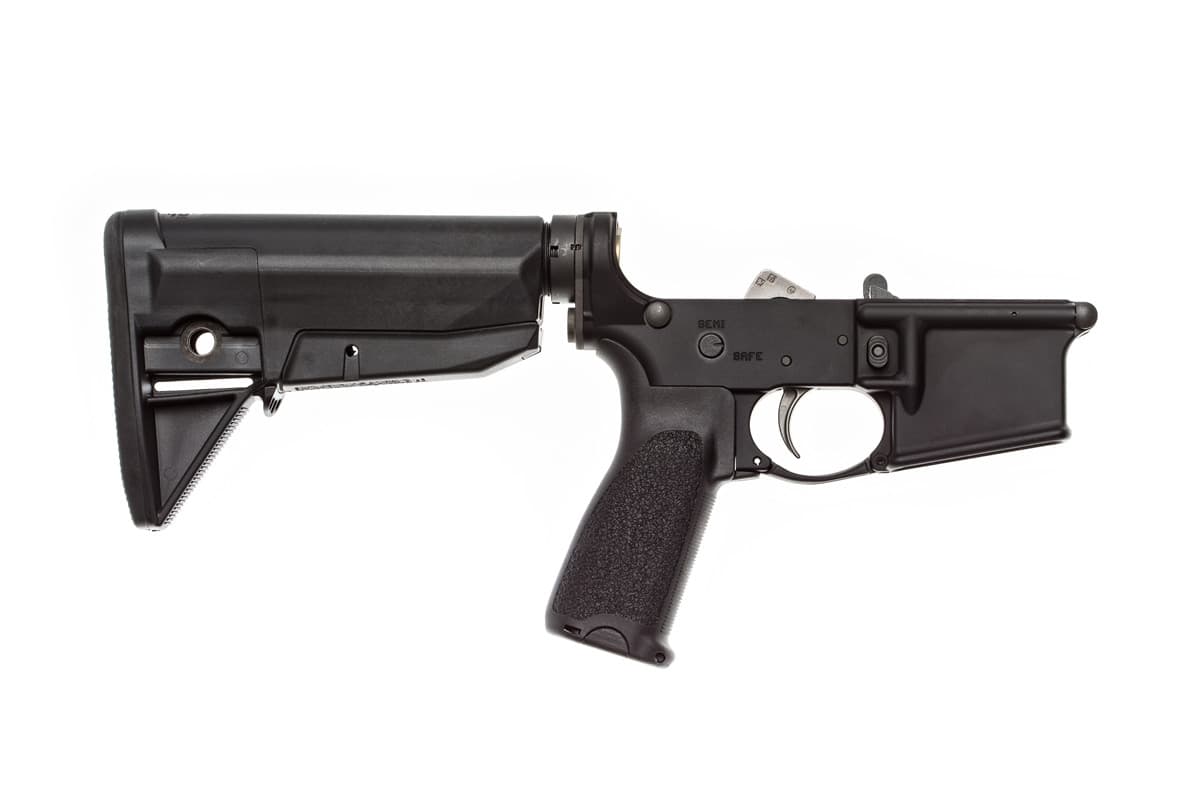
Best complete drop-in lower / cheapest plug-and-play option
Best duty-grade complete lower / BCM parts pedigree
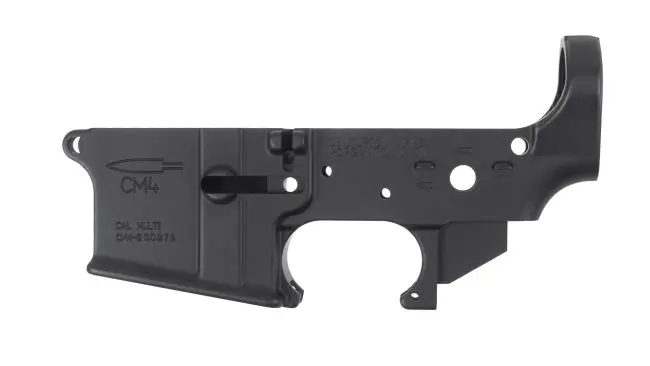
Best forged duty lower with M16 pocket / hand-deburred premium fit
Best value ambidextrous lower / cheapest true-ambi option
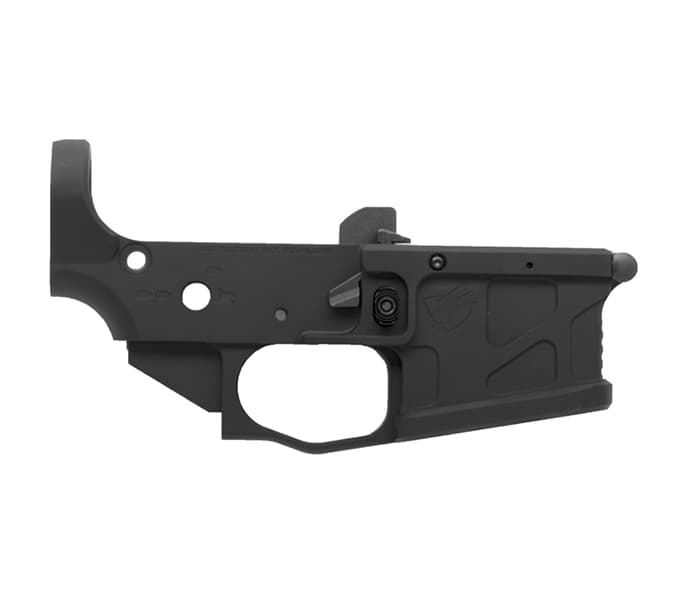
Best premium billet ambi / competition-grade upgrade
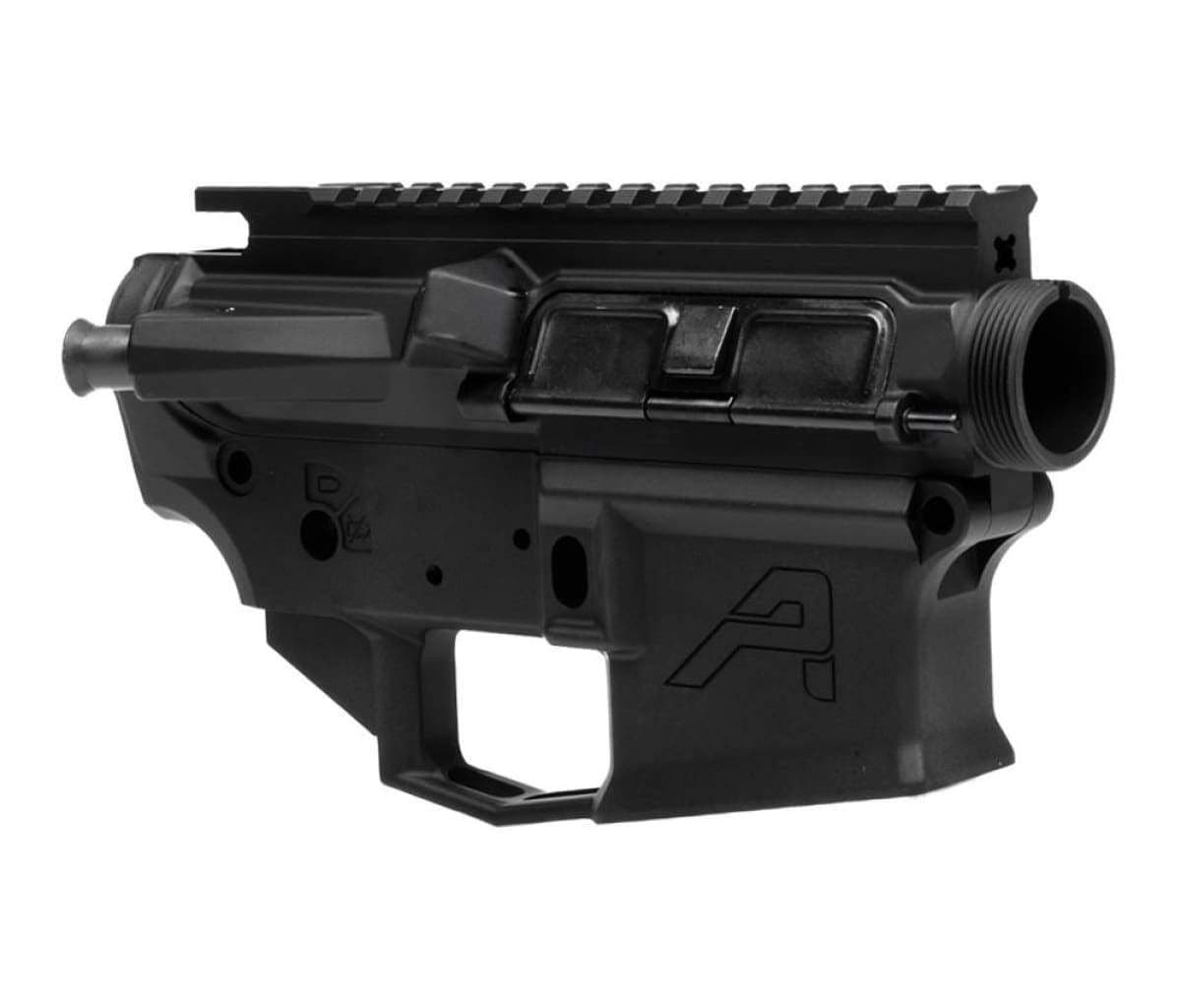
Best matched receiver set / when upper-lower color match matters
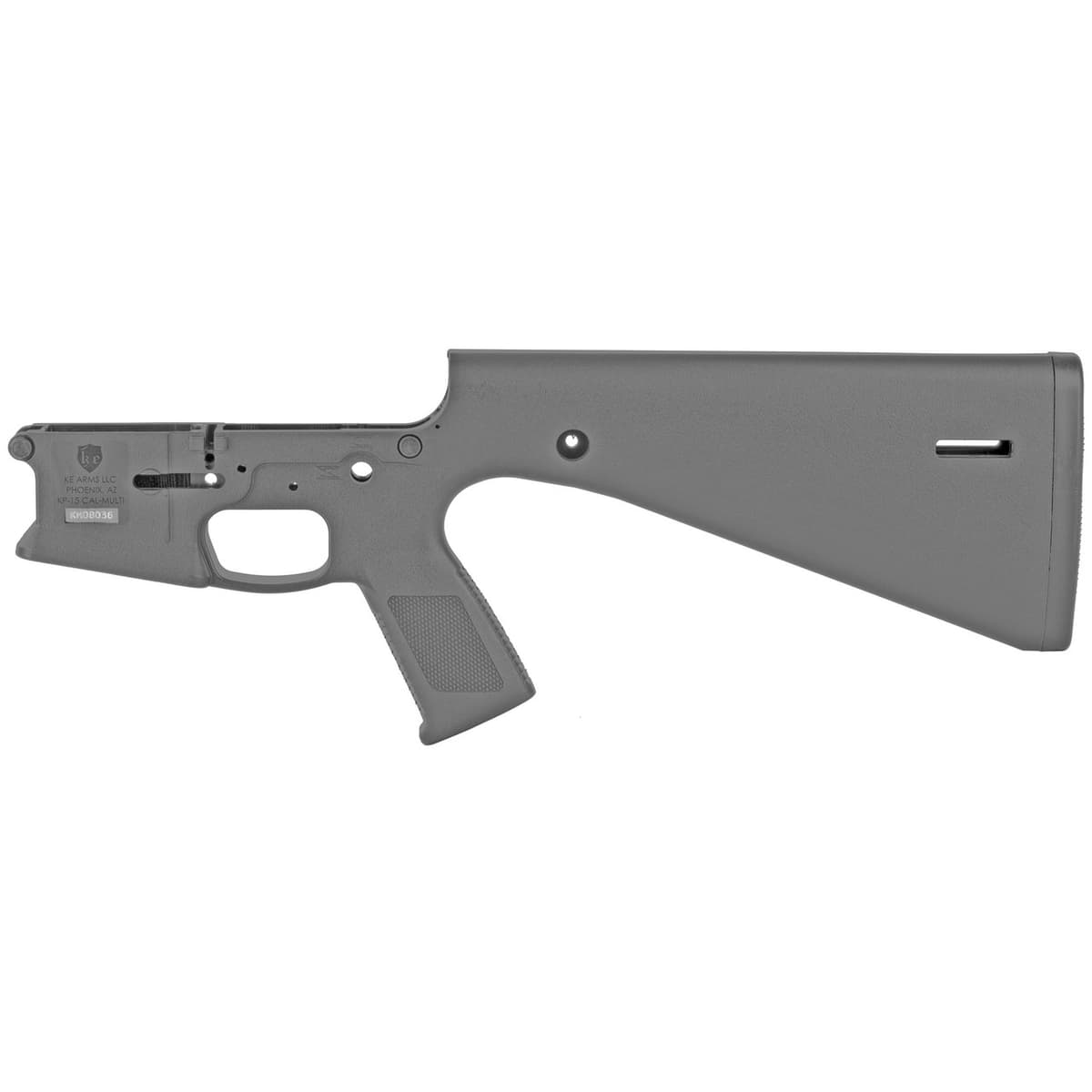
Best ultralight / polymer / WWSD-style minimalist build
Lower receivers are serialized firearms. Every option here ships to an FFL with a NICS background check; you cannot ship a lower to your home in any state.
Affiliate links - purchases support this site at no extra cost to you. (?)
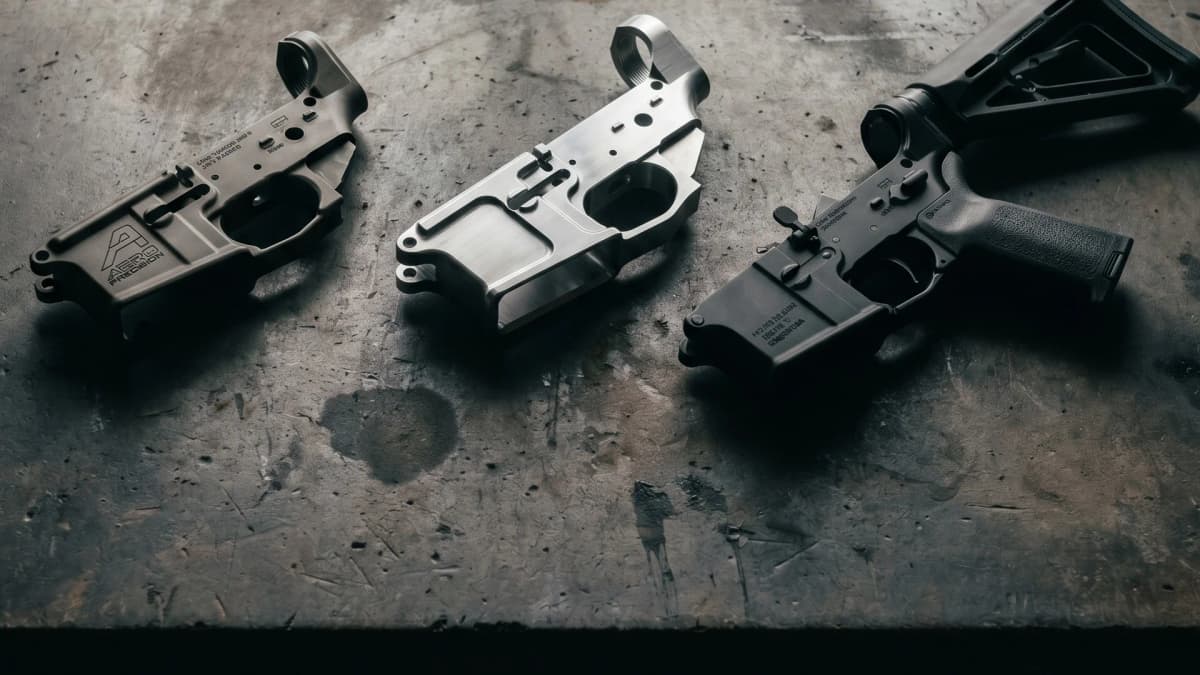
The forging vs billet vs polymer question gets oversold online. Here is what actually changes when you pick one over the others.
A forging starts as a chunk of 7075-T6 aluminum that gets hammered into a near-final shape under high pressure, then CNC machined to spec. The hammer process aligns the grain structure, which gives forged lowers their strength advantage at the buffer tower and pivot pin areas, the two real failure points. Cheaper to produce and lighter than billet at the same dimensions. The PSA Stealth, Aero M4E1, BCM, Centurion CM4, and Geissele Super Duty are all forged. This is what 95% of buyers should buy.
A billet lower starts as a solid block of 7075-T6 and gets machined down to a finished receiver. No forging step, so the grain structure is uniform but slightly weaker than forged at stress concentration points. Billet exists for three reasons: aesthetics (clean lines, no forging marks), complex internal geometry that cannot be forged (integrated ambi controls, reinforced magwell ribs, weight-cut pockets), and matched receiver sets where the upper and lower share an unusual profile. The ADM UIC is the only true billet lower in this guide, and it earns the price tag with the 40% reinforced magwell and the integrated ambi lever.
The KE Arms KP-15 is 30% glass-filled nylon molded as a monolithic piece, stock and buffer tube and grip and trigger guard included. About 1 lb total weight versus 2+ lbs for a forged lower plus stock plus buffer tube. Validated through 50,000+ rounds in the WWSD project rifles, so it is not a toy. It is also not duty-rated against impact like 7075. Buy it for ultralight builds, recreational range rifles, or as a backup lower for a parts-bin build. Do not buy it as your only home-defense rifle.
New lower releases, pocket compatibility updates, and LPK pairing guides for your next build.
The lower receiver is the only serialized part of the AR-15. Every transfer requires:
Practical workflow: call your local FFL before ordering. Confirm they accept transfers from your chosen vendor (most do, a few do not), confirm the transfer fee, and ask which name and license number to ship to. The vendor needs that information at checkout. Skip this step and your lower will sit in shipping limbo until the FFL faxes paperwork to the vendor.
State restrictions: several states (California, Connecticut, Delaware, Hawaii, Illinois, Maryland, Massachusetts, New Jersey, New York, Washington as of last check) have AWB or feature laws that affect how an AR-15 can be configured. Featureless rules, fixed-magazine requirements, and model-specific bans vary by state and change frequently. Read your state law before ordering, not after. Stripped lowers themselves are generally transferable; the configuration you build is what triggers the restrictions.
No, you cannot ship to your house. Federal law prohibits direct-to-consumer shipment of a serialized firearm across state lines. This applies even if you are the manufacturer of record (an 80% lower you finished yourself). The B5 EPT complete lower, the KE Arms KP-15 polymer lower, and every stripped lower in this guide all carry the same FFL requirement.
The PSA EPT B5 complete lower at $170 includes an LPK ($40), buffer tube kit ($35), B5 Bravo stock ($60), H buffer ($30), and EPT trigger ($40). A-la-carte that is $205 before tax, and you do the labor. The complete lower wins on price for that exact parts list. The stripped lower wins when you want to swap any of those parts for something better, especially the trigger. See the lower parts kit guide for LPK selection if you are building from a stripped receiver.
Every lower in this guide accepts standard AR-15 lower parts kits and triggers, with three caveats nobody warns you about.
ADM UIC and triggers with external anti-rotation plates: the UIC's internal geometry does not clear triggers that use an external anti-rotation plate with screws (some early Timney and CMC drop-in cartridges). Use the standard KNS or set-screw anti-rotation pins instead. Most modern drop-in triggers (LaRue, Geissele, Rise) are fine.
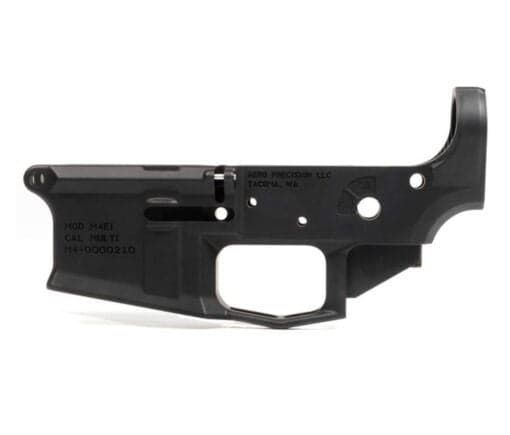
Threaded bolt catch pins are not cross-compatible: the Aero M4E1 ships with its own proprietary threaded bolt catch pin. If you later swap to a roll-pin lower, you need a standard roll pin (the threaded version will not fit). Keep the spare in the parts bin. Note that Aero Precision entered a Washington state receivership in 2026; see our Aero Precision receivership coverage for what it means for warranty and buying decisions.
Super Safety / Atrius pocket geometry: the fire control pocket shape determines whether an Atrius or Mars Super Safety drops in cleanly. Low-shelf and M16 pockets both clear the cam lever; high-shelf pockets (LMT MARS-L, Springfield, current Colt, KAC Ambi) bind and need material removed. Use the compatibility checker below to look up your specific brand.
For the trigger itself, the AR trigger guide walks through the LaRue MBT-2S, Geissele SSA, and ALG ACT recommendations that pair well with every lower here.
The lower decision drives the upper decision in two ways. First, tension screw lowers (Aero M4E1, ADM UIC) seat tightest against uppers from the same brand or with matching geometry. Second, an ambi lower needs an ambi charging handle on the upper to deliver the full left-side workflow, so factor a Radian Raptor LT or BCM Gunfighter into the build budget.
The matched M4E1 receiver set is the right answer when color match between the upper and lower halves matters to you. Aero anodizes them in the same batch, which the a-la-carte approach cannot guarantee. The threaded upper interface also accepts the Aero Atlas S-ONE, R-ONE, Quantum, Enhanced, KMR, MFR, and SLR M-LOK handguards without a proprietary barrel nut wrench. See the complete upper receiver guide for the pairing recommendations and the handguard selection guide if you are building from a threaded upper.
Going full ambi? The ambidextrous lower deep dive compares the Geissele Super Duty, ADM UIC, Radian AX556, and LMT MARS-L side by side if you want to pressure-test the $175 vs $370 vs $450 ambi tier choice.
Buying a polymer lower for a duty rifle: the KE Arms KP-15 is great for what it is, but it is not duty rated. If the rifle has to work after being dropped on concrete or used as an impact tool, buy forged 7075. Polymer is for recreational, ultralight, and backup builds.
Spending $370 on ambi when $175 does the same thing: the ADM UIC is gorgeous and the integrated ambi lever is the best on the market, but the Geissele Super Duty has the same ambi function at $195 less. Spend the difference on the trigger, the optic, or the suppressor instead.
Buying a stripped lower with no tools: an AR lower parts kit requires a pivot pin tool, a bolt catch roll pin starter punch, and a torque wrench rated for buffer tube castle nut spec. Without those, a $50 stripped lower turns into a $150 disaster. Either buy the tools or buy the PSA EPT complete lower.
Skipping the FFL phone call: order to an FFL that does not accept your vendor and your lower sits in transit for a week while the FFL refuses delivery. Call ahead, confirm the transfer fee, confirm the FFL license number, and verify they accept your chosen vendor. Five minutes saved is not worth a week of customer service emails.
Buying a high-shelf lower for a Super Safety build: the LMT MARS-L, KAC Ambidextrous, Springfield, and current Colt all use high-shelf fire control pockets that bind the Super Safety cam lever. If a Super Safety or FRT is in the build, stick to low-shelf or M16-pocket lowers (M4E1, BCM, Centurion, Geissele) or budget the milling time.
Aero M4E1 stripped lower ($140) or PSA EPT B5 complete lower ($170) if you do not have tools.
PSA Stealth ($50). Add a $30 CMMG LPK, a $99 LaRue MBT-2S trigger, and a $35 buffer tube kit.
Centurion CM4 stripped ($175) or the BCM Complete Lower Group ($525). CM4 for hand-deburred QC and an M16 pocket; budget another $200+ for the LPK, stock, and trigger. The BCM group is the factory-assembled path: low-shelf pocket, PNT trigger and Mod 0 stock installed, no parts sourcing.
Geissele Super Duty ($175). Step up to the ADM UIC ($370) only if you want billet aesthetics and the reinforced magwell.
Aero M4E1 receiver set ($310). Same anodizing batch, sequential serials, threaded upper.
KE Arms KP-15 polymer ($80). Fixed A1 length of pull, ~1 lb total. Recreational use only.
Still deciding the rest of the parts list? The AR-15 builder walks through compatible uppers, BCGs, handguards, and triggers once you pick a lower. The build kits guide covers the upper + LPK + buffer kit bundle if you want one SKU instead of an a-la-carte parts list.

Avid shooter with 10+ years of experience including competition shooting, and an associate member of the Professional Outdoor Media Association (POMA). Built 10+ AR-pattern rifles and several handgun platforms for home defense, competition, and suppressed night shooting.
This page contains affiliate links. Purchases through these links support the site at no extra cost to you. Read the affiliate disclosure
Continue exploring with these related resources

Suppressed AR-15 blowback hits your eyes and airway through the charging handle gap. These ported, sealed, and raised-lip gas-busting handles fix it. Ranked by mechanism and value.

The AR-15's factory takedown and pivot pins sit nearly flush, so most shooters fight them with a punch every time. Ranked extended, easy-install, and titanium sets from Battle Arms, Strike Industries, V Seven and more.

Extended buttons, ambidextrous catches, and oversized controls that make AR-15 reloads faster. Ranked picks for every budget, from a $18 Magpul button to the proven Norgon Ambi-Catch.
Related articles and industry updates

Oil infrastructure attacks, AI-driven semiconductor demand, and geopolitical instability are creating supply chain pressure on ammunition, optics, and emergency gear. Prioritized buying checklist: ammunition, magazines, optics, spare parts, and general emergency preparedness.

Which forced reset trigger fits your platform: a cross-platform router covering the AR-15, AK, MP5, Ruger PC and 10/22, FN PS90, Glock, Canik, and Taurus TX22, plus ranked AR-15 picks (Triggered Company Disruptor, Rare Breed FRT-15L3, Arc-Fire V2, Atrius FRS, Mars Super Safety). Pricing, legality, and which device fits your gun.

Lancaster County Circuit Judge John Martin granted a preliminary injunction in Crump v. Katz on June 25, 2026, blocking enforcement of Virginia's assault firearms and magazine ban (HB 217 / SB 749) through at least December 31, 2026. Gun Owners of America, Gun Owners Foundation, and VCDL secured the order, voiding the July 1 effective date. Attorney General Jay Jones announced an appeal to the Virginia Court of Appeals on June 26.