Key Takeaways
- →M-LOK leads roughly 8 to 1: in 2026 through August, relative interest averages 78 for M-LOK, 28 for quad rail, and 10 for KeyMod.
- →Quad rail peaked in December 2012 at the maximum value of 100 and has flattened between 24 and 28 every year since 2022 rather than disappearing.
- →KeyMod peaked in 2016 at a yearly average of 74 against M-LOK's 19, outdrawing it almost four to one, then fell to 10 by 2026.
- →The 2017 NSWC Crane test decided it: M-LOK averaged 1.3 MOA of point-of-aim shift on reinstall against KeyMod's 4.9 MOA, kept 100% of accessories attached in the drop test against KeyMod's 33%, and averaged more than three times the static failure load.
- →Builders have already finished the argument: in our Q2 2026 builder data, the most-selected handguard was the M-LOK Aero Precision Enhanced at 564 selections, and the runner-up Midwest Industries Combat Rail is M-LOK too.
M-LOK Won, and the Data Shows Exactly When
M-LOK passed both KeyMod and the quad rail in early 2019 and has not trailed either in a single month since. The chart below plots US Google search interest in the three AR-15 handguard attachment standards from January 2004 through August 2026, and it reads as three distinct eras: quad rail dominance through 2013, a brief and genuinely competitive KeyMod window from 2014 to 2017, and M-LOK ever after.
These are relative values on a 0 to 100 scale, indexed within this three-term set only. They describe how the three standards rank against each other over time, not how many people searched for anything.
The Quad Rail Era: 2004 to 2013
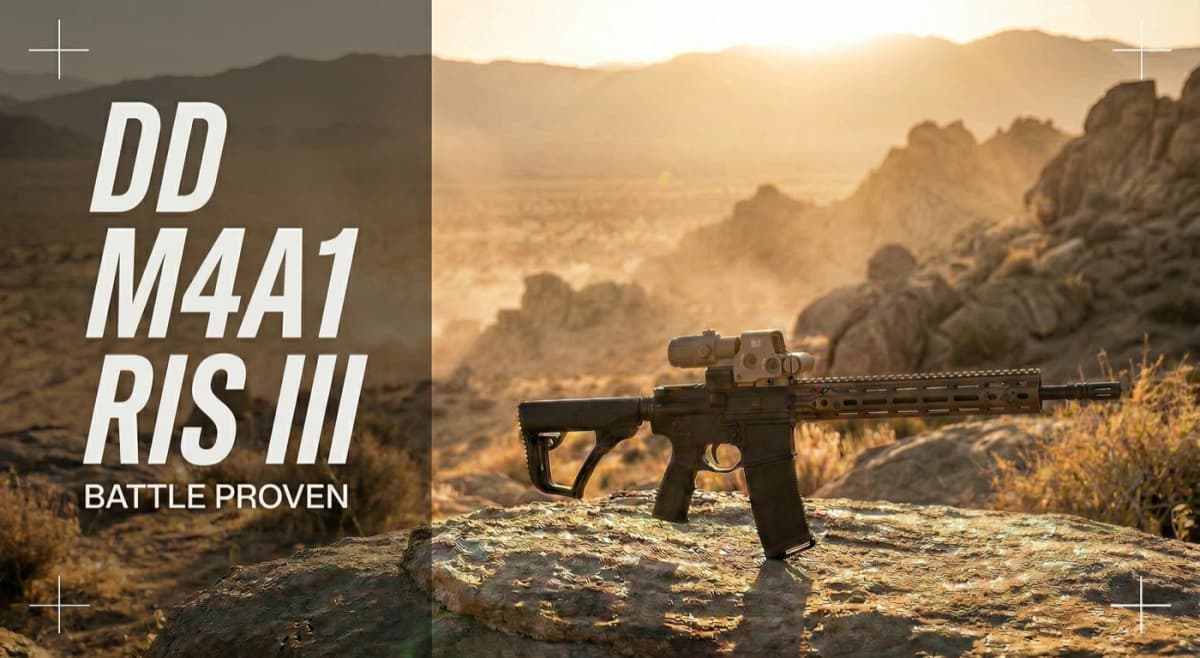
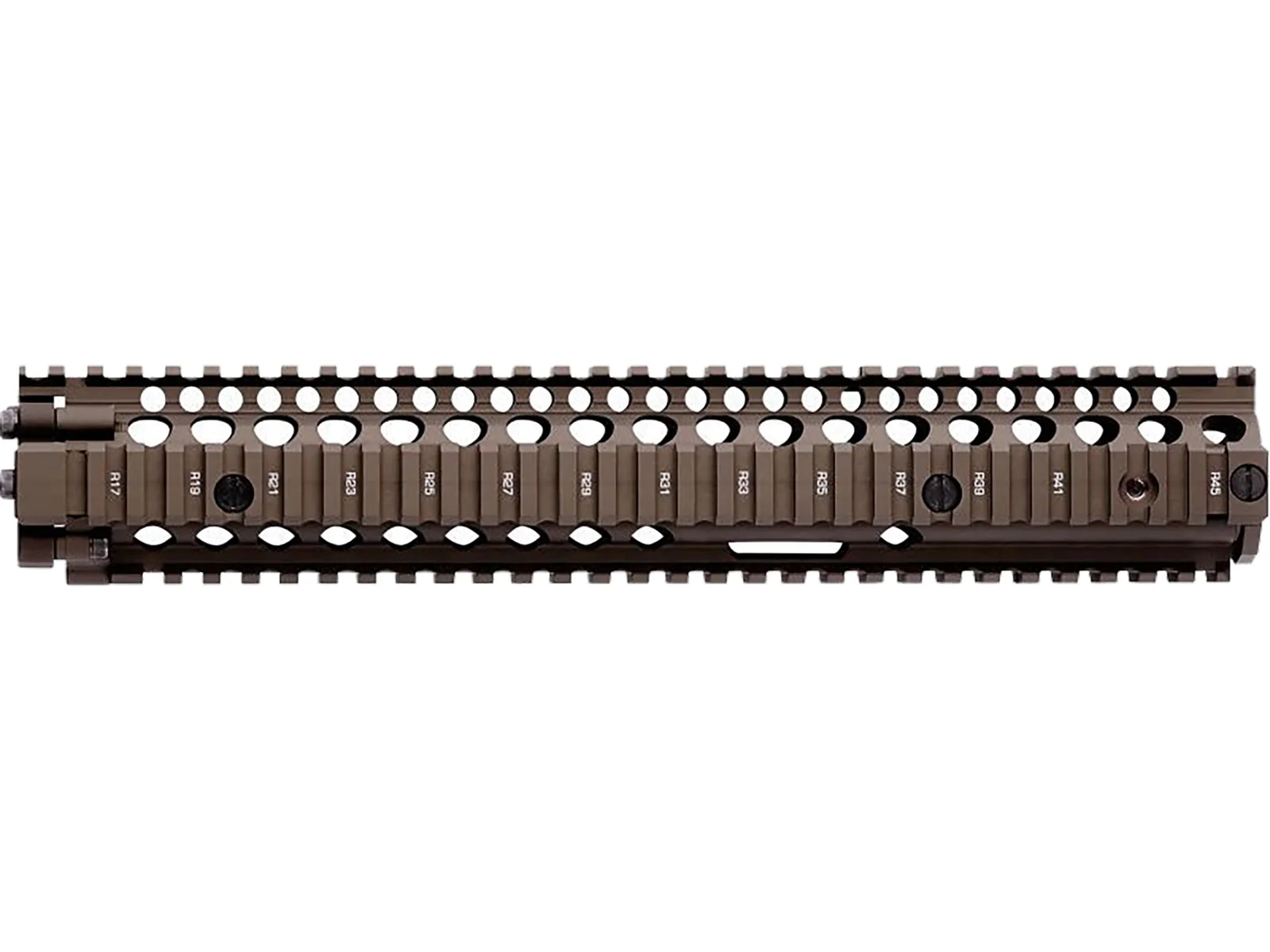
The quad rail led this set every month until KeyMod first passed it in June 2015, and it peaked at the full 100 in December 2012 and January 2013. Its rise tracks the military adoption curve: MIL-STD-1913, the Picatinny rail dimensioning standard, was approved on February 3, 1995, and by the 2000s the Knight's Armament RAS and then the Daniel Defense RIS II were the issued handguards on the M4A1 and the MK18. What the military carried, the commercial market copied.
A quad rail solves accessory mounting by brute force. Continuous 1913 rail on all four faces means any Picatinny accessory clamps anywhere, which was the whole point in an era when lights, lasers, grips, and optics all standardized on the same interface. The cost is that you carry rail you are not using. The Daniel Defense MK18 RIS II weighs 14.1 oz across 9.55 inches; the 15-inch BCM MCMR covers six more inches of barrel at 9.2 oz. Bare 1913 rail is also unpleasant to grip, which is why ladder panels and rail covers became their own product category.
KeyMod's Four Good Years: 2012 to 2016
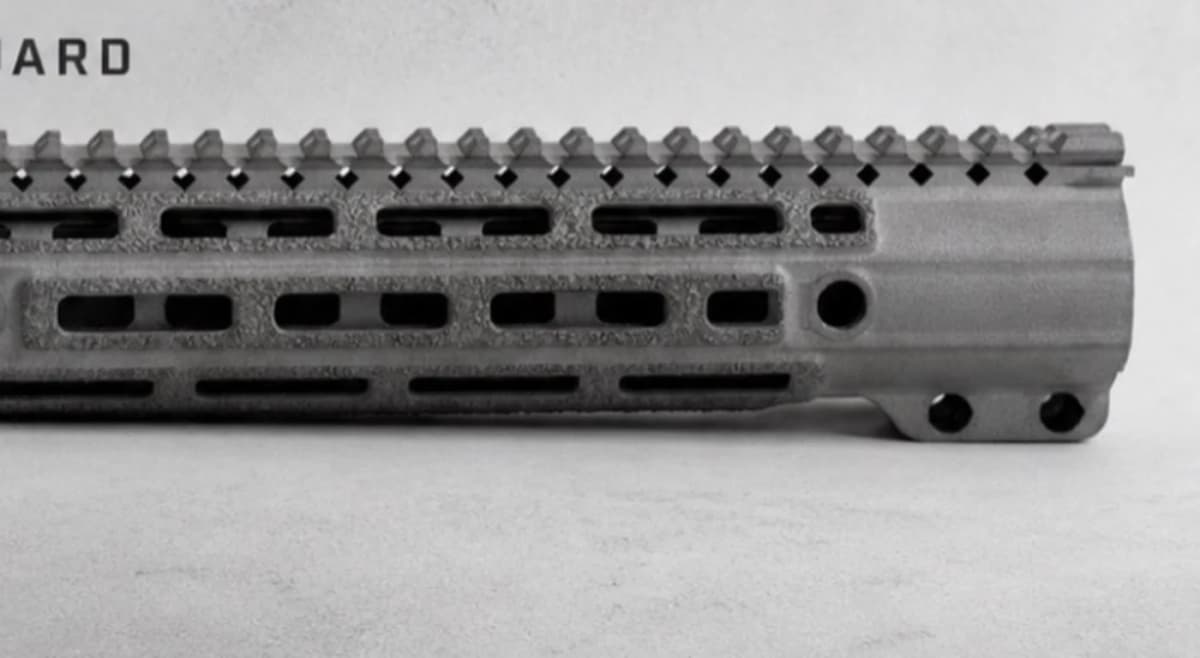
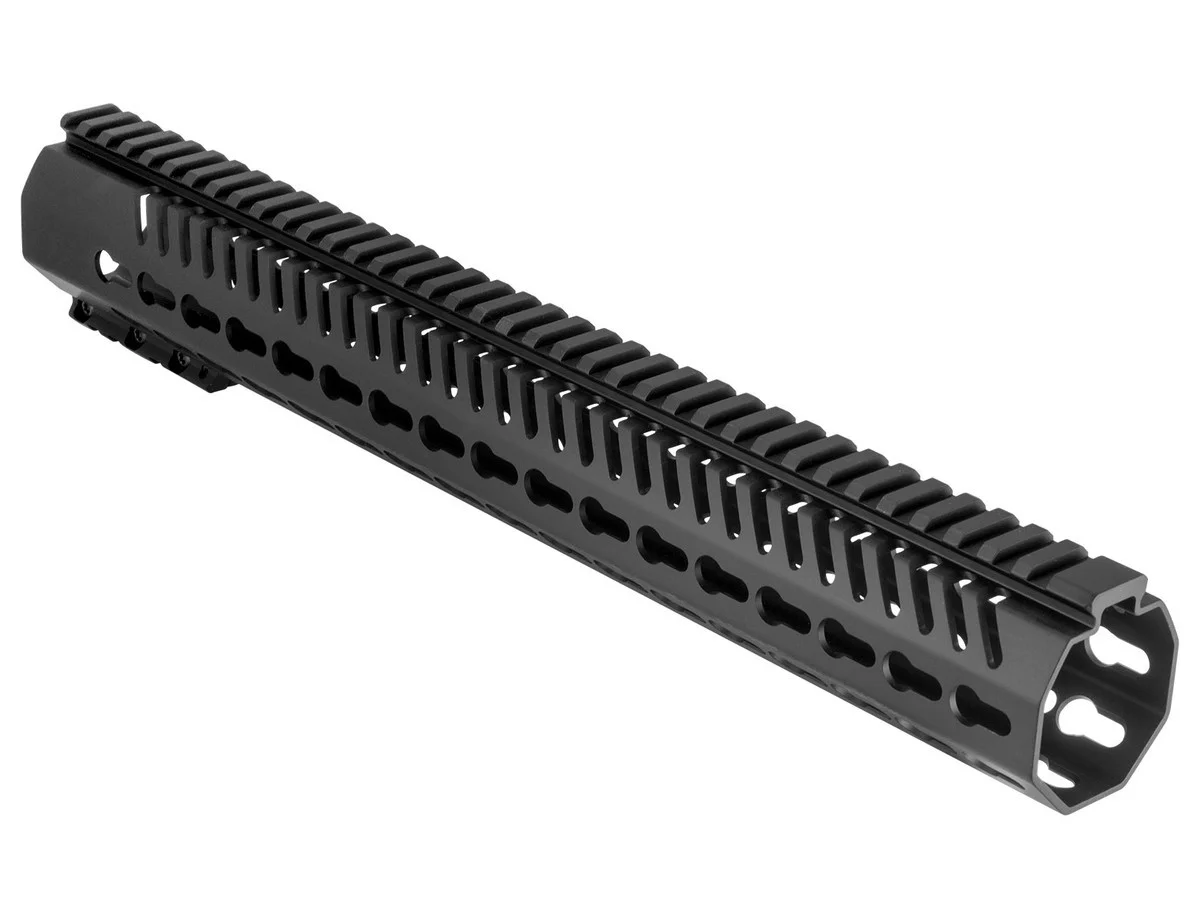
KeyMod was the first serious attempt to delete unused rail, and for about four years it was winning. VLTOR Weapon Systems released the technical data package publicly on July 26, 2012, into the public domain: any manufacturer could build KeyMod parts without asking VLTOR for permission or paying anything. Noveske Rifleworks co-developed early rail panels and had access before the public release. The design is a keyhole slot, a large round through-hole leading into a narrower slot; an accessory's mushroom-shaped nuts drop through the round hole, slide forward into the narrow section, and clamp down.
The open-standard approach worked. KeyMod interest first appears in this data set in December 2012, reaches a yearly average of 30 in 2014 against M-LOK's 3, and peaks at a monthly value of 90 in both July and November 2016 with a yearly average of 74. In 2016 KeyMod was not merely competitive with M-LOK, it outdrew M-LOK almost four to one and outdrew the quad rail as well.
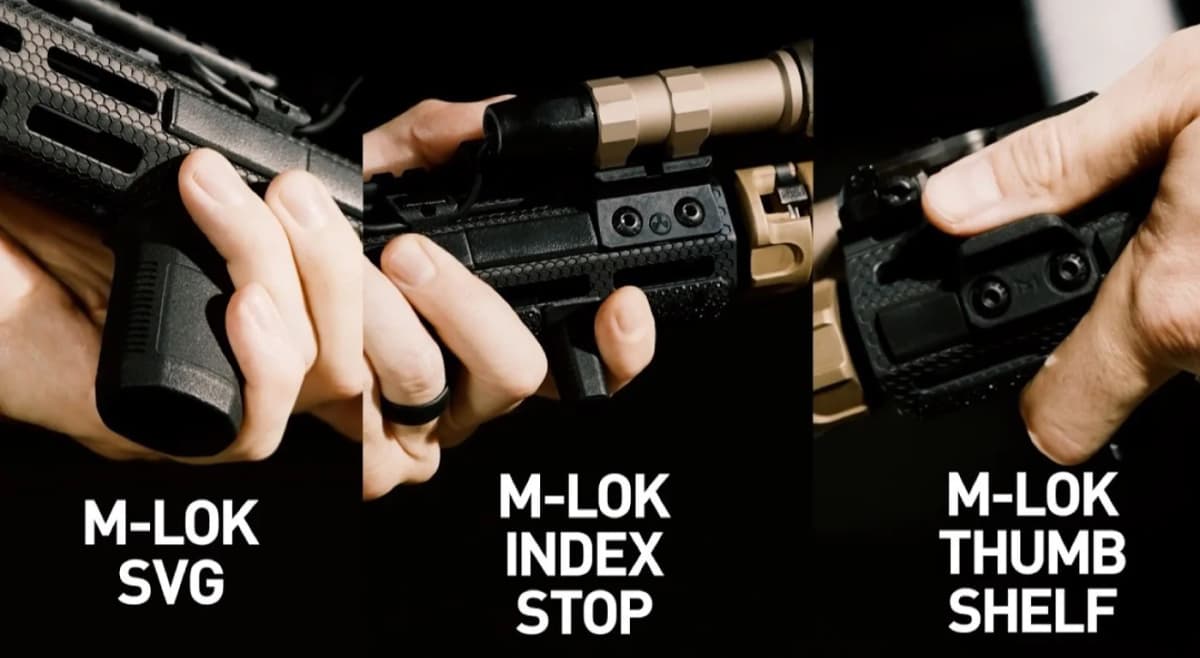
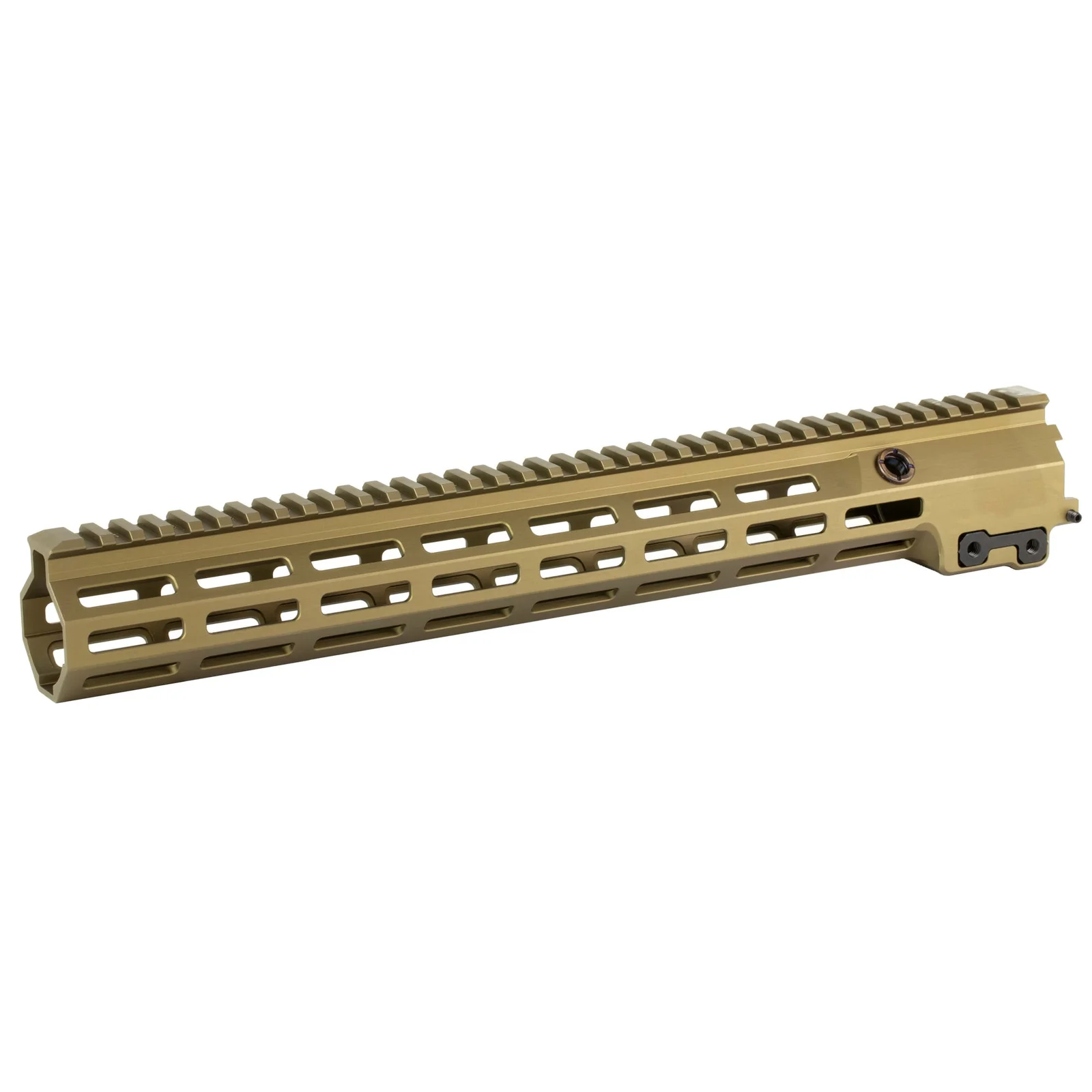
Magpul announced M-LOK in 2014 as an evolution of the MOE slot system it had used since 2007, and the NSWC Crane briefing dates its release to early 2015. The name is short for Modular Lock, and the mechanism is different from KeyMod in a way that turned out to matter: a T-shaped nut passes through an oblong slot and the mounting bolt rotates it 90 degrees, so tightening the bolt cams the nut against the inside face of the handguard. Magpul licenses it for free but not openly. The license agreement grants a royalty-free, non-exclusive, non-transferable right to the data package, trademarks, and patents, and it requires the licensee to hold that data package confidential and lets Magpul terminate on written notice. KeyMod was public domain; M-LOK is free but controlled.
The 2017 Test That Ended the Argument
The turn came from a government test, not the market. USSOCOM sponsored a comparison of the two systems at Naval Surface Warfare Center Crane Division, and the results went public twice in 2017: USSOCOM's selection of M-LOK was reported at the end of March, and the detailed briefing, titled "KeyMod vs. M-LOK Modular Rail System Comparison," was presented at the NDIA Armament Systems Forum on May 4, 2017.
The methodology is unusually clean for this kind of argument. Three manufacturers each built the same handguard in both variants, three of each, giving 18 handguards from Aero Precision, Midwest Industries, and Seekins. Each mounted to a 14.5-inch upper receiver group on an M4A1 lower in place of the issued quad rail. Because the same maker built both versions of the same rail, differences in machining quality and material cancel out and what remains is the interface.
Five tests, and the two systems split them:
- Endurance and rough handling: both passed. Cyclic loading simulating 10,200 rounds at a 1,020 RPM rate produced no failures and no fastener loosening in either system, and neither loosened under increasing peak loads up to roughly 400 lbf.
- Repeatability: M-LOK averaged 1.3 MOA of point-of-aim shift across removals and reinstalls, against 4.9 MOA for KeyMod, which Crane recorded as a 73% improvement. KeyMod's worst single measurement was 14.6 MOA.
- Drop test: six drops per handguard from five feet onto steel with a simulated weapon light mounted at 9 o'clock. Every M-LOK accessory stayed attached, though two thirds slid rearward in the slot. Only a third of the KeyMod accessories stayed on, and that third was attached to a severely damaged handguard. The KeyMod failure mode was the handguard fracturing between slots.
- Static failure load: M-LOK held on average more than three times the load KeyMod did, which Crane also framed as a 140% to 220% increase over the highest load any KeyMod sample reached.
One detail from the briefing cuts against the simple reading and is worth carrying: no M-LOK handguard actually failed in the static load test. Every M-LOK test ended at the accessory mount or the mount-to-rail interface, so those numbers are a floor for the interface rather than its limit. Every KeyMod failure, by contrast, was the handguard itself letting go. A second caveat runs the other way. M-LOK is installation-sensitive: deliberately mis-installed M-LOK, with the rail set at the maximum angle the slot allows, averaged 18.4 MOA of shift, far worse than KeyMod installed correctly. Torque your rail sections properly and the advantage is real; get lazy and you give it all back.
Crane recommended M-LOK to USSOCOM, which built it into the Suppressed Upper Receiver Group and the Advanced Sniper Rifle programs. That is the moment the commercial market read as a verdict.
How Fast KeyMod Fell After 2017
KeyMod's yearly average dropped every year from 2016 onward, and M-LOK's rose every year over the same stretch: 74, 63, 46, and 33 for KeyMod across 2016 to 2019, against 19, 26, 35, and 39 for M-LOK. The lines cross in February 2019, when M-LOK reaches 44 against KeyMod's 42, and they never cross back. M-LOK hit the full 100 in June 2020. KeyMod has averaged under 20 every year since 2021 and sits at 10 in 2026.
Reading month-to-month declines here is a trap, because all three series share the same relative scale and all three sag together in the summer. The year-over-year averages are the honest signal, and they are unambiguous: within about 24 months of the Crane briefing, the standard that had been outdrawing M-LOK four to one was behind it.
The hardware followed. Ruger dropped the KeyMod forend from the Ruger Precision Rifle for the 2018 model year and shipped M-LOK instead. Midwest Industries, one of the three makers in the Crane test, now lists a single KeyMod accessory rail where it once carried a full KeyMod handguard line. KeyMod was never universally discontinued, though, and that distinction matters if you own one: BCM still catalogs its KMR KeyMod handguards alongside the M-LOK MCMR and the 1913 QRF. An existing KeyMod rail is not orphaned. It is simply not where anyone is designing new parts.
For picking an actual rail rather than an actual standard, our AR-15 handguard buying guide ranks the current field by weight, rigidity, and mounting system, and the suppressor-ready handguard guide covers the inner-diameter math if a can is going under it.
M-LOK Rails Builders Actually Pick
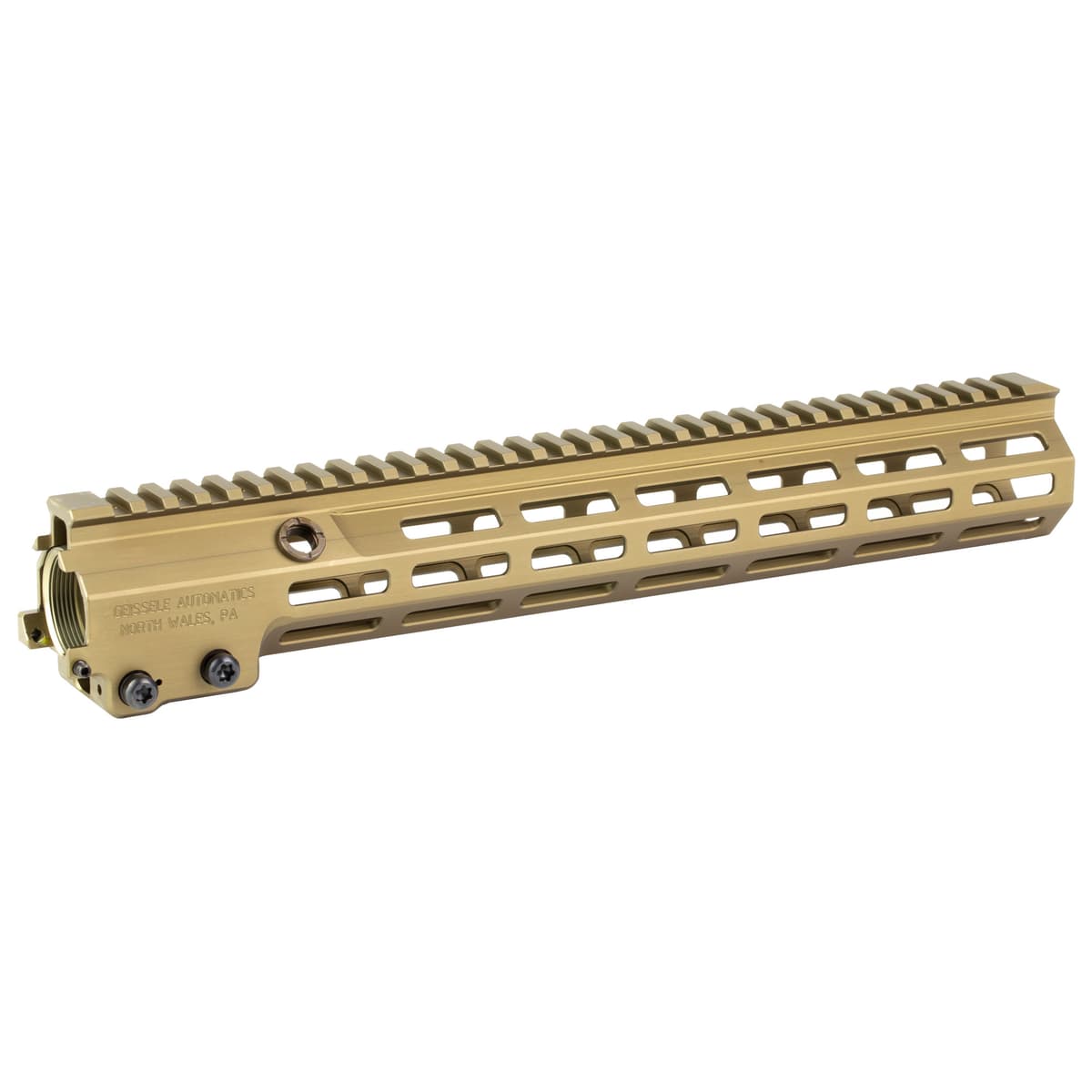
Geissele MK16 Super Modular Rail 13.5" (URGI)
- 13.5" URGI length, NSN 1005-01-672-4797
- M-LOK on seven sides, full-length 1913 top rail
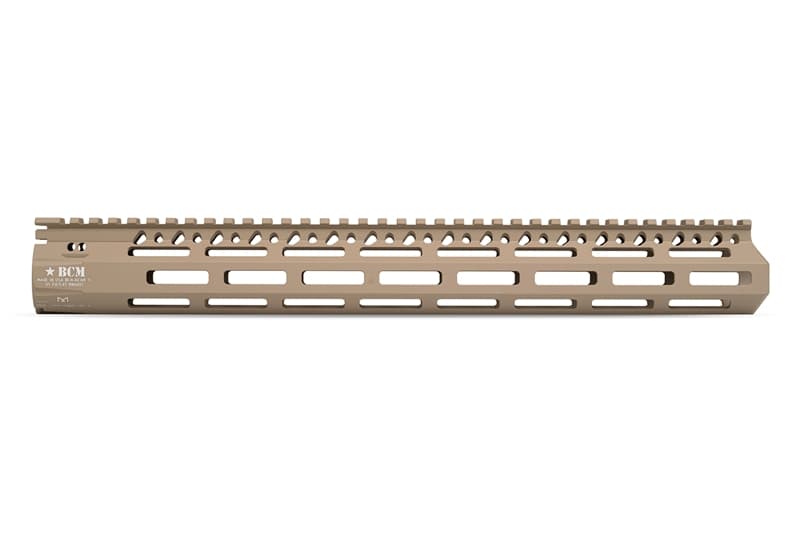
BCM MCMR M-LOK Handguard
- 9.2 oz for the 15-inch handguard
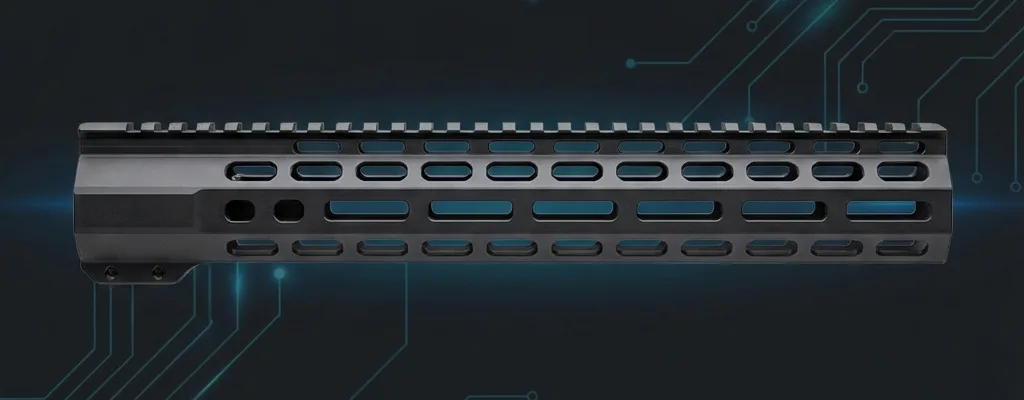
- Up to eight rows of M-LOK slots
Aero Precision Enhanced Handguard
- 564 organic builder selections in 90 days
- Mounts with 8 screws, no barrel nut, on the M4E1 upper
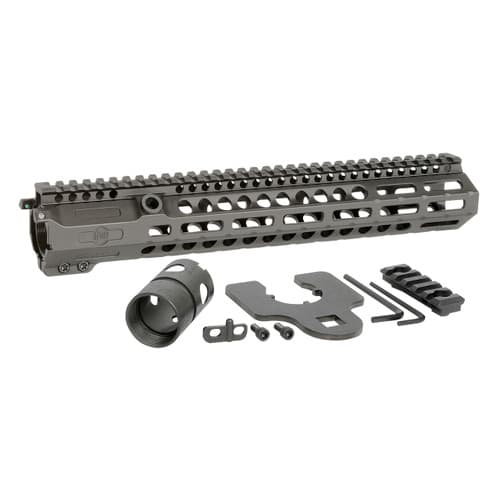
Midwest Industries Combat Rail
- 6061-T6 aluminum, 11.4 oz installed at 15 inches
- Seven sides of M-LOK plus a full-length top rail
Affiliate links (?)
What Builders Configure in 2026
Search interest measures curiosity; our own builder data measures choice, and it says the same thing louder. In the Q2 2026 edition of the Rifle Build Index, drawn from 95,228 organic component selections across 25,087 anonymized sessions between April 2 and July 2, 2026, the most-selected handguard was the Aero Precision Enhanced at 564 selections. The runner-up was the Midwest Industries Combat Rail. Both are M-LOK.
That is a category with no KeyMod contender at the top and no quad rail contender at the top, in a data set where the winning part in other categories is frequently the cheaper one rather than the fashionable one. The same quarter had the cheaper BCM Gunfighter charging handle beating the Radian Raptor-LT, so this audience is not simply buying whatever is newest. On handguards, they have converged.
You can see the same convergence in the rifle builder itself: filter the handguard category on an AR-15 build and the M-LOK options outnumber everything else by a wide margin, which is a direct reflection of what manufacturers are producing.
Why Quad Rail Never Went to Zero
Quad rail interest stopped falling after 2021 and has held between 24 and 28 every year since, including 28 in 2026. That floor is clone builds and issued configurations, not holdouts. The MK18 Mod 1 and the M4A1 SOPMOD Block II are defined by the Daniel Defense RIS II; a build using an M-LOK rail instead is a different rifle, not a modernized version of the same one. Crane's own 2017 briefing listed MIL-STD-1913 quad rail handguards as then in current use on the MK18 Mod 1 and the Upper Receiver Group, which is how a standard keeps a constituency after losing a test.
The military itself moved on from the quad rail on this platform. The Geissele MK16 that USASOC adopted for the Upper Receiver Group-Improved (URG-I) is an M-LOK rail, and it replaced the RIS II in that role. Both configurations now have a following, which is why our clone build guide carries parts lists for Block II and URGI side by side, and why the MK18 build guide treats the RIS II as a requirement rather than a compromise.
Quad Rail Parts for Clone Builds
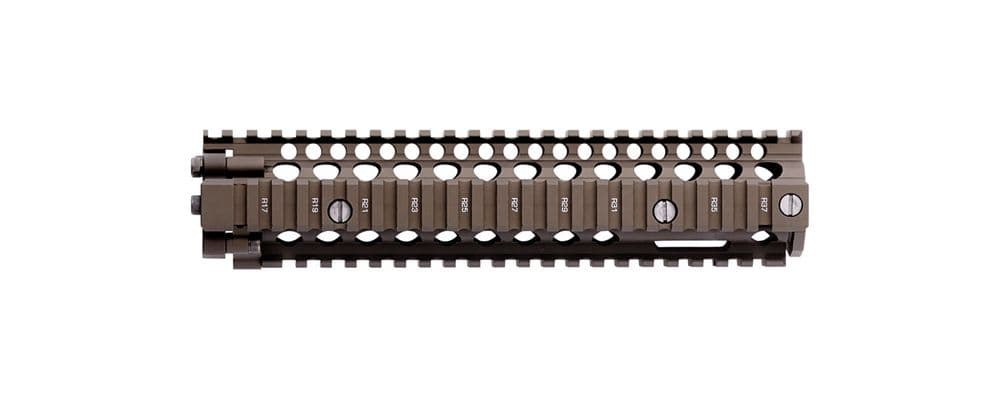
Daniel Defense MK18 RIS II
- 9.55" length for 10.3" carbine-gas MK18 builds
- Six-bolt bolt-up mount, 14.1 oz
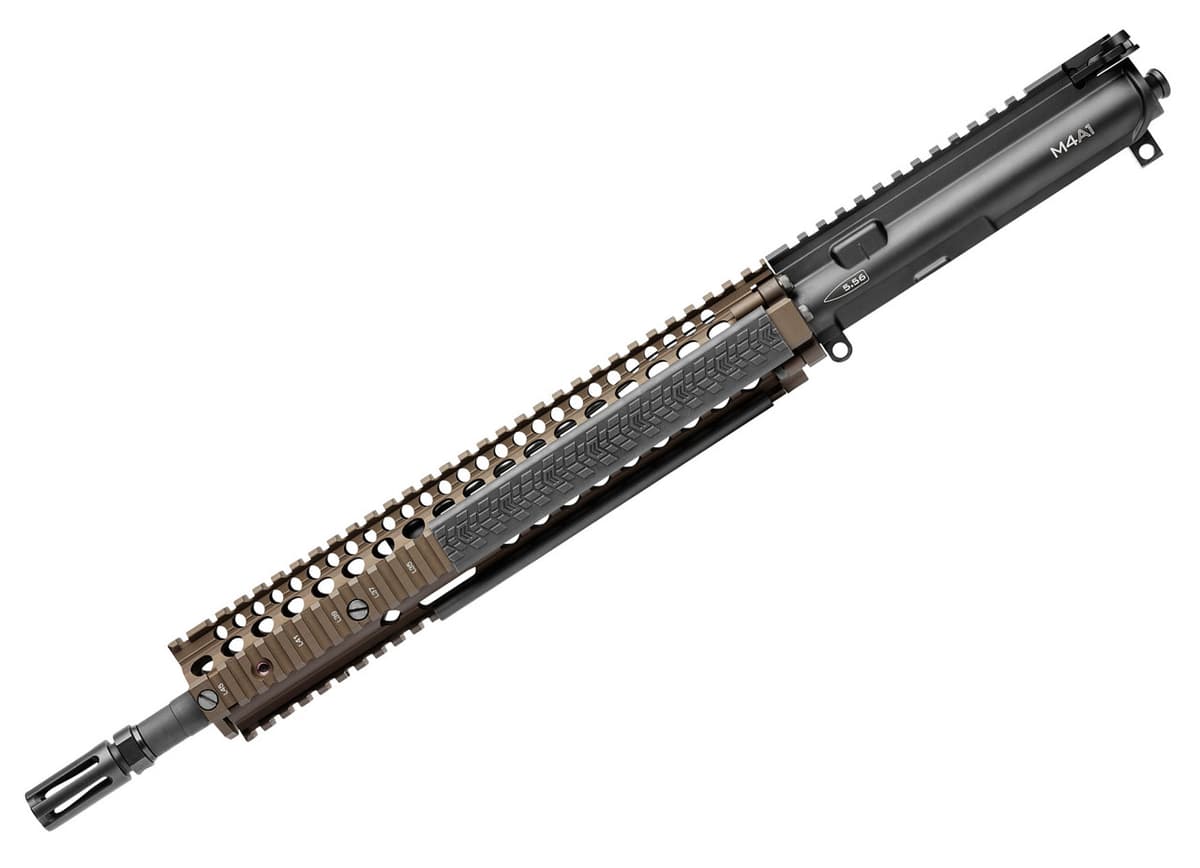
Daniel Defense M4A1 RIS II Upper Receiver Group 14.5"
- 14.5" cold hammer forged barrel, pinned and welded to 16"
- RIS II quad rail with a pinned low-profile gas block
Affiliate links (?)
Yearly Data Table
Calendar-year means of the monthly relative-interest values, per series. 2026 covers January through August. Dashes mark years with no data for that term.
| Year | M-LOK | KeyMod | Quad rail |
|---|---|---|---|
| 2004 | – | 16 | – |
| 2005 | – | – | – |
| 2006 | – | – | 8 |
| 2007 | – | – | 8 |
| 2008 | – | – | 13 |
| 2009 | – | – | 22 |
| 2010 | – | – | 22 |
| 2011 | – | – | 32 |
| 2012 | – | 2 | 54 |
| 2013 | – | 8 | 59 |
| 2014 | 3 | 30 | 52 |
| 2015 | 8 | 46 | 50 |
| 2016 | 19 | 74 | 57 |
| 2017 | 26 | 63 | 44 |
| 2018 | 35 | 46 | 36 |
| 2019 | 39 | 33 | 28 |
| 2020 | 76 | 37 | 41 |
| 2021 | 68 | 19 | 31 |
| 2022 | 72 | 15 | 28 |
| 2023 | 77 | 13 | 27 |
| 2024 | 77 | 10 | 25 |
| 2025 | 71 | 9 | 24 |
| 2026 | 78 | 10 | 28 |
Embed this chart
The chart above is a standalone SVG at rifleconfigurator.com/research/trends/handguard-standards/chart, 880 by 460, with its source line built in.
The chart and the table above are free to reuse, in whole or in part, in commercial and non-commercial work, with attribution to Rifle Configurator Research and a link to this report. More published data sets live at Rifle Configurator Research.
Methodology
The series come from Google Trends, United States, web search, retrieved August 15, 2026, covering January 2004 through August 2026 at monthly resolution. The three terms were compared in a single request, which is what makes them comparable to each other.
Google Trends reports relative interest on a 0 to 100 scale, where 100 is the highest single month reached by any term in the request and every other value is scaled to it. These are not search volumes, they cannot be converted into search volumes, and they are not comparable to values from any other Trends request. Every comparison in this article is between the three plotted series only.
Two limits are worth stating. The data set carries one isolated KeyMod reading in January 2004, eight years before the standard existed, which is unrelated query noise rather than signal; treat the KeyMod series as beginning in December 2012. And a term's interest reflects how often people needed to look it up, which tracks adoption during a transition and understates a settled standard afterward, since nobody searches what they already know.
The builder figures come from our own Q2 2026 Rifle Build Index: 25,087 anonymized sessions and 95,228 organic component selections between April 2 and July 2, 2026, counted once per part per session, excluding unchanged template loads and our own account. Selections measure configuration intent, not confirmed purchases.
Get the Next Trend Study
We publish original search-trend and builder-behavior data on AR-15 parts. Subscribe for the next data set, plus new build guides and hands-on reviews.
Frequently Asked Questions
▶Is M-LOK or KeyMod better?
▶Is KeyMod obsolete?
▶Will M-LOK accessories work on a KeyMod handguard?
▶Is M-LOK better than Picatinny?
▶Why do people still buy quad rails in 2026?
Bottom Line
Build on M-LOK. Buy quad rail only when a clone demands it, and buy KeyMod only to keep an existing rail running.
This is one of the few standards fights in the AR world that got settled by evidence rather than fashion. KeyMod was the better idea first and the more open standard by a wide margin, and it lost anyway, because a test with three manufacturers building both versions of the same rail found M-LOK held roughly three times the load and kept accessories attached through drops that shed two-thirds of the KeyMod mounts. The market took about two years to finish agreeing.
The practical reading for a build today: pick your rail on weight, rigidity, inner diameter, and mounting system, because the attachment standard question is already answered. Spec one in the rifle builder and the M-LOK accessories you buy for it will still fit the next handguard you own.