Best Shooting Target Cameras for Long-Range Practice
The Longshot Ranger+ is the best shooting target camera for most long-range practice. At $449 it pairs a 1920x1080 camera that sits near the target with a Wi-Fi receiver at the firing line, and Longshot rates the link for 1,000 yards. Buy by distance first: every system here publishes a stated range, and a camera rated short of your firing line is the wrong camera whatever its resolution.
Key Takeaways
- →Best overall: The Longshot Ranger+ ($449) carries a 1,000-yard rating, a 1920x1080 image, an included receiver, and up to six hours of battery.
- →Extreme range and multiple targets: The Longshot LR-3 ($999) is rated for two miles, sends a 2688x1512 image, and its receiver can run four cameras.
- →One-mile value: The Caldwell Ballistic Precision LR ($348.74) reaches one mile and has an external power jack plus an app for Android, iPhone, Windows, and Kindle.
- →Short ranges: The Longshot Ranger ($229) covers 100 yards at 1080p; the SME Sight-In Edition and Longshot Marksman cover 300 yards, and the Caldwell Sight-In 440 yards.
- →Not a scope camera: All eight sit downrange and stream the target. Recording the sight picture through an eyepiece takes a scope camera instead.
Best Shooting Target Cameras
These eight downrange systems are ranked for long-range practice. Stated wireless range rules out the wrong camera first, because a 100- or 300-yard system cannot serve a 600-yard firing line. Price, image detail, and receiver design then settle the order among the systems that reach.
Longshot Ranger+ 1000 Yard Target Camera
Best overall for long-range practice
- +1,000-yard rating covers common long-range practice distances
- +Included receiver extends the link far beyond the base Ranger
- +Costs less than the shorter-range Marksman while retaining a 1080p image
- −Six-hour rating trails the nine-hour Marksman and LR-3
- −Single-camera system does not accept expansion cameras
Longshot LR-3 2 Mile Target Camera
Best for extreme range and multiple targets
- +Two-mile rating is the longest range in the consumer shortlist
- +2688x1512 image matches the Marksman and exceeds the 1080p and 720p options
- +Receiver can support as many as four programmed cameras
- −Highest base price among the single-camera consumer kits
- −Separate camera and receiver add another powered unit and tripod to the setup
Caldwell Ballistic Precision LR Target Camera
Best value for a one-mile firing line
- +One-mile rating reaches common 1,000-yard firing lines
- +External power input supports use beyond a single battery charge
- +App combines live view with photos, video, notes, and group-size calculation
- −One-mile limit is half the LR-3's stated two-mile range
SME Sniper Edition Target Camera
Best one-mile system for low-light targets
- +One-mile rating reaches beyond the SME Sight-In and both short-range Caldwell and Longshot options
- +Dockable receiver keeps the two wireless units together during transport
- +Built-in LEDs support target viewing in low light
- −960p image has less detail than 1080p and 2688x1512 systems
- −One-mile limit is half the LR-3's stated two-mile range
Caldwell Ballistic Precision Sight-In Target Camera
Best for weather-exposed ranges through 440 yards
- +440-yard rating reaches farther than the 300-yard SME Sight-In and Marksman
- +Waterproof camera and transmitter housings have a stronger published enclosure claim than the weather-resistant SME systems
- +External power jack supports sessions beyond the internal battery rating
- −720p is the lowest published image resolution in the shortlist
- −440-yard limit is too short for 600- and 1,000-yard firing lines
SME Sight-In Edition Target Camera
Best compact system for 300-yard low-light use
- +All-in-one transmitter keeps the downrange setup to one main powered unit
- +Built-in LEDs support target viewing in low light
- +Weather-resistant housing and standard tripod mount suit range setup
- −300-yard limit rules out common 600- and 1,000-yard firing lines
- −960p image carries less detail than the 1080p and 2688x1512 Longshot systems
Longshot Marksman 300 Yard Target Camera
Best 300-yard image detail and upgrade path
- +2688x1512 image carries more detail than the Ranger models' 1080p feed
- +Nine-hour rating is three hours longer than the Ranger models
- +Separate receiver upgrade can turn the camera into an LR-3 system
- −300-yard base range is shorter than the less expensive Ranger+
- −Base kit needs the separate upgrade before it can use an LR-3 receiver or extra cameras
Longshot Ranger 100 Yard Target Camera
Best budget pick for a 100-yard range
- +Lowest current price in the Longshot target-camera line
- +Full HD image is sharper than Caldwell's 720p Sight-In model
- +No separate downrange receiver to carry or charge
- −100-yard limit is too short for most long-range rifle practice
- −Single-camera design cannot expand to another target view
Affiliate links - purchases support this site at no extra cost to you. (?)
Which Long Range Target Camera Fits Your Firing Line
Match the stated range to your farthest firing line, then pay for image detail. For practice out to 1,000 yards, buy the Longshot Ranger+ ($449). Its included receiver carries a 1920x1080 feed across Longshot's 1,000-yard rating. The costs are a six-hour battery rating, three hours short of the Marksman and LR-3, and a single-camera design that cannot add a second target view.
Buy the Longshot LR-3 ($999) when the firing line runs past 1,000 yards or you want more than one target on screen. Longshot rates the link for two miles, the camera sends a 2688x1512 image, the system is rated for up to nine hours on a single charge, and the receiver can be programmed for as many as four cameras. The kit includes the camera, the Wi-Fi receiver, a hard case, two mini tripods, and two chargers.
For a one-mile firing line at a lower price, the Caldwell Ballistic Precision LR ($348.74) and the SME Sniper Edition ($369.99) both carry a stated one-mile link. The Caldwell streams live HD, has an external power jack for longer fixed setups, and its free app runs on Android, iPhone, Windows, Kindle, and most other tablets, with photos, video, notes, and group-size calculation. The SME Sniper Edition sends a 960p image, has built-in LEDs for low-light target viewing, and its removable Wi-Fi receiver docks to the camera for transport.
Under 500 yards, the choice is image detail against price. The Caldwell Ballistic Precision Sight-In ($269.99) reaches 440 yards with waterproof camera and transmitter housings and an external power jack, but its 720p image is the lowest published resolution in this group. The SME Sight-In Edition ($257.99) combines a 960p camera and Wi-Fi transmitter in one weather-resistant unit with low-light LEDs for 300 yards. The Longshot Marksman ($499) covers the same 300 yards with a 2688x1512 image and a nine-hour rating, and a separate receiver upgrade converts it into an LR-3 system later. The Longshot Ranger ($229) is the 100-yard budget pick: a 1920x1080 image, up to six hours, and no receiver to carry or charge.
How a Wireless Target Camera Works
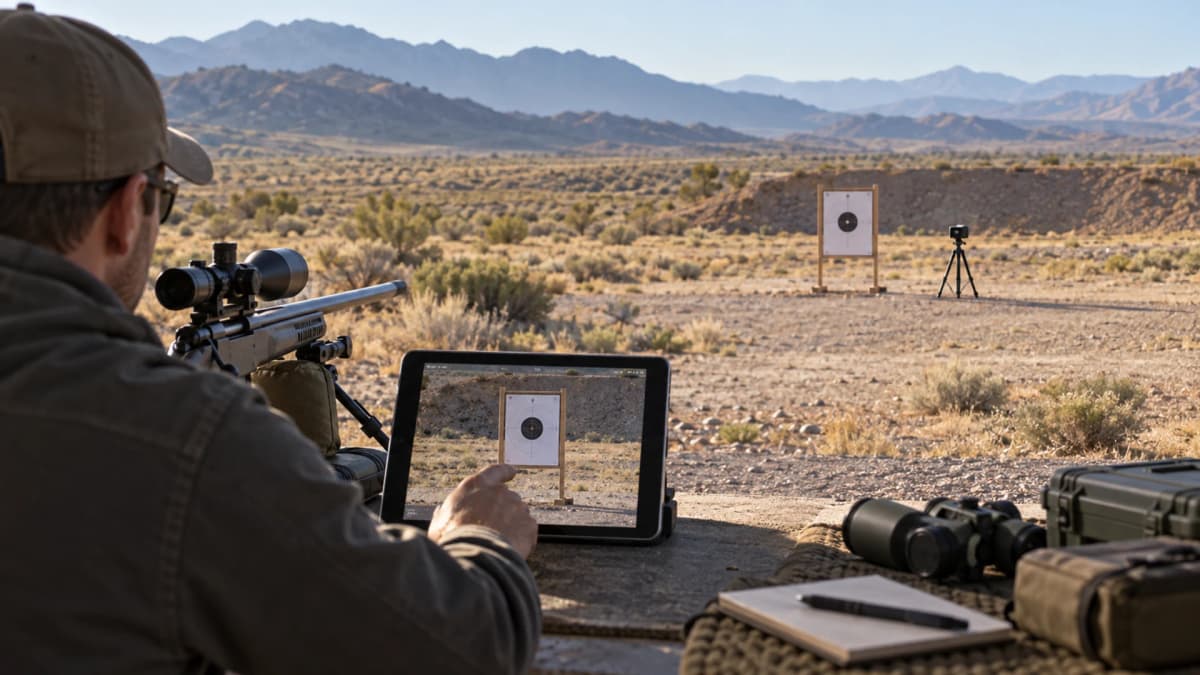
A wireless target camera sits downrange near the target and streams a live image of it to a phone, tablet, or receiver at the firing line. Because the lens views the target from a few yards away, bullet holes show up without looking through hundreds of yards of air, and nobody walks downrange to check a group.
The field splits into two link designs. The Longshot Ranger and Marksman connect to your phone or tablet with no separate receiver and are rated for 100 and 300 yards. The Ranger+ and LR-3 add a Wi-Fi receiver at the firing line, which is what extends the Ranger+ link from the Ranger's 100 yards to 1,000. SME follows the same split: the Sight-In Edition is an all-in-one camera and transmitter rated for 300 yards, and the Sniper Edition adds a removable receiver for a one-mile link. Longshot systems create their own Wi-Fi network, so your phone joins the camera directly and no internet, cellular service, hotspot, or range Wi-Fi is involved.
A downrange target camera is not a scope camera. A scope camera or phone-to-scope adapter stays at the firing line and records through a riflescope or spotting-scope eyepiece, so its useful distance depends on that glass. The best scope camera guide covers eyepiece cameras and phone adapters for recording the sight picture. A spotting scope still handles jobs a fixed camera cannot, such as glassing for game or reading a target you did not set a camera beside; the hunting spotting scope guide covers that glass.
How to Set Up a Target Camera Downrange
Set the camera roughly 10 to 15 feet from the target and offset from it, which is Longshot's placement direction, keep it outside the expected impact area, connect your device, and confirm the full target fills the live view before walking back. The same five steps apply to every system in this guide.
- 1. Match the rating to the distance. Confirm the system's stated wireless range covers the farthest point between the camera and the firing line, with margin when terrain or range layout puts the equipment farther apart than the marked target distance.
- 2. Place the camera beside the target. Longshot directs users to set its camera roughly 10 to 15 feet from the target and offset from it. Keep the camera outside the expected impact area. Both SME editions use a standard 1/4-inch tripod mount and a 15-degree ball joint for aiming.
- 3. Set up the receiver when the system has one. The Longshot Ranger+ and LR-3 and the SME Sniper Edition use a separate Wi-Fi receiver at the firing line. The Longshot Ranger and Marksman connect without one.
- 4. Connect your phone or tablet. Join the system's wireless network from your phone or tablet and open the maker's app. Longshot systems create their own network, so no internet, cellular service, hotspot, or range Wi-Fi is needed.
- 5. Frame the full target before walking back. Confirm the whole target fills the live view before returning to the firing line, then fire a first shot and check that the hole shows clearly on screen.
Placement is the camera's protection. Longshot's Bulletproof Warranty is repair or replacement coverage, not armor: the cameras themselves are not bulletproof, and Longshot notes that steel armor can block the wireless signal.
Multi-Camera Target Systems for Several Distances
The Longshot LR-3 ($999) is the system to buy for more than one target view. One LR-3 receiver can be programmed for as many as four cameras, so targets at several distances stream to the same firing line, and Longshot sells two-, three-, and four-camera LR-3 kits.
The Longshot Marksman reaches the same platform through Longshot's separate receiver upgrade, which programs the camera into the two-mile LR-3 system. The base Marksman kit has no receiver and runs a single camera. The Ranger and Ranger+ stay single-camera systems with no expansion cameras, so a shooter who expects to add target views should start with the LR-3 or the Marksman.
Using a Shooting Target Camera for Zeroing and Long-Range Practice
A shooting target camera turns every group into a measured correction without a walk downrange: fire the group, read its offset on the screen, adjust, and fire again. The Longshot app includes impact marking, group measurement, and zero adjustment tools, and the Caldwell apps save photos and video, add notes, and calculate group size.
At 100 yards, one MOA spans 1.047 inches and 0.1 mil spans 0.36 inches, so a group centered 2 inches low needs about eight quarter-MOA clicks or six tenth-mil clicks of elevation. The optic zeroing guide covers zero distances and the click math, and the optic zeroing simulator lets you practice turning a group offset into turret clicks before range time.
At 600 and 1,000 yards, the camera's close view of the target lets you grade each wind call against a visible hole. The long range shooting for beginners guide lays out the progression from 100-yard groups to called wind at 600 to 800 yards, and the best long range rifle scope guide covers the FFP optic that has to track those corrections.
Get New Precision Shooting Gear Guides
Target camera, optic, and long-range practice guides when they publish.
Shooting Target Camera Specs Compared
Sort by stated range to find the systems that reach your firing line, then compare image resolution, battery rating, and price within that group.
- Longshot Ranger 100 Yard Target CameraStated range100 yardsImage1920x1080Price$229
- SME Sight-In Edition Target CameraStated range300 yardsImage960pPrice$257.99
- Longshot Marksman 300 Yard Target CameraStated range300 yardsImage2688x1512Price$499
- Caldwell Ballistic Precision Sight-In Target CameraStated range440 yardsImage720pPrice$269.99
- Longshot Ranger+ 1000 Yard Target CameraStated range1,000 yardsImage1920x1080Price$449
- Caldwell Ballistic Precision LR Target CameraStated range1 mileImageLive HDPrice$348.74
- SME Sniper Edition Target CameraStated range1 mileImage960pPrice$369.99
- Longshot LR-3 2 Mile Target CameraStated range2 milesImage2688x1512Price$999
| Product | Image | Buy | |||
|---|---|---|---|---|---|
Longshot Ranger 100 Yard Target Camera | 100 yards | 1920x1080 | Up to 6 hours | $229 | Buy |
SME Sight-In Edition Target Camera | 300 yards | 960p | Integrated battery charging system | $257.99 | Buy |
Longshot Marksman 300 Yard Target Camera | 300 yards | 2688x1512 | Up to 9 hours | $499 | Buy |
Caldwell Ballistic Precision Sight-In Target Camera | 440 yards | 720p | Up to 6 hours | $269.99 | Buy |
Longshot Ranger+ 1000 Yard Target Camera | 1,000 yards | 1920x1080 | Up to 6 hours | $449 | Buy |
Caldwell Ballistic Precision LR Target Camera | 1 mile | Live HD | Rechargeable lithium-ion | $348.74 | Buy |
SME Sniper Edition Target Camera | 1 mile | 960p | Integrated battery charging system | $369.99 | Buy |
Longshot LR-3 2 Mile Target Camera | 2 miles | 2688x1512 | Up to 9 hours | $999 | Buy |
Affiliate links - purchases support this site at no extra cost to you. (?)