Key Takeaways
- →The rifle moves its own barrel: Advanced Weapons Systems says its aim-stabilized rifle merges machine vision, sensor fusion, and ballistic computation with an articulated barrel that adjusts at the moment of trigger pull.
- →Fulcrum is now tied to the rifle: A current biography for AWS co-founder Gerald Morse names him lead designer of the Fulcrum Barrel for the Advanced Battle Rifle, a platform it describes as integrating multi-phase stabilization and spatial tracking.
- →Three pending trademarks: FULCRUM BARREL filed August 25, 2026 for rifle, gun, and cannon barrels; TAR and DRAGONHUNTER both filed August 10, 2026 for rifles and rifle scopes respectively. All three remain applications, not registrations.
- →Twelve granted patents behind it: Every one from an application filed on a single day, June 10, 2020, with a thirteenth still pending from 2024. US 11,105,589 illustrates a barrel movably mounted within the stock; US 12,631,428 granted May 19, 2026.
- →Nothing is published: No caliber, weight, power draw, correction angle, actuation speed, durability result, or independent live-fire data exists for the AWS system. The company says it is in validation and testing.
What the Fulcrum Barrel Is
The Fulcrum Barrel is the articulated barrel at the center of Advanced Weapons Systems' aim-stabilized rifle. Most smart rifles compute a correction and draw it on a display for the shooter to chase. AWS wants the weapon to close that gap itself by physically changing the direction of the bore at the instant the trigger breaks.
Advanced Weapons Systems describes its platform as merging machine vision, sensor fusion, ballistics computation, and a novel articulated barrel into a single human-carried weapon. The company says the system automatically adjusts the barrel at the moment of trigger pull, eliminating the need for manual operator repositioning, and that this lets the weapon actively "come to the target" rather than wait for the operator to finish the job. AWS is a privately held company that lists its headquarters in Whitefish, Montana and a headcount of two to ten people.
The one-sentence version is the reason the concept travels: the rifle moves its own barrel to correct the shot.
The Fulcrum Connection Is No Longer Speculative
A current biography for AWS co-founder and director of communications Gerald "Z" Morse states plainly that he serves as lead designer on the Fulcrum Barrel for the Advanced Battle Rifle, which it describes as a next-generation platform integrating multi-phase stabilization and spatial tracking technologies. That is the link that was previously missing.
Before that, the evidence was circumstantial. AWS filed a pending U.S. trademark application for FULCRUM BARREL on August 25, 2026, serial number 50070997, covering rifle barrels, gun barrels, and barrels for cannons. The filing proved AWS intended to use the name on a real firearm product. It did not establish where the barrel sat inside the company's weapon program.
The biography settles that. Fulcrum Barrel is not an unrelated trademark or a generic barrel project. It is the articulated-barrel element of the AWS rifle. What it does not establish is readiness: there is still no evidence the hardware works to specification, or that it exists outside prototypes.
How a Self-Correcting Barrel Works
The correction happens inside the weapon before the round is fired, not in flight. Nothing in the public AWS material describes a guided projectile. The system runs a closed loop: sensors observe the target and the weapon's own movement, the computer calculates where the bore must point at the firing moment, a positioning subsystem changes the barrel's angle relative to the stock, and the firing subsystem releases the round through the newly positioned barrel.
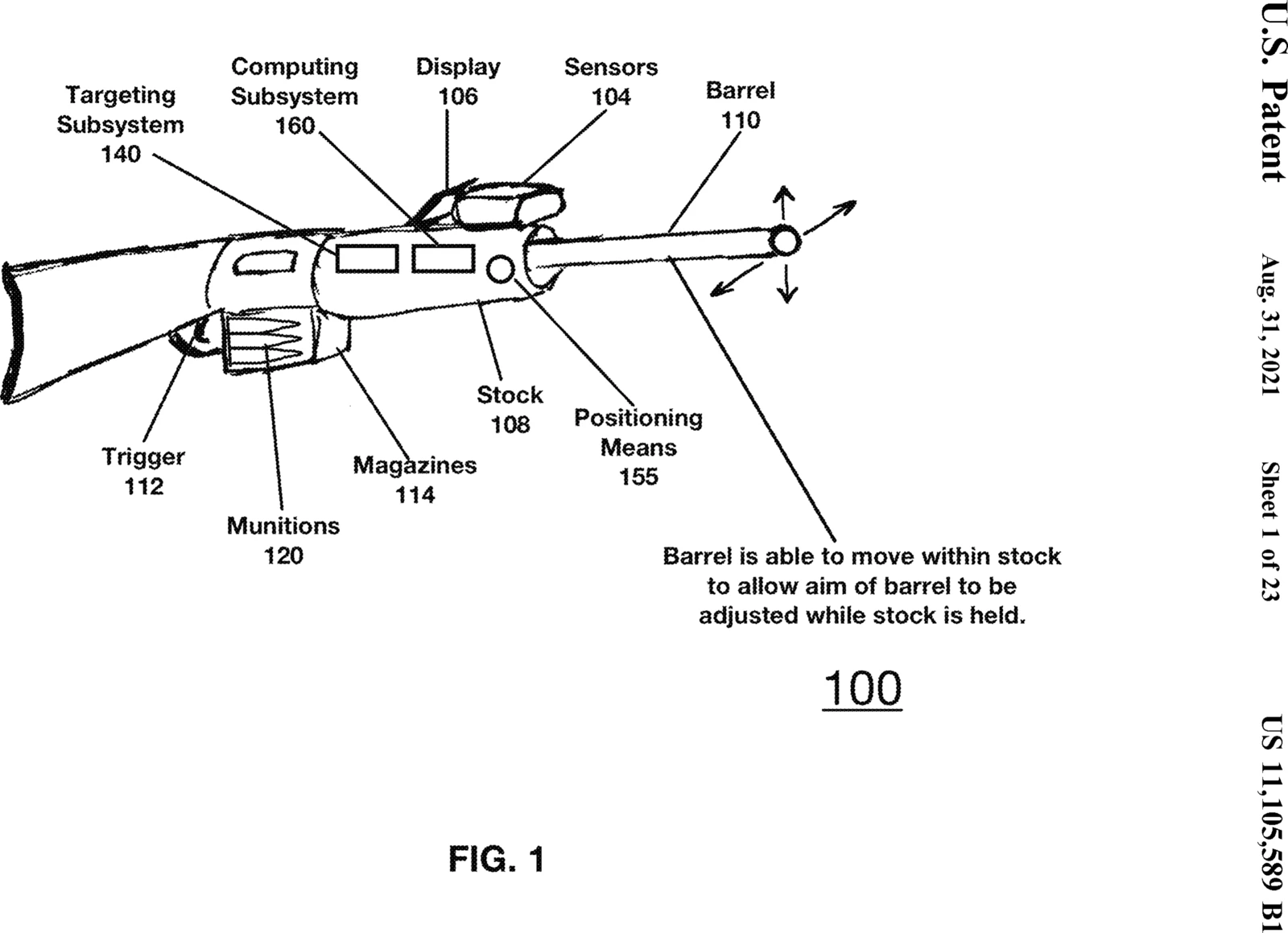
AWS patent US 11,105,589 describes a barrel movably mounted within a stock, so the aim of the barrel can be adjusted while the stock stays in the shooter's hands. The computational subsystem determines where the chosen target is and where the barrel needs to be aimed, the positioning means adjusts the barrel, and the firing subsystem fires responsive to that positioning.
The shooter still shoulders and points the rifle. Fulcrum is built to make the final correction inside a limited mechanical window, not to swing the muzzle wherever it likes. One AWS patent embodiment restricts target selection to targets within the system's range of barrel correction, specifically so the round can reach the target it picked. The operator has to get the weapon close enough for the mechanism to finish the alignment.
The closest everyday analogy is a stabilized camera gimbal built into a rifle. The difference is that this gimbal has to stay accurate while containing chamber pressure, shedding heat, feeding ammunition, and absorbing recoil.
What the Patent Drawings Actually Show
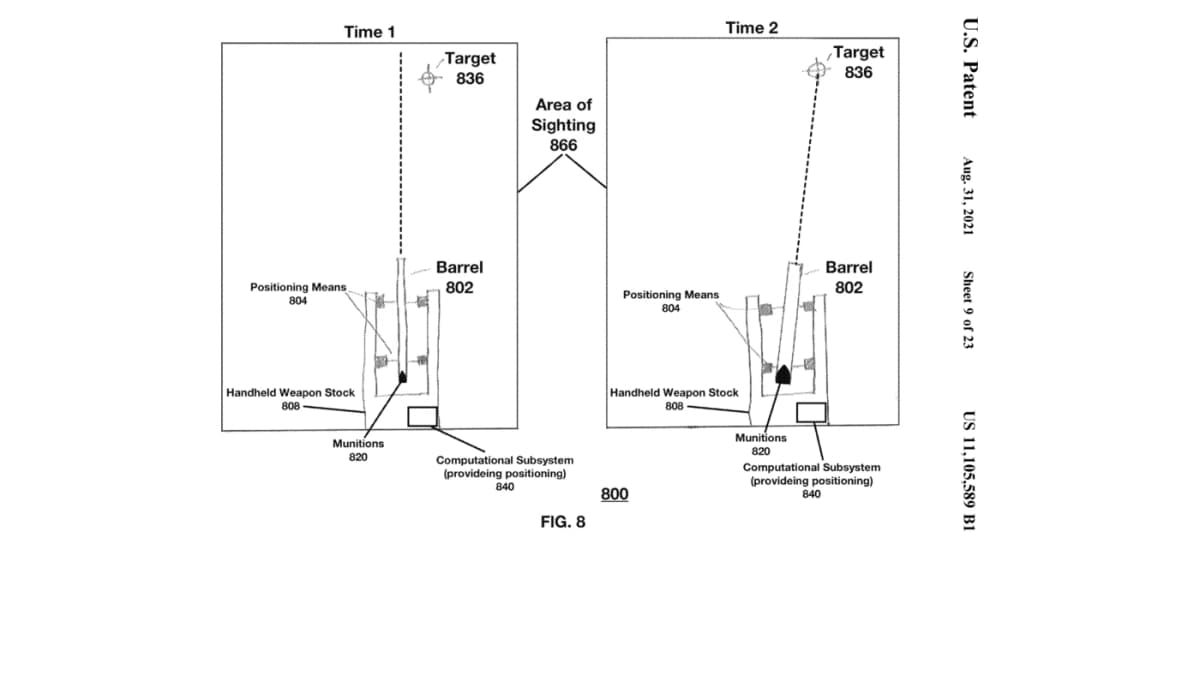
Figure 8 of US 11,105,589 shows the whole concept in two frames. At Time 1 the system detects an error between where the munition will strike at firing time and where the target will be. At Time 2 the positioning means has changed the barrel angle so the projected shot path intersects the target. The stock has not moved.
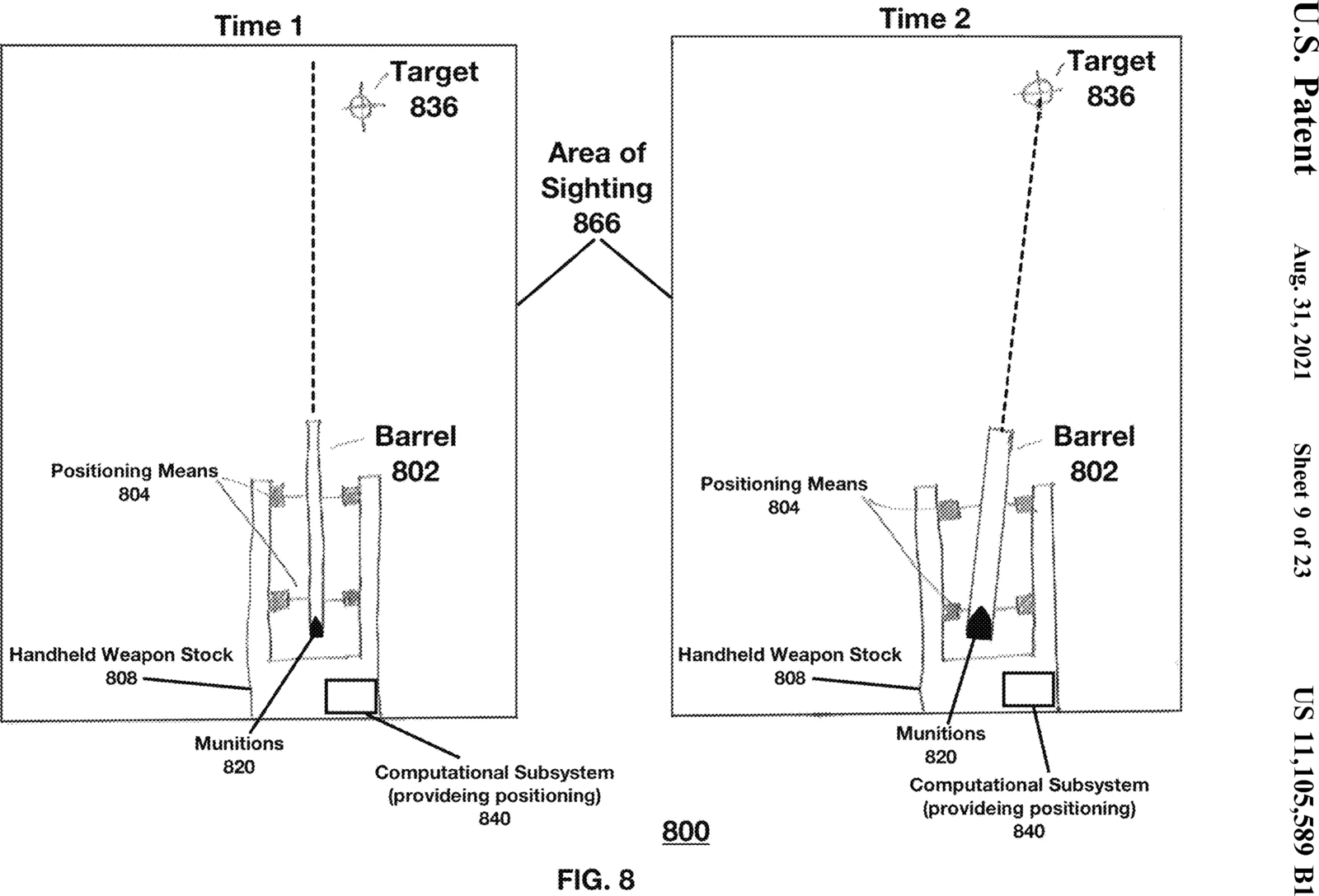
The patent was filed June 10, 2020 and granted August 31, 2021 to inventors Brett C. Bilbrey and David H. Sitrick, with assignment recorded to Advanced Weapons Systems on September 4, 2025. It leaves the actuator technology deliberately open, listing positioning means that can use electrical, thermal, magnetic, mechanical, or pneumatic actuators. That is patent breadth, not a production specification.
The family is larger than one filing. AWS holds twelve granted U.S. patents, all from applications filed on a single day, June 10, 2020, plus a pending application filed April 10, 2024 covering automated handheld weapons linked with a drone. US 12,631,428 granted May 19, 2026 and continues the same architecture of sensing, target selection, computational aim correction, and firing after the aim has been adjusted. One 2023 grant carries the mechanism in its title outright: US 11,703,307, method of human transported weapon with movably mounted barrel adjusted at firing time with use of neural network.
Those filings range well past the current public product story, into target classification, firing inhibition, munition selection, linked weapons, and drone integration. Those are patent embodiments rather than confirmation that every feature is installed on a Fulcrum- equipped rifle. The moving barrel is not one of the optional paragraphs, though. It is drawn and described repeatedly.
AWS Is Protecting a Whole Rifle System, Not One Part
Three pending trademark applications sketch the product family, and they were not all filed at once. TAR and DRAGONHUNTER were both filed on August 10, 2026, serial numbers 50041117 and 50041185. FULCRUM BARREL followed fifteen days later on August 25.
TAR covers rifles and rifle parts including actions, hand guards, hand grips, and fore ends, and lines up with the Trajectory Adjusting Rifle named on the AWS website. DRAGONHUNTER is filed specifically for rifle scopes, matching the DragonHunter Optics the site displays alongside it. FULCRUM BARREL covers the barrels themselves.
The naming is not fully settled in public. The AWS website leads with Trajectory Adjusting Rifle and DragonHunter Optics. The Morse biography calls the weapon the Advanced Battle Rifle. AWS has not explained whether those are the same platform under two names, or a program description alongside a product name. What the filings do show is a company protecting a rifle, an optic, and the barrel technology that performs the correction, which is a system rather than a smart scope bolted to a conventional gun.
Ballistic Computation You Can Buy Today
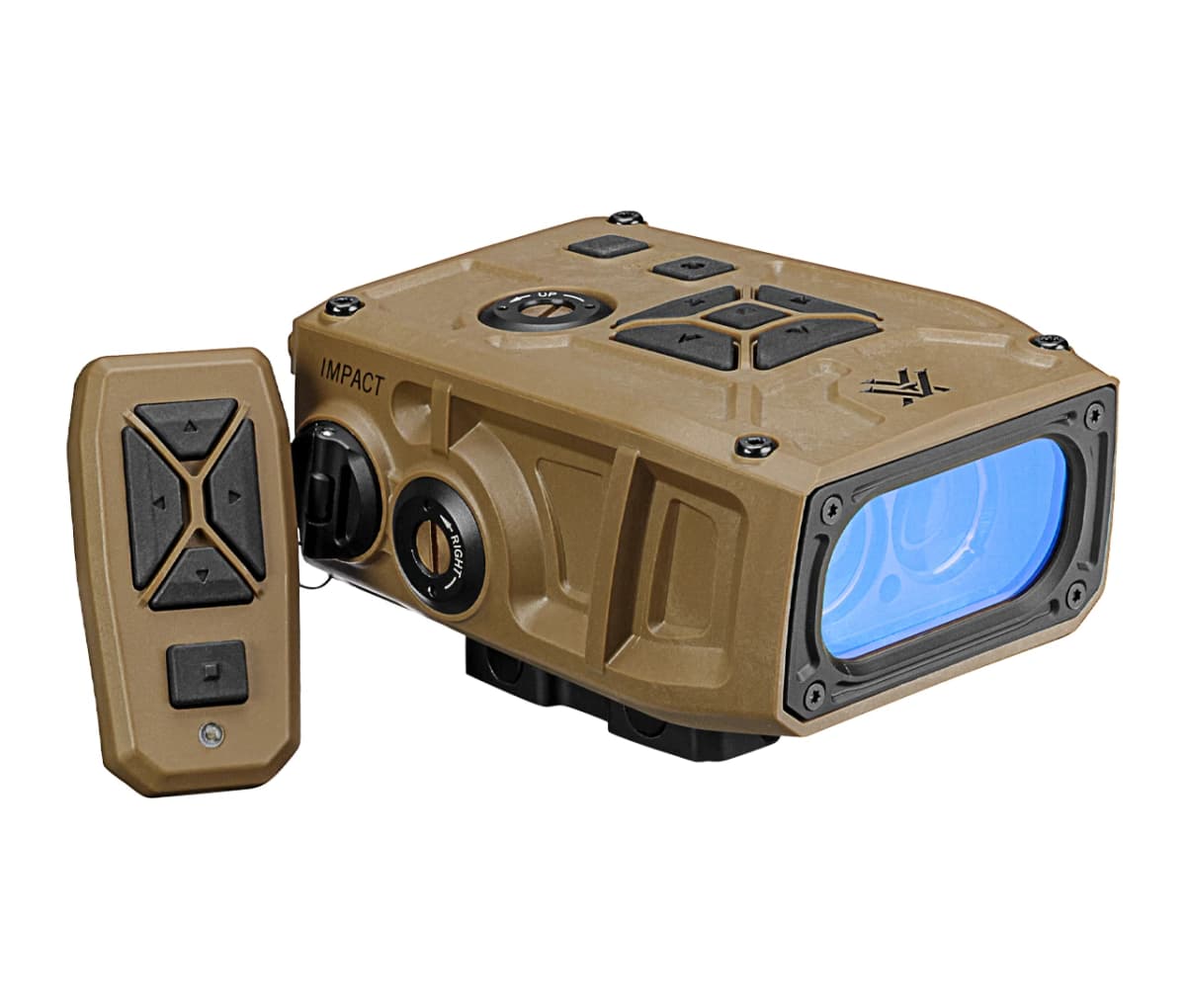
Impact 4000 Ballistic Rail-Mounted Laser Rangefinder
- Picatinny or diving-board mounted weapon LRF
- Up to 4,000 yd reflective / 2,500 yd tree / 1,500 yd deer
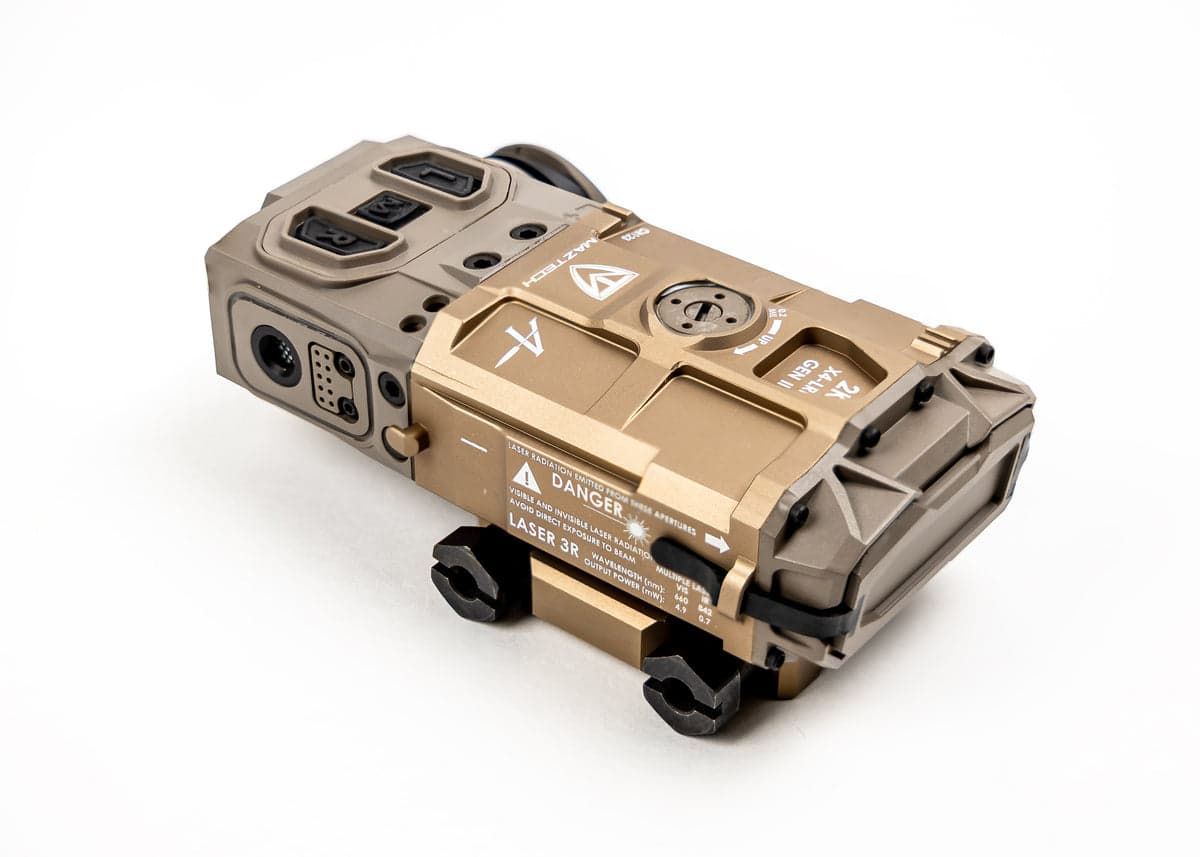
X4-LRF 2K Gen II Rangefinder
- STANAG 4694 rail mount compatible with Picatinny MIL-STD-1913
- 2K 905 nm rangefinding laser with co-aligned visible and IR aiming lasers
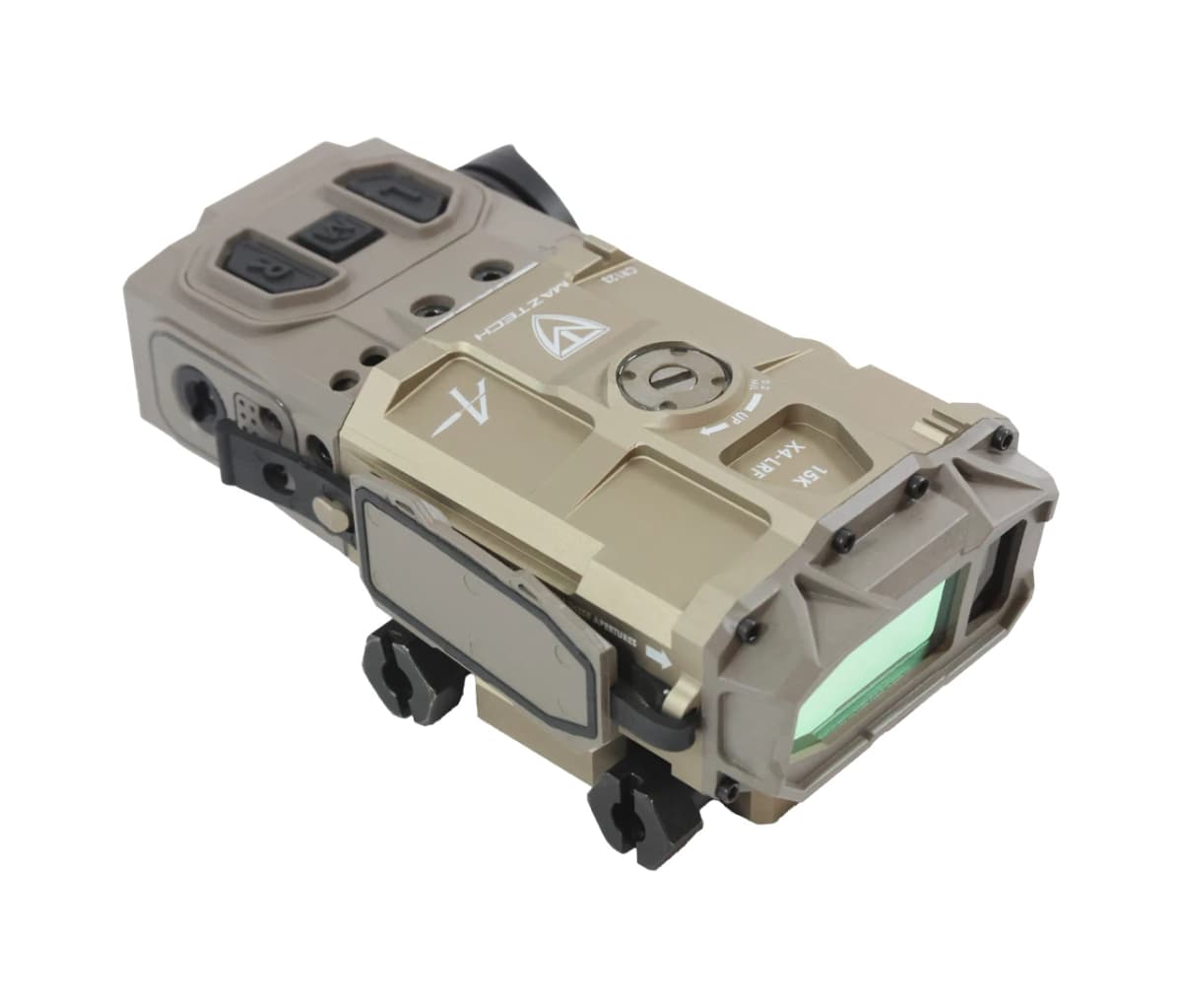
X4-LRF 15K Rangefinder
- STANAG 4694 rail mount compatible with Picatinny MIL-STD-1913
- 15K 1534 nm rangefinding laser with co-aligned visible and IR aiming lasers
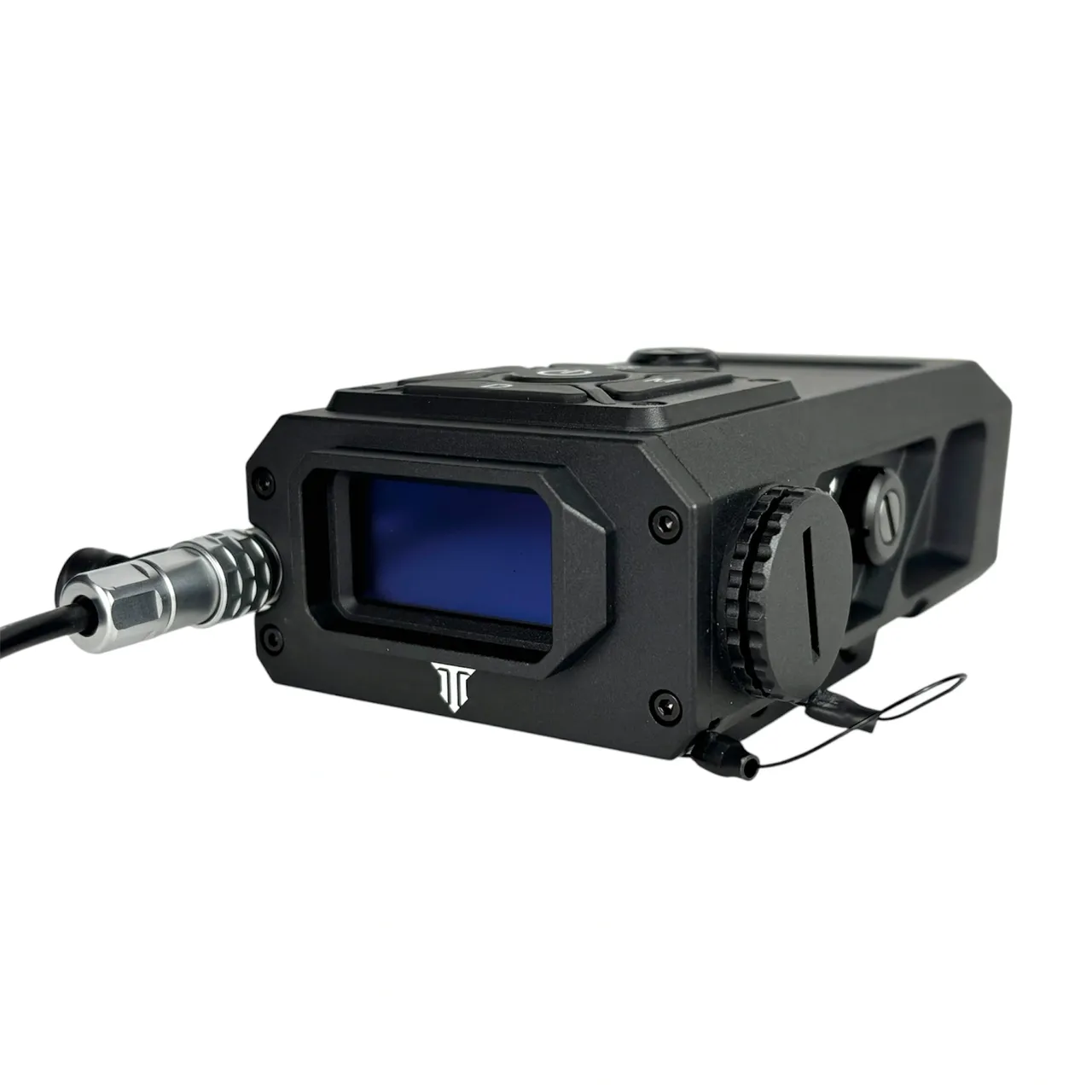
FIRE4000 AB Elite Ballistic Rangefinder
- 4,000 yd reflective / 1,500 yd vegetation / 1,200 yd animal
- Applied Ballistics and AB Quantum app support
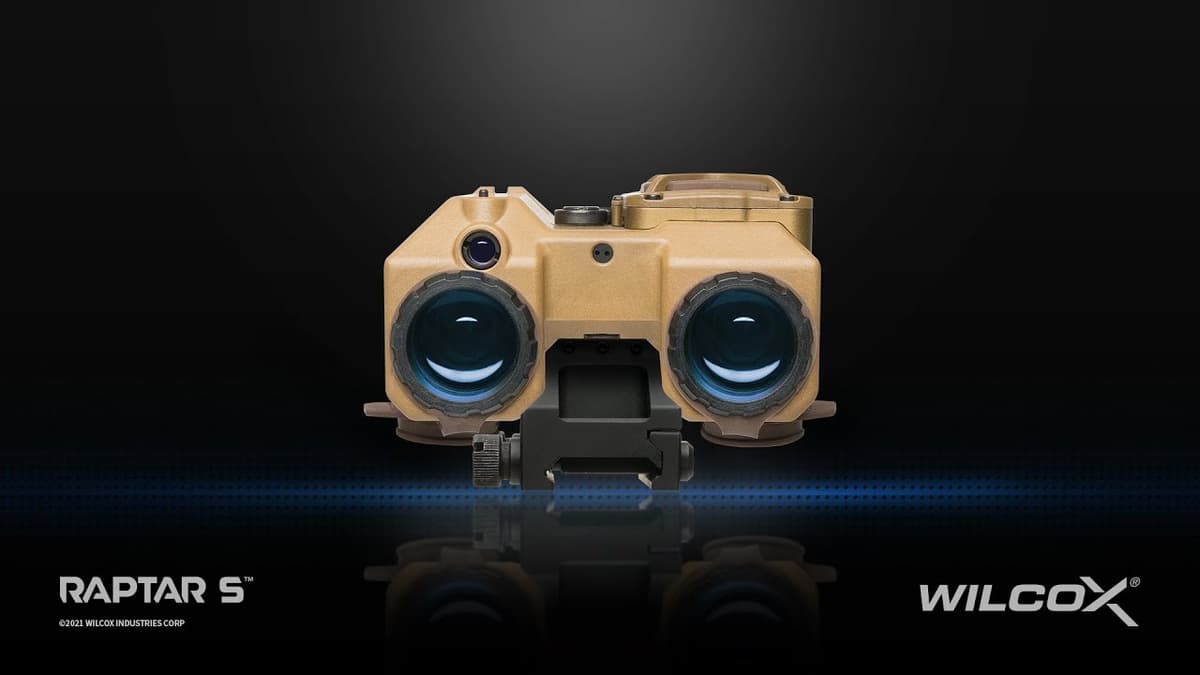
RAPTAR S Red Laser Low Power Rangefinder
- 1,500 m laser rangefinder
- Applied Ballistics solver with G1/G7 custom drag curve support
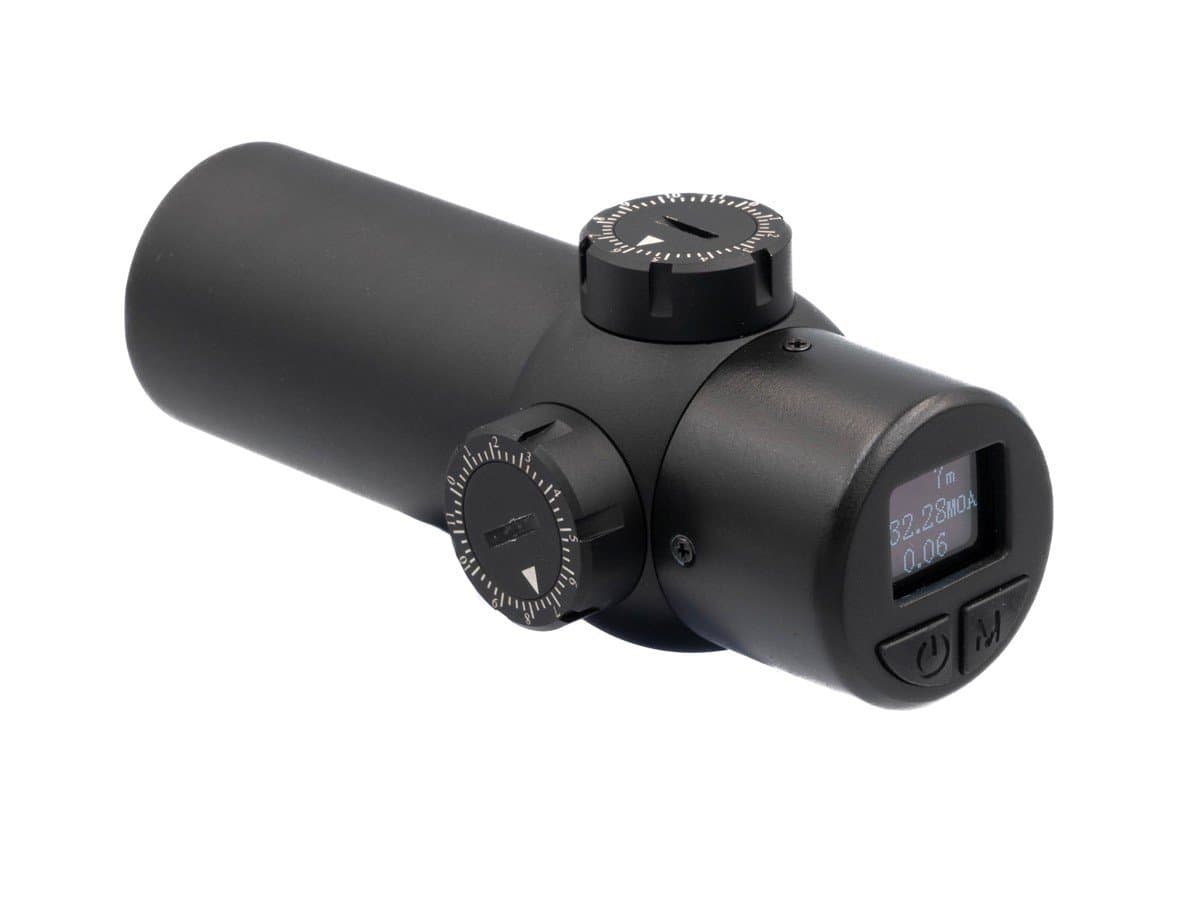
Rangefinder Module w/ Ballistic
- Weapon-mountable ballistic rangefinder module
- 1,000 m maximum range
Affiliate links (?)
Why Moving the Barrel Changes the Smart-Rifle Equation
Display-based fire control of the kind the Army fields on the XM157 leaves the bore mechanically fixed to the rifle, which means the shooter still has to move and hold the whole weapon until it points correctly. A ballistic computer can solve for range, drop, wind, and lead. A digital optic can draw that solution as a corrected reticle. Some systems will hold the shot until the shooter's aim crosses an acceptable window. None of them reduce the angular error themselves.
That is the problem Fulcrum targets. Human aim is never static. The rifle moves with breathing, muscle tremor, posture, trigger manipulation, and whatever instability the shooting position carries. When the target is also moving, the correct firing solution keeps changing while the shooter is still trying to finish the shot. An articulated barrel gives the computer a second option: shrink the error instead of reporting it.
The counter-drone case is where AWS is pushing hardest. The company lists counter-drone capability as a key outcome and says its precision tracking is directly applicable against modern, low-cost UAS threats. Small fast drones are a hard tracking and lead problem, especially when shooter and target are both moving, and the economics of drone warfare make a rifle-launched answer attractive. AWS has published no counter-UAS test results. Purpose-built optics such as the EOTech HWS CUAS attack the same problem from the sighting side instead.
For a civilian shooter the practical comparison is what already exists. A quality laser rangefinder with a ballistic solver plus a long-range scope with repeatable turrets solves the calculation half of the problem today and leaves the holding half to the shooter. The Army's fielded answer, the Vortex XM157 fire control, packs a rangefinder, solver, and digital display into one unit and still leaves the bore fixed to the receiver.
The Army Demonstrated This Idea in 2015
AWS is not the first organization to articulate a rifle barrel under computer control. A 2015 U.S. Army presentation on the Advanced Small Unit Small Arms Technology research program described an active stabilization technology called AimLock, in which the barrel and receiver were articulated independently from the shooter-interface components. The grips, stock, and optic mounted to an outer carriage that enveloped the moving parts, while target-tracking software and electromechanical actuators redirected the internal barrel and receiver relative to that carriage.
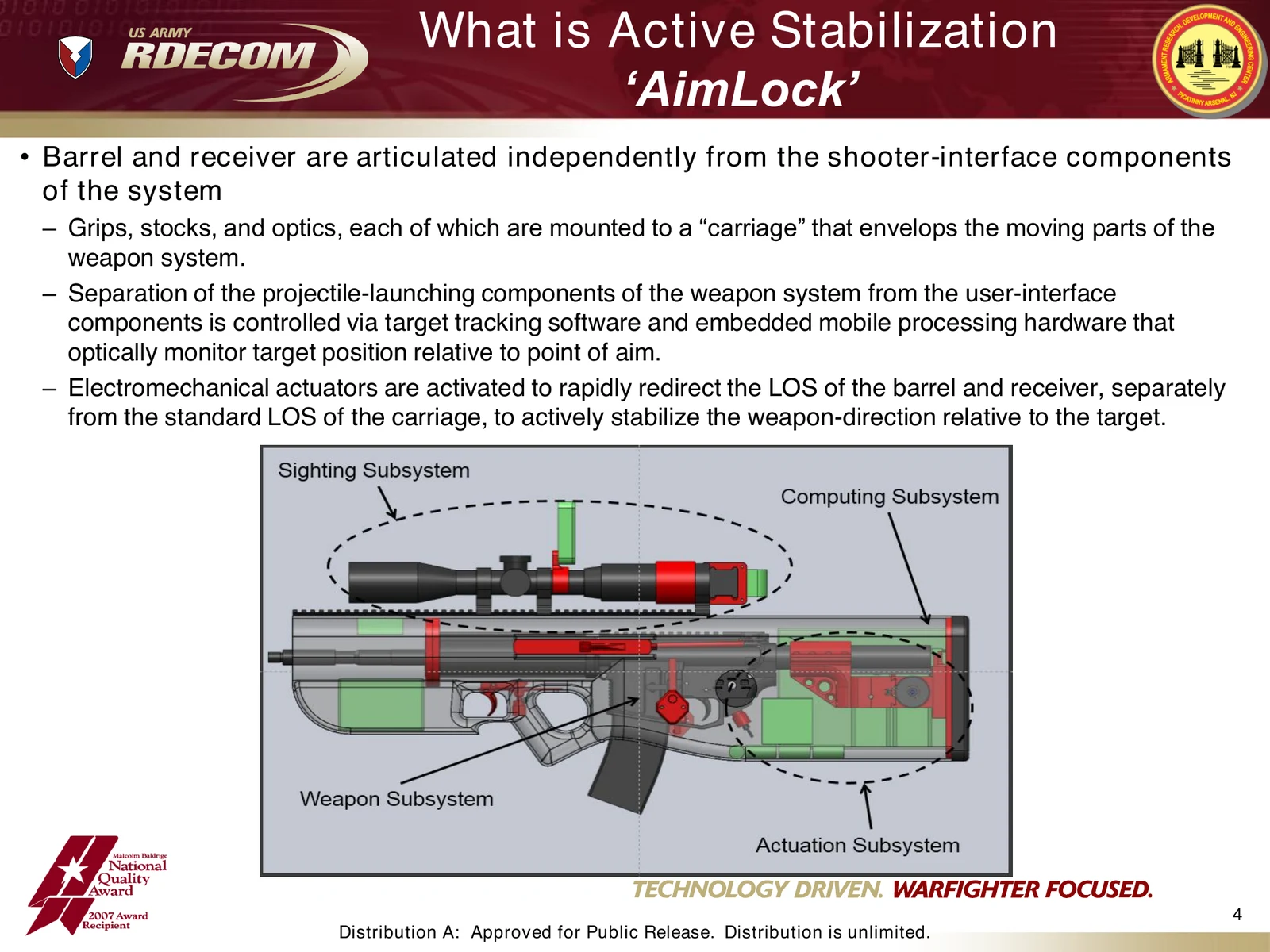
The program aimed squarely at shooter wobble from unsupported positions, setting a threshold of 10 percent and an objective of 25 percent reduction in baseline dispersion. Phase I integrated optical target detection and tracking with active electromechanical stabilization and demonstrated a proof of concept on an M4-type platform. Phase II ran live fire and reported improved hit probability for both skilled and unskilled shooters with decreased engagement time against stationary and moving targets. Phase III, still in progress at the time of the briefing, added inertial sensors, rangefinding, barometric and wind sensors, and ballistics engines. Live fire ran at roughly 100 yards on a 12-inch steel plate with 5.56 and 7.62 stabilized platforms.
That history cuts two ways. It confirms that physically stabilizing a barrel is buildable rather than a patent-office thought experiment, because a government program built demonstrators and shot them. It also means AWS will not be significant for being first. Its opportunity is turning the concept into something compact, integrated, and useful with a decade of newer computer vision, sensor processing, and embedded hardware. There is no public evidence connecting the AWS team to the Army program, and the two designs should not be treated as the same system.
The Hard Part Is Surviving as a Rifle
A conventional firearm depends on extremely repeatable relationships between barrel, chamber, bolt, receiver, feed path, and sights. Fulcrum introduces deliberate movement into a structure whose entire value is rigidity, and that is the engineering bill AWS has to pay.
AWS has not disclosed whether the production concept moves the barrel alone, a barrel and extension assembly, the barrel and receiver together, or a larger internal module. That single choice drives feeding, lockup, recoil management, and how the system tracks the changing angle between optic and bore. Mechanical play is the next problem: any backlash in the pivot, bearing, or actuator becomes angular uncertainty at the muzzle, and small errors at the mechanism become large displacement downrange.
Timing is the third. The loop has to detect movement, update the target track, compute the solution, command the actuator, reach the corrected angle, and settle or lock before ignition. Run that loop too slowly and the rifle or the target has already invalidated the answer. Then come the ordinary facts of a fielded weapon: heat, recoil, carbon, dust, water, impact, battery life, and wear. The mechanism has to hold calibration across all of it and fail predictably when a sensor, motor, or computer does not cooperate.
AWS says it is advancing the technology through validation and testing. It has not released a correction envelope, actuation speed, accuracy data, durability results, or an independent live-fire evaluation. Moving a barrel is the easy claim. Moving it fast and precisely without giving up what a rifle is supposed to be is the part that decides whether Fulcrum matters.
What Is Confirmed and What Is Not
Confirmed: AWS publicly describes an aim-stabilized rifle combining machine vision, sensor fusion, ballistic computation, and an articulated barrel that adjusts at trigger pull. Its patents illustrate and claim a barrel moving within a stock under computational control. Its FULCRUM BARREL application covers firearm barrels. Its co-founder's current biography identifies the Fulcrum Barrel as part of the Advanced Battle Rifle.
Not confirmed: there are no published specifications for caliber, weight, power consumption, correction angle, or response time. The exact moving assembly has not been disclosed. There is no public performance comparison against a conventional rifle, no durability testing, and no independently verified live-fire demonstration of the current system. FULCRUM BARREL is also a pending application rather than a registration, and Bison Armory has sold a conventional Fulcrum barrel line since 2015, so the name is not an uncontested exclusive right.
The open question is no longer whether Fulcrum Barrel belongs to the AWS self-correcting rifle. It does. The question is whether a company this small can turn a deep patent portfolio and a genuinely clever mechanism into a weapon that produces measurable gains without sacrificing the reliability of the rifle it means to replace.
Stay Updated on Smart Rifles and Fire Control
New fire control systems, aim-stabilization programs, and the optics that actually ship, sent when there is something worth reading.