Key Takeaways
- →Purpose-built drone reticle: a primary aiming dot inside fractured outer circles for hovering aircraft, with four lead references for crossing targets.
- →Calibrated holds, no math: against a drone crossing at 30 mph on a 90-degree path, the inner dots hold at 50 meters and the outer chevrons at 90 meters.
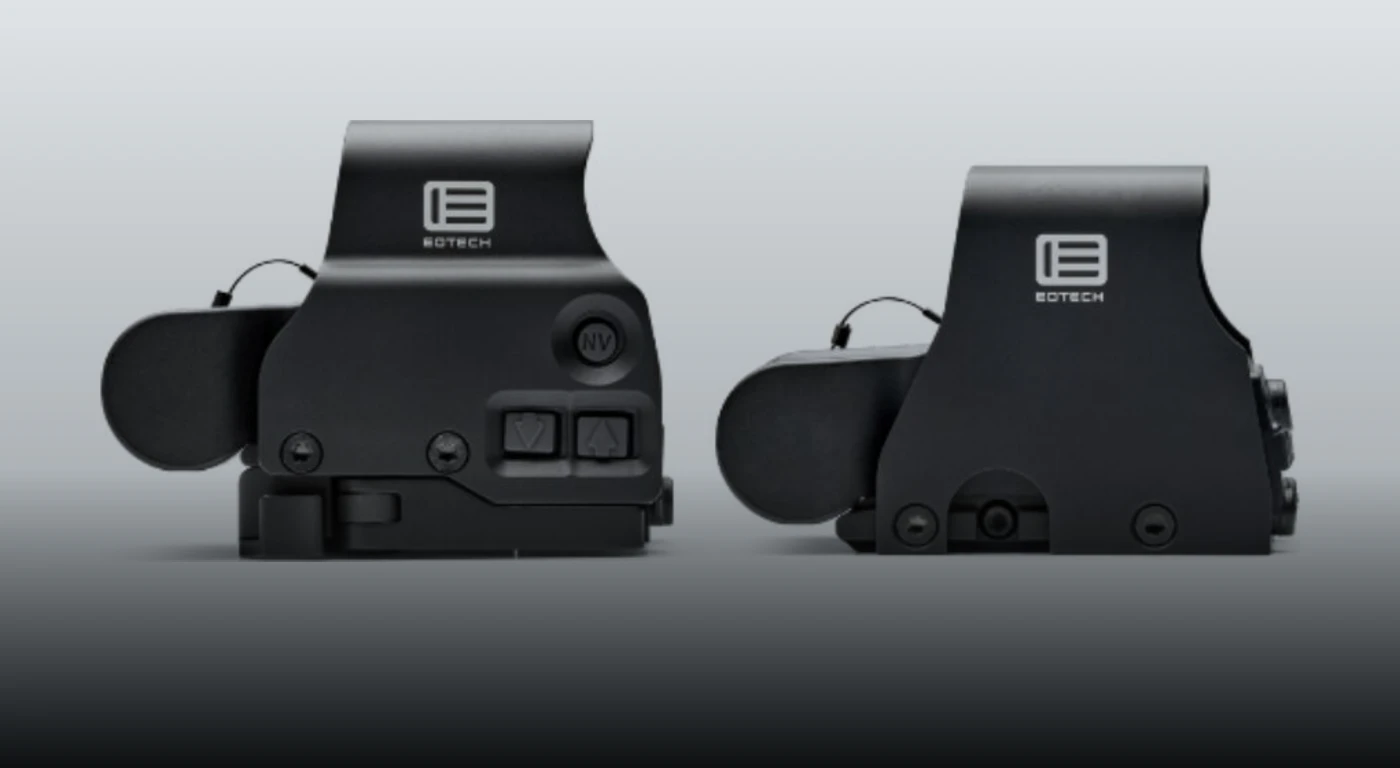
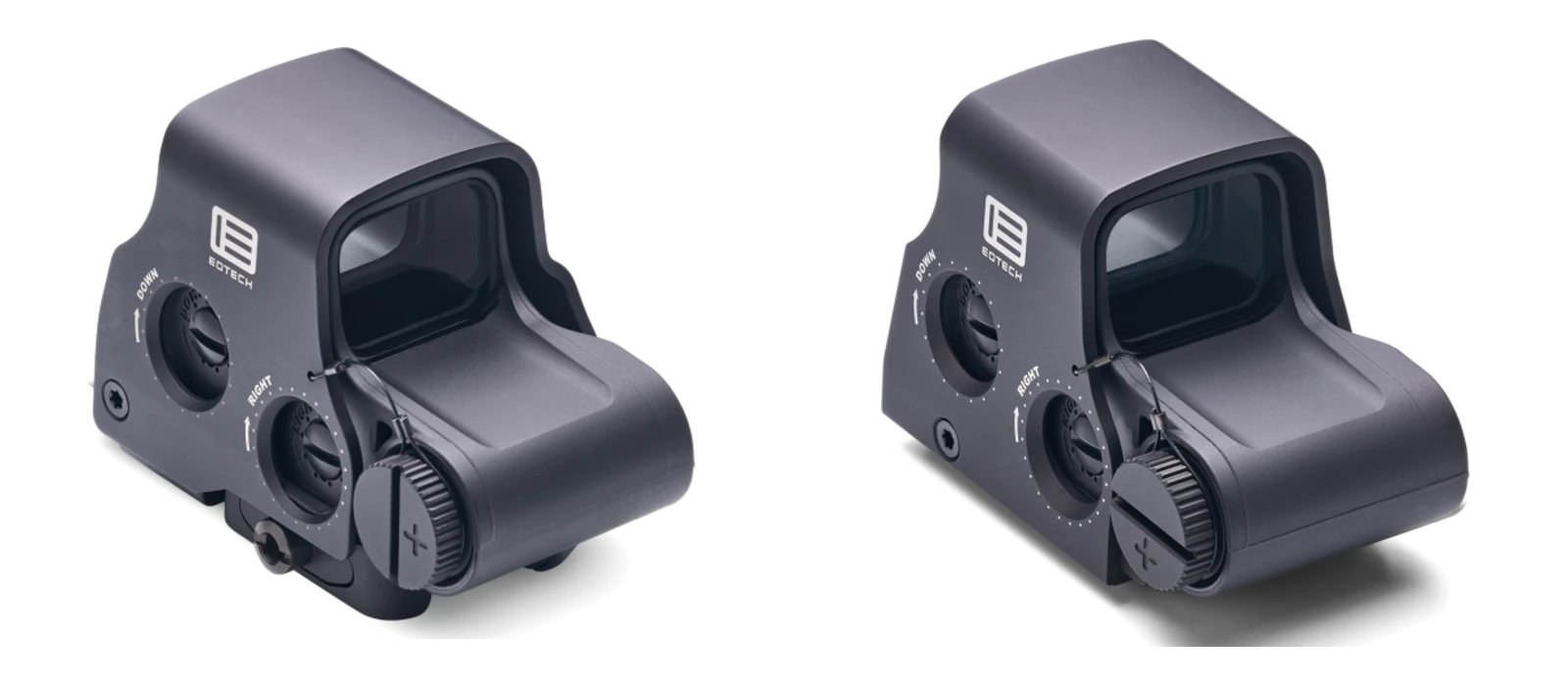
- →Two bodies: EXPS3 at 11.2 oz with side buttons, a lockable quick-detach lever, and lower 1/3 co-witness; XPS3 at 9.0 oz with rear buttons, a 7/64 hex crossbolt, and true co-witness.
- →Unchanged hardware: single CR123 at 1,000 hours on setting 4, 20 daylight and 10 night vision brightness settings, 0.5 MOA clicks, submersible to 33 feet, made in the USA.
- →No price yet: EOTech has not published an MSRP and the CUAS is not listed on eotechinc.com. The standard EXPS3 lists at $859 and the standard XPS3 at $799.
What EOTech Actually Changed
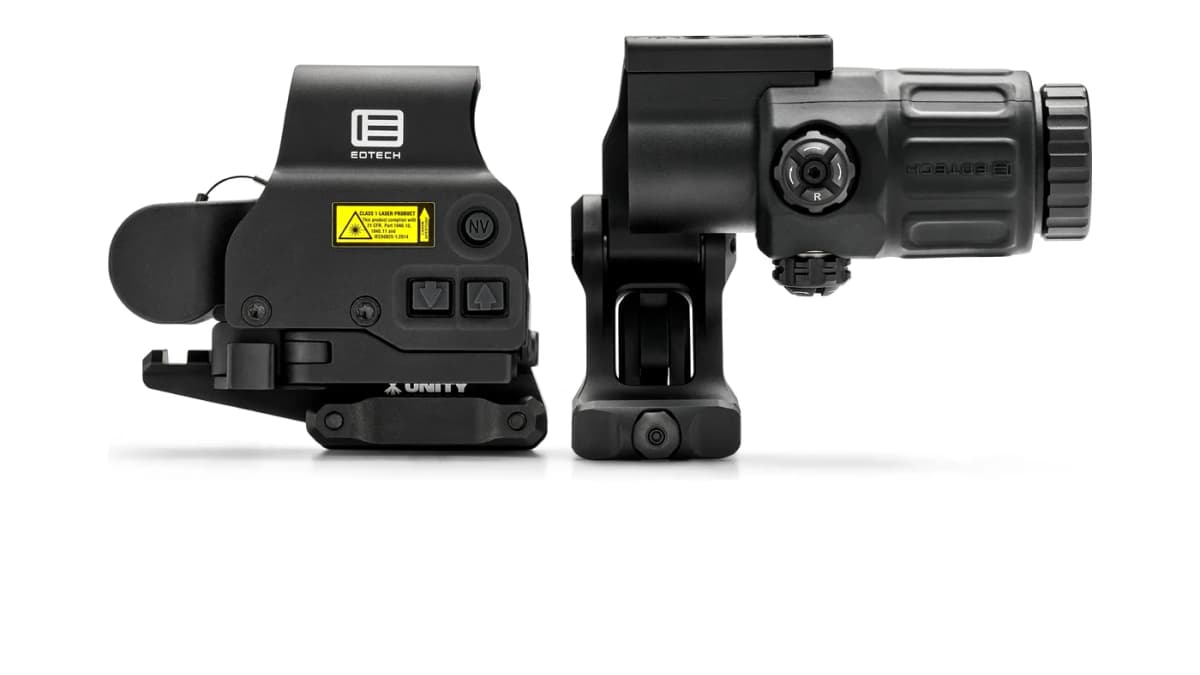
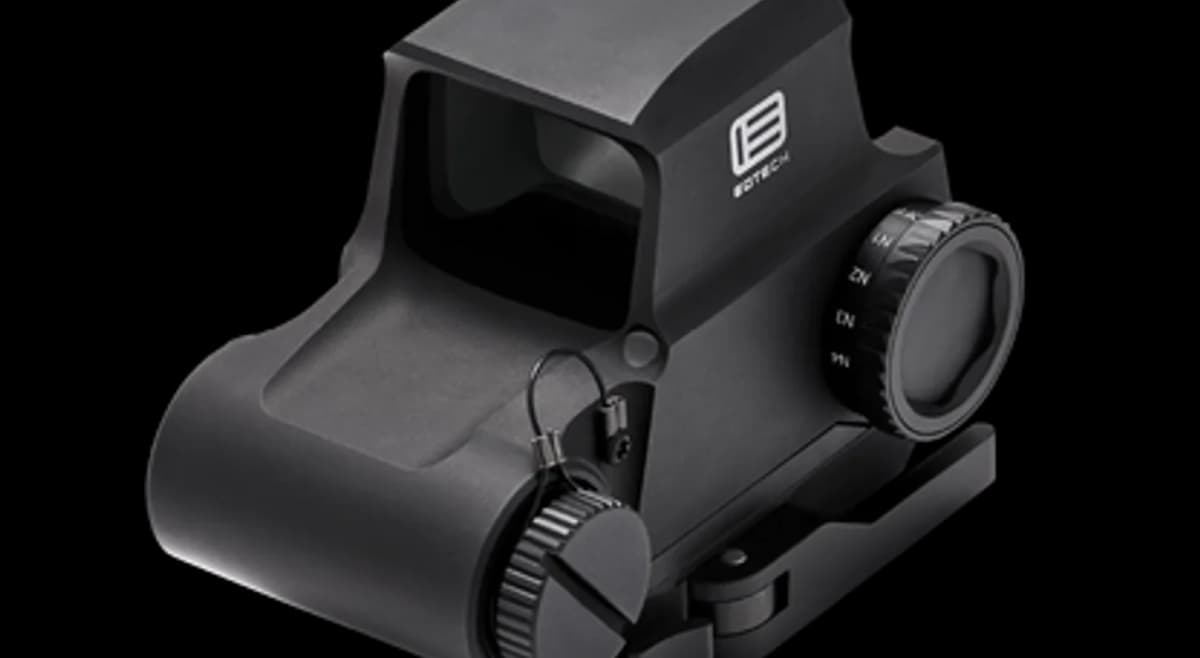
EOTech changed the reticle and nothing else. The HWS CUAS is the existing EXPS3 and XPS3 hardware carrying a new holographic pattern built around drone engagement geometry: a primary aiming dot ringed by fractured outer circles, flanked by two inner dots and two outer chevrons that serve as lead holds. Housing, window, battery compartment, button layout, adjustment turrets, and mount interface all carry over from the sights EOTech has been shipping for years.
That is a deliberate engineering choice rather than a shortcut. A unit that already trains on EXPS3 sights gets a counter-drone capability without a new manual of arms, a new battery logistics line, or a new mount inventory. The optic that comes off the rack for a drone response has the same zeroing procedure, the same brightness controls, and the same quick-detach behavior as the one already on the rifle.

How the Reticle Solves the Lead Problem
The reticle turns a moving-target lead calculation into a hold-off you can see. EOTech built the spacing around a drone crossing at 30 mph on a 90-degree path: at 50 meters the shooter puts the inner left or right dot on the aircraft, and at 90 meters the outer chevron on the same side takes over. The center dot inside its fractured circles is the hold for a stationary or hovering target, where the broken circle segments give the eye something to snap onto against open sky.
Leading a small aerial target by feel is the part shooters get wrong, because there is no ground reference to judge speed against and the aircraft subtends almost nothing at 90 meters. Baking two distances and two directions into the glass removes the estimate. The shooter picks a reference, not a number. The threat driving that design is the class of aircraft covered in our Shahed drone explainer, where cheap airframes arrive in volume and gun-based defenses have to solve the lead problem hundreds of times a night.
This is also why EOTech built it as a hologram rather than an LED reflex pattern. “Holography is essential when designing large pattern reticles. The CUAS reticle is achieved through complex and often expensive unconventional optics to correct for parallax error and other aberrations,” said Todd Estes, VP of Engineering at EOTech. “The holographic solution ensures that all the potential aiming points stay in focus at the target position regardless of the size and shape of the reticle.” With five aiming references spread across the window, a head position slightly off the optical axis is exactly the condition that would walk the outer holds off target on a conventional reflex sight. For the broader technology comparison, see our holographic sights versus red dots breakdown.
EXPS3 or XPS3: Which Body to Pick
Pick the EXPS3 if a magnifier or night vision device is going behind the sight, and the XPS3 if weight and a permanent mount matter more. The EXPS3 puts its brightness buttons on the left side of the housing, so they stay reachable with a magnifier on a flip-to-side mount crowding the rear of the optic. It rides on an adjustable, lockable quick-detach lever and sits at lower 1/3 co-witness with iron sights.
The XPS3 drops 2.2 oz to 9.0 oz and shortens the footprint by 0.2 inches in width, with the buttons moved to the rear of the housing and a 7/64 hex crossbolt in place of the lever. It sits at true co-witness. That crossbolt is the tell for the intended use: a sight that stays on the gun, on a rifle or shotgun kept ready for a drone response, rather than one that comes on and off between roles.
EOTech HWS CUAS Specifications
HWS CUAS (EXPS3 and XPS3)
| Dimensions (EXPS3) | 3.8" x 2.3" x 2.6" (96.5 x 58.4 x 65 mm) |
| Dimensions (XPS3) | 3.8" x 2.1" x 2.5" (96.5 x 53.3 x 64 mm) |
| Weight (EXPS3) | 11.2 oz (317.5 g) |
| Weight (XPS3) | 9.0 oz (255 g) |
| Water resistance | 33 ft (10 m) depth |
| Mount | 1" Weaver or MIL-STD-1913 rail |
| Zero adjustment | 0.5 MOA per click |
| Brightness | 20 daylight, 10 night vision |
| Battery | One CR123 |
| Battery life | 1,000 continuous hours at setting 4 |
| Mounting (EXPS3) | Lockable quick-detach lever |
| Mounting (XPS3) | 7/64 hex crossbolt |
| Co-witness (EXPS3) | Lower 1/3 |
| Co-witness (XPS3) | True / absolute |
| Origin | Made in USA |
| MSRP | Not announced |
Shop Current EOTech Holographic Sights
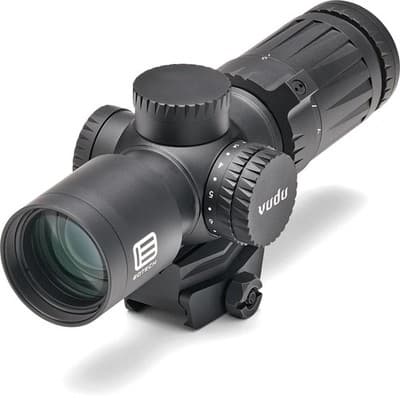
EOTech Vudu 1-10x28 FFP
- 1-10x magnification
- First focal plane
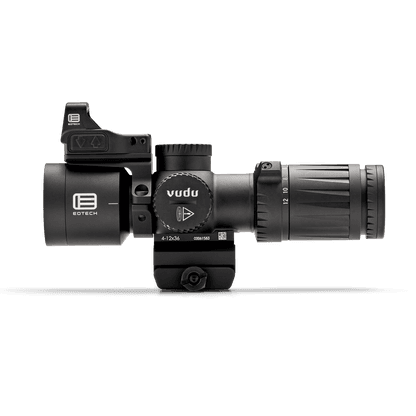
EOTech Vudu 3-9x32 SFP
- 3-9x magnification
- Second focal plane
EOTech Vudu 4-12x36 FFP
- 4-12x magnification
- First focal plane

EOTech EXPS3
- Holographic reticle
- Night vision compatible
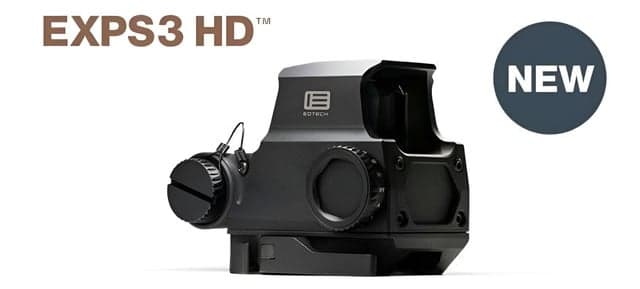
EOTech EXPS3 HD
- All-aluminum housing
- Rotary brightness dial

EOTech XPS2
- Holographic reticle
- 1 MOA dot + 65 MOA ring
Affiliate links (?)
What This Means for Civilian Buyers
The optic itself carries no special restrictions, but the engagement it is built for does. Federal law classifies an unmanned aircraft as an aircraft, which puts shooting one down in reach of 18 U.S.C. 32, destruction of aircraft, a felony. Counter-drone authority is delegated rather than general: DHS and the Justice Department have held it since 2018 under 6 U.S.C. 124n, and an interim final rule effective July 1, 2026 extended it to state, local, tribal, and territorial law enforcement. Private property owners are not on that list, and a drone over your yard does not put them there. Our explainer on whether you can legally shoot down a drone over your property walks the statutes, the jamming prohibition, and the state-law remedies that do apply.
Setting the law aside, it is also a poor general-purpose reticle. Five aiming references spread across the window is clutter when the target is a silhouette at 50 yards, and the outer chevrons hold for a 30 mph crossing aircraft, not for anything on the ground. For a rifle that has to do everything else, the standard 68 MOA ring with a 1 MOA center dot is the reticle that made EOTech's reputation, and the EXPS3 that carries it runs $815.
The more interesting signal is the category. Counter-drone work has largely belonged to jammers, nets, and dedicated systems, and this approach needs none of that: it is a reticle change on a rail-mounted optic, running on the rifle or shotgun already in the rack. The jamming half of that answer is exactly what fiber optic drones were built to defeat, which is why small arms keep coming back into the picture. Guns are the last rung on a counter-drone ladder that starts with jamming. Sight makers have spent years optimizing reticles for targets on the ground; the CUAS is cut for one above the horizon. Our EOTech model guide covers which of the current sights fits which role, and you can mount any of them on a build to check clearance against a magnifier or offset iron sights.
Availability and Pricing
EOTech announced the HWS CUAS as a development on August 10, 2026 and has not published an MSRP, a ship date, or a product page for it. The announcement describes the sight in both EXPS3 and XPS3 models with full specifications, which puts it past the concept stage, but there is no dealer listing to point at.
For a pricing frame, EOTech lists the standard HWS EXPS3 at $859 and the standard HWS XPS3 at $799 on its own site. The CUAS uses the same housings, glass, and electronics, so those numbers are the floor the reticle change gets added to. The EXPS3 HD announced at SHOT Show 2026 is the other recent movement in the line, adding shake-awake to a platform that has never had it.
Stay Updated on EOTech Optics
We cover new EOTech releases, holographic sight comparisons, and hands-on optic reviews as they land.