Key Takeaways
- →What to buy: M193-spec 55gr FMJ for almost everything. It is typically the least expensive of the three, it is welcome at ranges that ban steel core, and it upsets more consistently than green tip.
- →What separates them: M193 is a 55gr lead-core FMJ, M855 is a 62gr load with a hardened steel penetrator over lead, and M855A1 is a lead-free 62gr copper slug under a 19gr exposed steel penetrator.
- →Velocity: chronographed from a 16-inch barrel, M193 ran 3,055 ft/s and M855 ran 2,997 ft/s. From 11.5 inches they fell to 2,847 and 2,745 ft/s, against a rough 2,500 to 2,700 ft/s fragmentation band.
- →Armor: current NIJ levels put M193 at RF1 (3,250 ft/s reference) and M855 at RF2 (3,115 ft/s). The retired Level III test used only 7.62x51 M80 ball, so a Level III plate was never required to face either one.
- →Federal status: M193 falls outside the federal armor piercing definition outright. M855 is covered by the sporting-purposes exemption ATF granted in 1986 and extended to loose projectiles and cores in Ruling 2026-1 effective July 2, 2026. M855A1 has no published ATF determination either way. State ammunition rules and range policy are separate questions.
Which 5.56 Load Should You Buy?
Buy M193. For range days, carbine classes, zeroing, and general practice, a 55-grain M193-spec load such as PMC X-TAC 55gr FMJ at $11.99 per 20 covers every job a range rifle has, for less money and without the steel penetrator that gets you turned away at indoor ranges and chews up steel targets.
Buy M855 only for a specific reason: you want the steel penetrator for barrier work, or you are stocking a NATO-spec 62-grain load to match a duty rifle, or you want the heavier, higher-BC bullet for wind at distance. It is not match ammunition, it does not upset in soft targets as consistently as M193, and it costs more per round.
M855A1 is not a practical purchase. Lake City produces it under military contract, and as of August 2026 no manufacturer-listed civilian M855A1 load turned up; treat anything on the civilian market as secondary-market ammunition and verify lot and provenance before buying. Our full breakdown of M855A1 covers the specs, the pricing, and why a steady diet of it is hard on a civilian rifle.
If the rifle has a job beyond punching paper, neither ball round is the obvious answer. M193 arrived with the M16 in the 1960s and M855 followed in 1982, and both were built to a military requirement rather than a civilian one. For precision work a match load is built for the job in a way ball is not. For defensive use an expanding bullet works by a different mechanism than fragmentation, with its own velocity envelope that a maker can tune to the barrel you actually own. Our 5.56 ammo selection guide sorts the training, defense, and match lanes.
M193, M855, and M855A1: What Each Round Actually Is
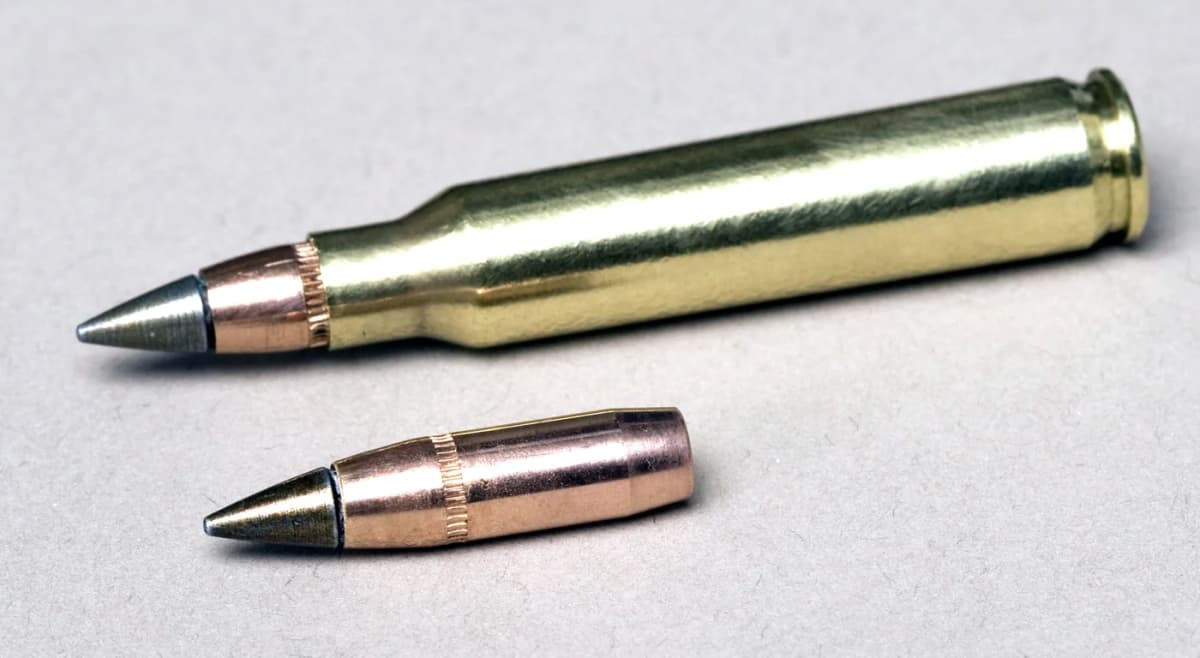
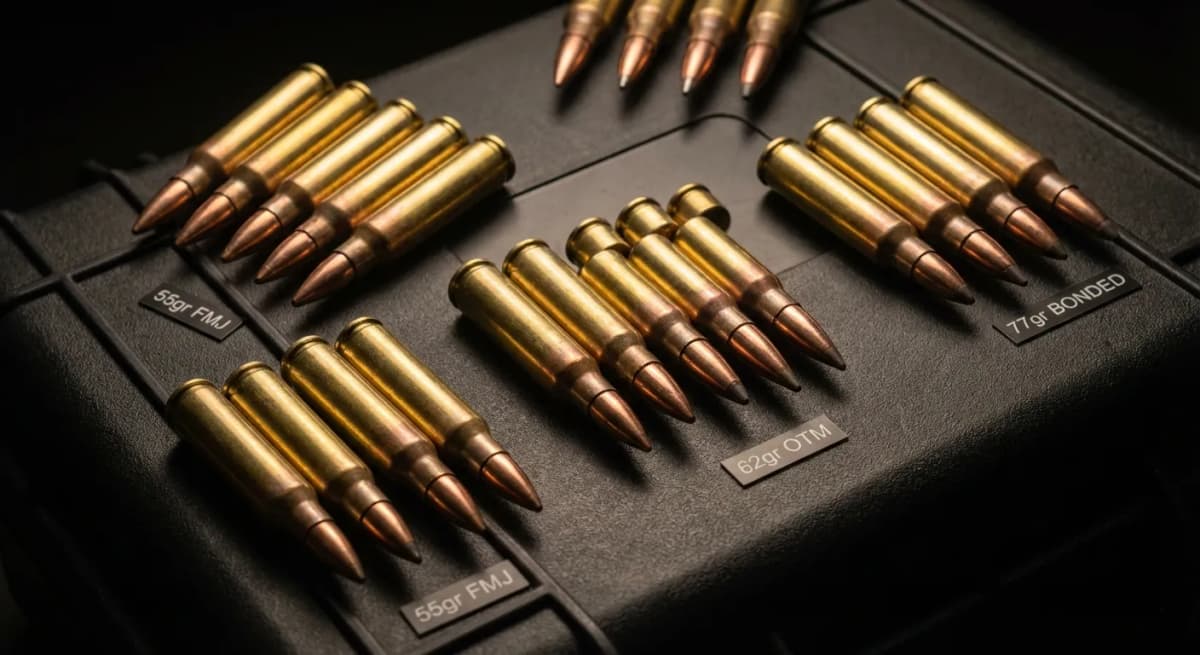
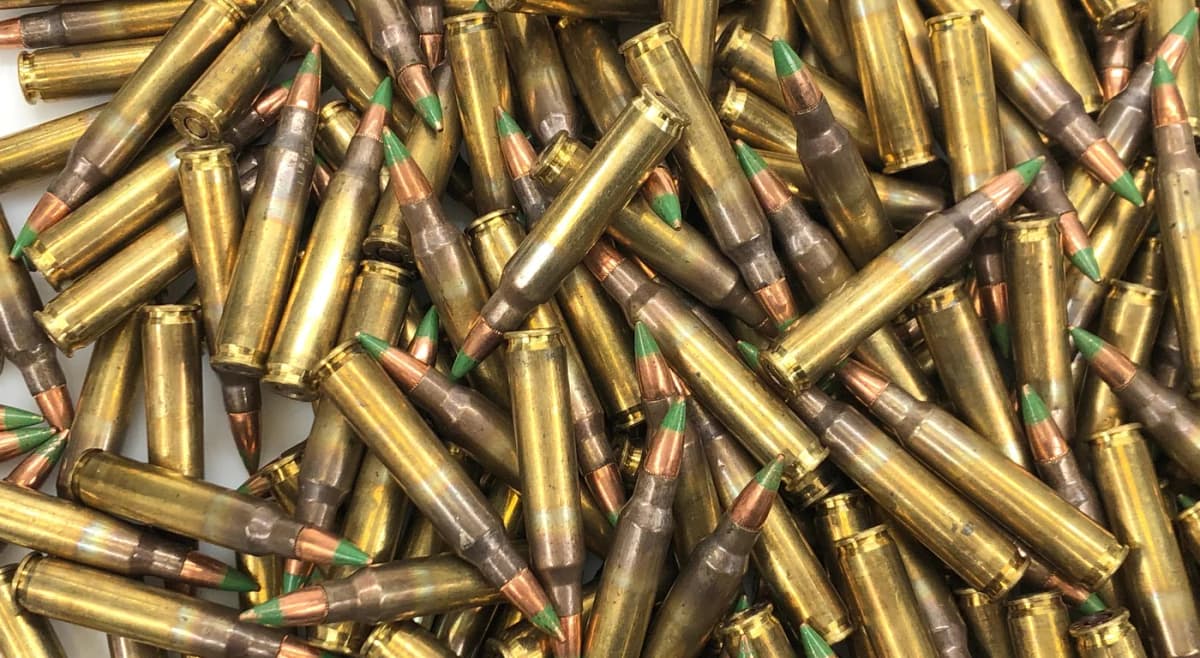
All three are 5.56x45mm ball cartridges, and the projectile is where most of the difference lives. M193 is a 55-grain full metal jacket with a plain lead core and an unpainted copper tip, adopted with the M16 and standard until 1982. M855 is the U.S. designation for the Belgian SS109 specification that NATO standardized in 1980: a 62-grain projectile that seats a hardened steel penetrator at the nose of the lead core and wears a green painted tip to mark it. M855A1 is the Army's 2010 replacement: a lead-free 62-grain bullet stacking a 19-grain hardened steel penetrator, nearly twice the weight of M855's, on top of a solid copper slug.
The M855A1 penetrator is not just heavier. It is arrowhead shaped and fully exposed at the tip, seated in a reverse-drawn jacket rather than hidden under one. What looks like a bronze painted tip is an anti-corrosion coating on the exposed steel itself. M855A1 also changed the cartridge behind the bullet, not only the bullet: it uses a different propellant with a flash suppressant and a de-coppering additive, a reverse-drawn jacket, and different primer staking.
M193
| Bullet weight | 55 gr |
| Core | Lead |
| Penetrator | None |
| Tip marking | Plain copper |
| Adopted | 1960s, standard to 1982 |
| NIJ reference velocity | 3,250 ft/s |
M855 (SS109)
| Bullet weight | 62 gr |
| Core | Lead |
| Penetrator | Hardened steel |
| Tip marking | Green paint |
| Adopted | SS109 NATO 1980, M855 1982 |
| NIJ reference velocity | 3,115 ft/s |
M855A1 (EPR)
| Bullet weight | 62 gr |
| Core | Copper slug |
| Penetrator | 19 gr hardened steel |
| Tip marking | Bronze coating |
| Adopted | 2010 Army, 2018 USMC |
| NIJ reference velocity | Not an NIJ threat |
One consequence of that construction difference matters more than any ballistic number: M855 and M855A1 both stick to a magnet, and M193 does not. That single test is how many indoor ranges sort ammunition at the door.
Velocity by Barrel Length and the Twist Rate Myth
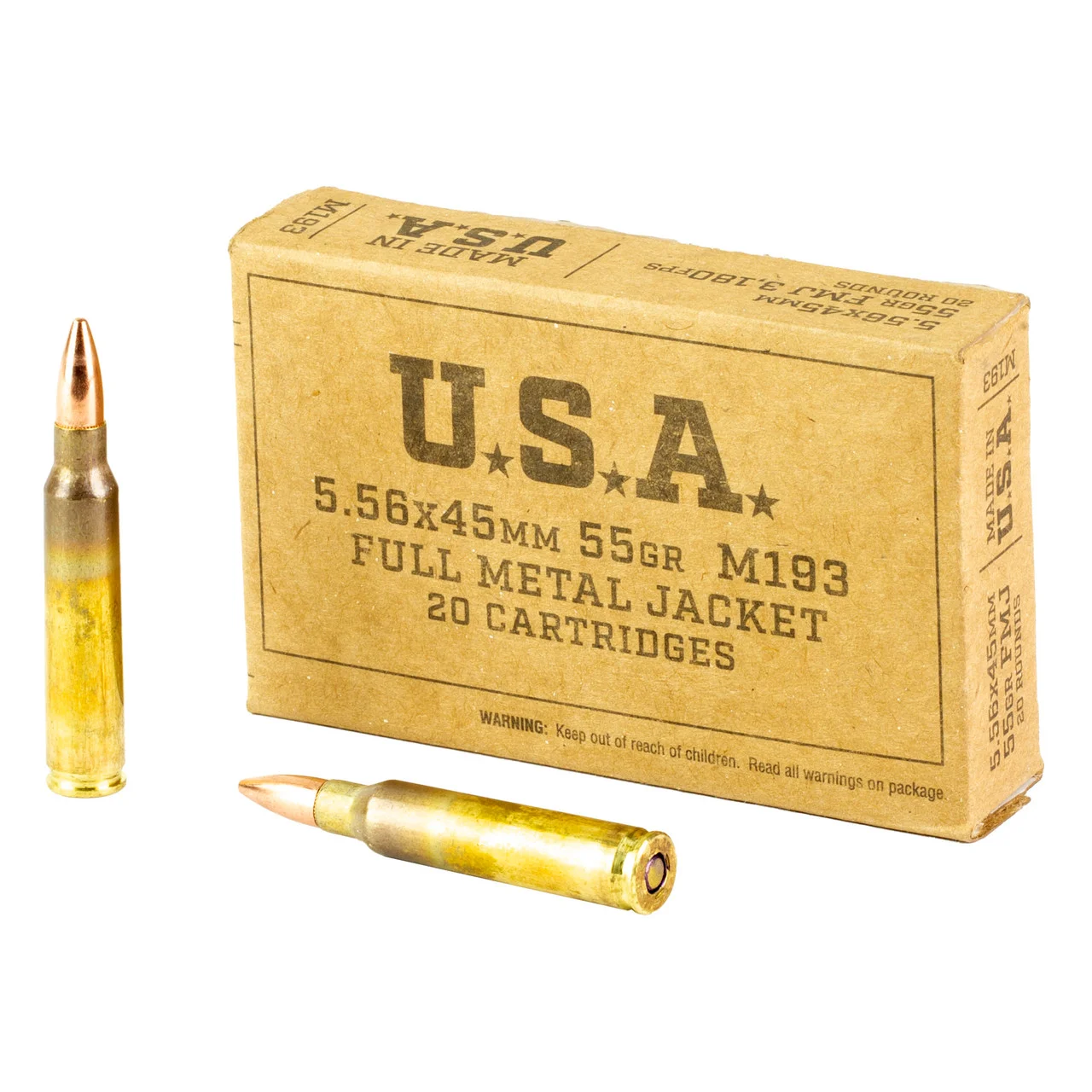
The lighter bullet is the faster one. In a published side-by-side comparison, M193 averaged 3,055 ft/s from a 16-inch AR against 2,997 ft/s for M855, and from 11.5 inches M193 ran 2,847 ft/s against M855's 2,745 ft/s. Exact figures move with the loading, the barrel, and the day. Longer tubes favor both: a 20-inch barrel pushes commercial SS109-spec loads around 3,100 ft/s and M193-spec loads past 3,200 ft/s.
Now the twist rate. The common claim is that the 1:7 twist in every modern AR exists to stabilize the 62-grain M855 bullet. It does not. A February 1986 U.S. Army study concluded that a 1:9 twist "would be more appropriate for the M16A2 rifle, improving accuracy and reliability," and multiple studies confirmed it. The problem was the M856 tracer, which at 63.7 grains is longer, heavier, and slower than M855 and would not stabilize in 1:9. The M16A2 and later the M4 got 1:7 to keep the tracer flying, and by the same testing that choice roughly doubled M855 group sizes against what 1:9 delivered.
The practical takeaway is that a 1:7 barrel stabilizes M193, M855, M855A1, and 77-grain match bullets without any trouble. It is not optimal for the two ball rounds, but the loss shows up as group size, not as keyholing. If you are choosing a chambering rather than a load, our AR-15 caliber guide covers how 5.56 stacks up against 300 Blackout and 6.5 Grendel on cost and ballistics.
Accuracy: None of Them Are Match Ammunition
Treat all three as ball ammunition and buy accordingly: what any of them groups depends on the rifle, the twist, and the lot, and none of them is built to a match standard. One published test of M855A1 through a standard 1:7 barrel produced a best 100-yard group of 1.62 inches, 1.6 MOA at 300 yards, and 1.8 MOA at 400 yards, with roughly one flyer in every five rounds. Fired through a 1:9 barrel, the same ammunition cut group sizes by about half. That testing found M855A1 more accurate than the green tip it replaced, and still short of the "match-like" accuracy its developers advertised. It did not put M855A1 up against M193.
Ranking M193 against M855 is rifle-dependent rather than settled. A 1984 Marine Corps test fired 6,000 rounds each of M193 and the then new M855 through M16A1s and M16A2s: the A1s showed virtually no accuracy decline, while the A2s saw groups more than double, with chamber pressure the sole variable between the two loads at 50,000 versus 53,000 psi. Against that, M855's heavier bullet carries a higher ballistic coefficient, which is a real advantage in wind past a couple hundred yards. Expect M193 to look better up close and M855 to hold up better in a crosswind at distance, and expect your own barrel to have a vote.
One structural point does hold for M855 regardless of rifle. A steel penetrator and a lead core are two different densities inside one jacket, so any variation in how they seat relative to each other shifts the bullet's center of gravity. M193 has a single homogeneous core and nothing to misalign.
If accuracy is the point, stop shopping ball ammunition entirely. IMI Razor Core builds a 77-grain Sierra MatchKing on the Mk262 Mod 1 pattern, with sealed case necks and primers, which is a different class of tool rather than a better version of the same one. Heavy 77-grain bullets want a 1:7 or 1:8 twist; test them in a 1:9 barrel before committing to a case.
Fragmentation: Both Loads Run Out of Velocity
Both ball loads depend on impact velocity to do anything interesting, and the commonly used benchmark for 5.56 ball is roughly 2,500 to 2,700 ft/s. Published terminal-ballistics references put the critical minimum for meaningful performance at about 2,700 ft/s, with fragmentation becoming unreliable below that and largely absent under about 2,500. It is a band rather than a switch, and where a given bullet lands inside it depends on jacket construction, cannelure, yaw at impact, and what the bullet hits first.
Run the arithmetic anyway and the picture gets uncomfortable for short barrels. M855 leaves an 11.5-inch barrel at 2,745 ft/s, which is inside that band at the muzzle and below it a short distance downrange. M193 from the same barrel starts at 2,847 ft/s and buys a little more room, but not much. From a 16-inch gun both loads start above the band and fall through it well inside a couple hundred yards. Our short-barrel 5.56 ammo guide ranks the loads that keep working when velocity runs out.
M855 carries a second problem that M193 does not. Its acceptance specification contains no requirement that the bullet fragment at all, so lot-to-lot variation in fragmentation is expected rather than a defect. Field reports of M855 punching straight through without upsetting are well documented, and the yaw-angle dependence behind them is the exact failure mode the Army designed M855A1 to eliminate.
Barrier Performance: Where Green Tip Earns Its Reputation
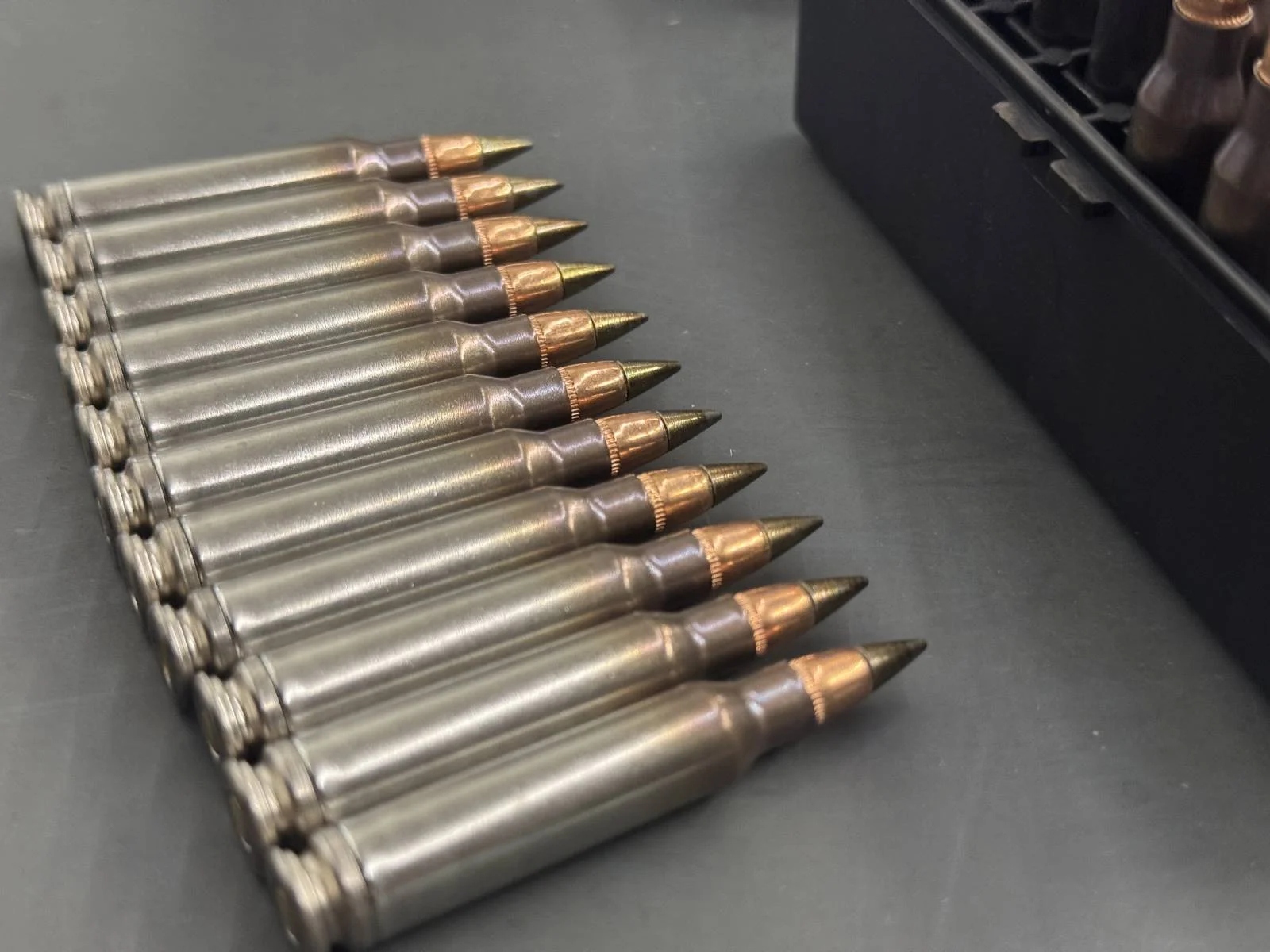
Against hard barriers M855 beats M193, and M855A1 beats both by a wide margin. Published side-by-side testing fired M855 and M855A1 into 3/8-inch hardened steel at 100 yards: the green tip failed to penetrate and left a silver crater, while the M855A1 punched cleanly through. Repeated against 3/8-inch soft steel at 300 yards, M855A1 went through again and M855 left a surface smear.
The Army rates M855A1 from the M4's 14.5-inch barrel as defeating 3/8-inch hardened steel out to 350 meters, measured as the range at which half the rounds pass through, and describes that as more than double the distance M855 manages. Concrete tells the same story: M855A1 breaches concrete block at 90 yards from a 20-inch barrel and 40 yards from an M4, while a single M855 projectile could not breach a block at any distance.
M193 sits at the bottom of that hierarchy against steel and concrete, though testing has put real divots in steel with it, so treat this as a ranking rather than a pass. Against interior partitions the gap narrows to the point of irrelevance: most 5.56 ball loads will go through multiple layers of drywall, with results varying by load, wall construction, barrel, and distance, and choosing green tip only adds a hardened penetrator to that problem. If the rifle is a home defense gun, this whole category is the wrong one, and an expanding or frangible load is the answer.
Will Green Tip Defeat Body Armor?
It depends on the plate, and the useful news is that the current NIJ standard finally names both rounds explicitly instead of leaving buyers to guess. Under NIJ Standard 0101.07 and its companion specification, the rifle levels are RF1, RF2, and RF3. RF1 is tested with 7.62x51mm M80 ball at 2,780 ft/s, 7.62x39mm mild steel core at 2,400 ft/s, and 5.56mm M193 at 3,250 ft/s. RF2 adds 5.56mm M855 at 3,115 ft/s on top of everything in RF1. RF3 is a single threat, .30-06 M2 AP at 2,880 ft/s.
That structure encodes the real-world answer. M193 is an RF1-class threat and M855 is a step up at RF2 because of its steel penetrator, while RF3 is defined by a much harder threat entirely. RF1 takes the place of the old Level III and RF3 takes the place of Level IV, which makes RF2 the genuinely new tier and M855 the round that created it. The trap is legacy labeling: NIJ 0101.06 tested Level III against 7.62x51mm M80 ball and Level IV against .30-06 M2 AP, and named neither M193 nor M855 anywhere in the document, so 0101.06 Level III certification does not establish how a plate handles either 5.56 load. It does not prove a given plate fails against them either. That gap is exactly why the unofficial "Level III+" label appeared in the commercial market. Buy off the maker's published 5.56 test results, not off the rating on the box.
What a plate stops is a separate question from how federal law classifies the ammunition, and the two do not line up. M193 falls outside the federal armor-piercing definition entirely, M855 arrives at the same place through a sporting-purposes exemption rather than through the definition, and M855A1 has no published ATF determination at all. The next section covers why that matters.
Shop 5.56 Loads
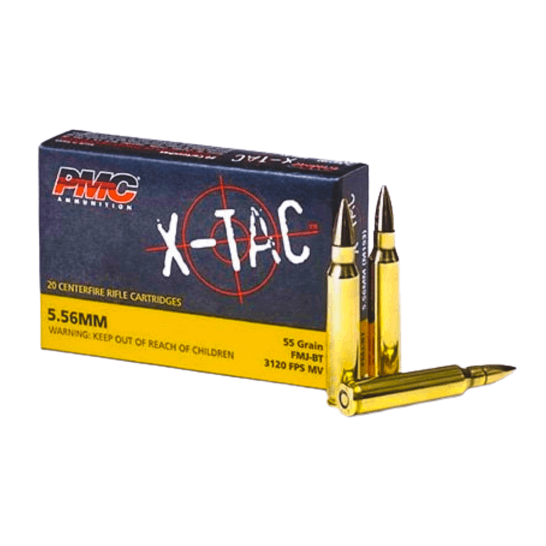
PMC X-TAC 5.56 NATO 55gr FMJ
- 55gr 5.56 NATO MIL-SPEC FMJ boat tail, the M193-class training round
- PMC lists this as a 5.56mm NATO load at 3,270 fps from a 20-inch test barrel
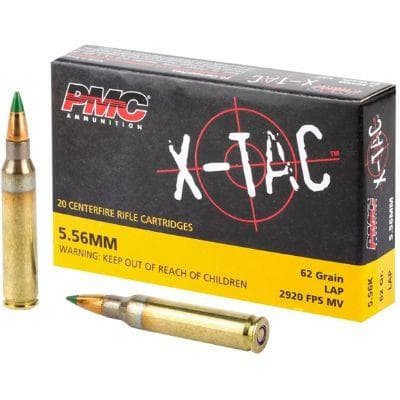
PMC X-TAC 5.56 NATO 62gr LAP (Green Tip)
- PMC's 62gr 5.56K LAP load, the commercial green-tip equivalent of M855
- 3,100 fps from 20 inches, 2,920 fps from 16 inches
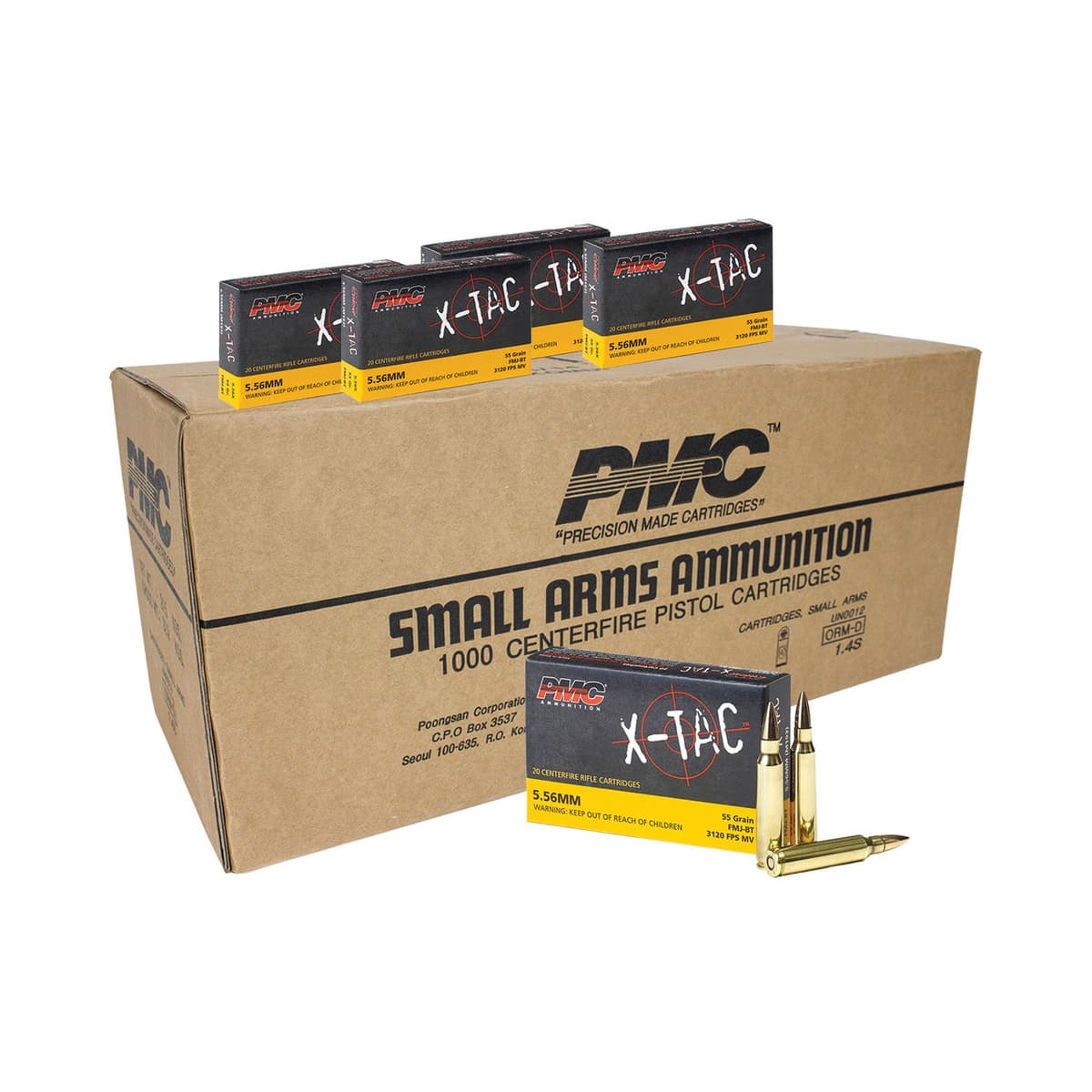
PMC X-TAC 5.56 NATO 55gr FMJ XM193 (1,000 Rounds)
- 1,000-round case of the same PMC 5.56X 55gr FMJ-BT load
- Case pricing is the low-cost-per-round way to feed a carbine class
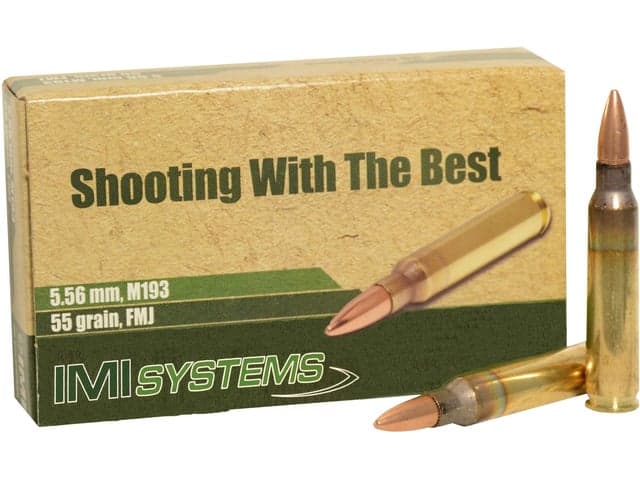
IMI 5.56 NATO M193 55gr FMJ
- Loaded by Israel Military Industries to the original M193 ball spec
- The canonical M193 pick rather than an M193-class commercial substitute
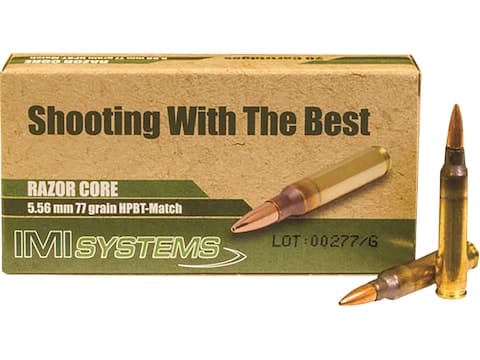
IMI Razor Core 5.56 77gr OTM
- 77gr Sierra MatchKing hollow point on the Mk262 Mod 1 pattern
- Sealed case necks and primers for all-weather use
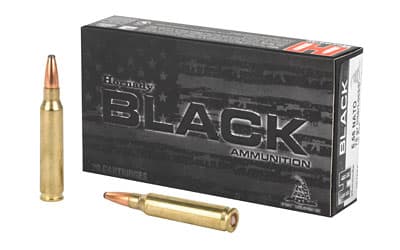
Hornady BLACK 5.56 NATO 75gr InterLock HD SBR
- Hornady item 81296: bullet and propellant both built around short-barrel velocities
- Expands rather than fragments, with a velocity envelope tuned for short barrels
Affiliate links (?)
Range Rules: The Magnet Test Decides Your Day
Many indoor ranges refuse steel-core and steel-penetrator ammunition, and a facility that does will often check it with a magnet at the counter. M855 and M855A1 both stick. M193 does not, which is the practical reason a 55-grain lead-core load is the default range round rather than the cheapest one. Bring green tip to an indoor range and there is a good chance you buy their ammunition instead.
Outdoor ranges care for a different reason. A hardened steel penetrator can pit or hole steel targets that shrug off lead core all day, with the outcome depending on plate hardness, thickness, and distance, and target makers warn against steel-core ammunition for exactly that reason. Steel damage is expensive and permanent, so plenty of clubs that allow green tip on paper ban it on steel. Read the specific range and target-maker rules before you unpack a case of it.
Is Green Tip Ammo Armor Piercing Under Federal Law?
For anyone not otherwise prohibited from possessing ammunition, M855 and SS109 green-tip ammunition is not restricted by the federal armor-piercing provisions, and as of July 2, 2026 that covers the loaded cartridges and their projectiles alike. The route it took there is worth understanding, because it is not the one most coverage describes. M193 is the simple case: plain lead and copper, outside the statutory definition outright. M855 got there through an exemption instead, which is a different legal animal. Start with the text. The federal definition in 18 U.S.C. 921(a)(17)(B) has two prongs. The first covers a projectile or projectile core which may be used in a handgun and is constructed entirely from tungsten alloys, steel, iron, brass, bronze, beryllium copper, or depleted uranium. The second covers a full jacketed projectile larger than .22 caliber designed and intended for use in a handgun whose jacket exceeds 25 percent of the bullet's weight. Note the first prong's verb: it asks whether a projectile may be used in a handgun, not whether it was built for one. ATF's 2015 analysis leaned on exactly that, reasoning that 5.56 qualifies because AR-pattern handguns share receivers and magazines with the rifles. M193 is plain lead and copper and falls outside both prongs.
M855 is where the common explanation goes wrong. The popular version says green tip escapes the definition because its lead core means it is not "constructed entirely" from the listed metals. ATF has never taken that view. It treated the M855 projectile as armor piercing precisely because the core consists of a steel penetrator forward of a lead core, and what makes M855 lawful to manufacture and sell is the separate sporting-purposes exemption ATF granted the cartridge in 1986 under 18 U.S.C. 921(a)(17)(C), on the finding that the round was recognized as suitable for target shooting because of its accuracy. That distinction is not academic: an exemption is a discretionary agency determination, which is why 2015 was legally possible in the first place. On February 13, 2015 ATF published a proposed framework that would have withdrawn that exemption, citing the arrival of AR-pattern handguns chambered for the cartridge. On March 10, 2015, after receiving more than 80,000 comments, ATF announced it would not issue a final framework. The exemption still stands.
It also got wider. Since 1986 ATF had read the exemption to cover only assembled SS109 and M855 cartridges, leaving loose projectiles and pulled bullets regulated as armor piercing ammunition, which was a live problem for handloaders. ATF Ruling 2026-1, effective July 2, 2026, superseded that reading and held that the SS109 and M855 cartridges, projectiles, and projectile cores alike are not subject to the restrictions in 18 U.S.C. 922(a)(7). Component green-tip bullets are now on the same footing as loaded rounds.
One more distinction is worth keeping straight. The armor piercing restrictions in 18 U.S.C. 922(a)(7) and (a)(8) reach manufacture, importation, and sale, not ownership, and ATF itself wrote in the 2015 framework that "it is legally permissible to possess armor piercing ammunition under current law." That is a statement about the armor piercing category specifically. Every other federal ammunition restriction still applies on its own terms, including the prohibited-person rules in 18 U.S.C. 922(g), which cover ammunition of any classification, and 18 U.S.C. 929 separately enhances penalties for using armor piercing ammunition during a crime of violence. As for M855A1, no published ATF determination classifies it as armor piercing, and the Army describes the Enhanced Performance Round as not an armor-piercing round.
State law is a separate variable and it does not follow the federal answer. California is the statute most often raised at green tip, and it is explicit: the definition at Penal Code 16660 covers "handgun ammunition designed primarily to penetrate metal or armor" and expressly excludes "a shotgun shell or ammunition primarily designed for use in a rifle." California regulates ammunition sales and transfers on its own terms regardless. Read the law of the state you are buying and shooting in, and expect the restriction you actually run into to be the range's.
Stay Updated on 5.56 Ammo
Bulk 5.56 price movements, new factory loads worth testing, and ammunition deals from the retailers we track.
Frequently Asked Questions
▶Does the military use M855 or M193?
▶Is M193 green tip ammo?
▶What 5.56 ammo do Navy Seals use?
▶Is green tip 5.56 illegal?
▶What does a green tip bullet mean?
▶Is green tip better than FMJ?
▶What do ammo tip colors mean?
▶Will 5.56 green tip penetrate body armor?
The Verdict
Buy M193 for range work, buy M855 only when you specifically need the steel penetrator, and stop looking for M855A1.
M193 wins on price, velocity, range access, and consistency of upset, and it works off the same rough 2,500 to 2,700 ft/s velocity band M855 does. Green tip buys barrier penetration and a better wind profile, and charges you in range bans, destroyed steel targets, and money. M855A1 beats both on barrier penetration and consistency by a wide, tested margin, and is a military-contract load rather than a commercial product, which makes it trivia rather than a shopping decision. If the rifle is for anything more serious than practice, skip all three and read our 5.56 ammo selection guide before you buy a case of anything.