Suppressor Guide 2026: $0 Tax, eForm Waits & Best Silencers header image
Intel
May 22, 2026
Suppressor Guide 2026: $0 Tax, eForm Waits & Best Silencers

Suppressor buying in 2026 looks nothing like 2024: $0 federal tax, eForm 4 approvals in days, and a modern catalog of flow-through and HUB-standard cans. This hub explains what changed, what didn't, and which suppressors to start with by caliber.

Ops // Dossier NFA.26--:--:--Z

Index 05.23.26/Dossier NFA.26/Content Hub

SuppressorsEvery can, guide, and dispatch · 2026

$0 stamp · 5-day eForm · 42-state legal

Suppressor buying in 2026 looks nothing like 2024. The federal tax is $0, eForm 4 approvals are running in days, and 42 statesallow ownership. This hub indexes every suppressor in the catalog, every guide we've published, and every dispatch worth reading, sorted by how you actually shop: caliber, host, and price.

// First can · 01

If You've Never Bought a Suppressor

03 steps
// Step 0101/03

Pick the host

Decide which rifle or pistol the can lives on first. Host dictates caliber, mount, and back-pressure tolerance. The compatibility basics guide covers mount families and gas tuning.

// Step 0202/03

Pick the can

Use the caliber matrix below or the match finder. If you only run one rifle, the top picks ladder will never steer you wrong. Browse the full 38-can catalog if you want to sort by weight, mount, or price.

// Step 0303/03

File the form

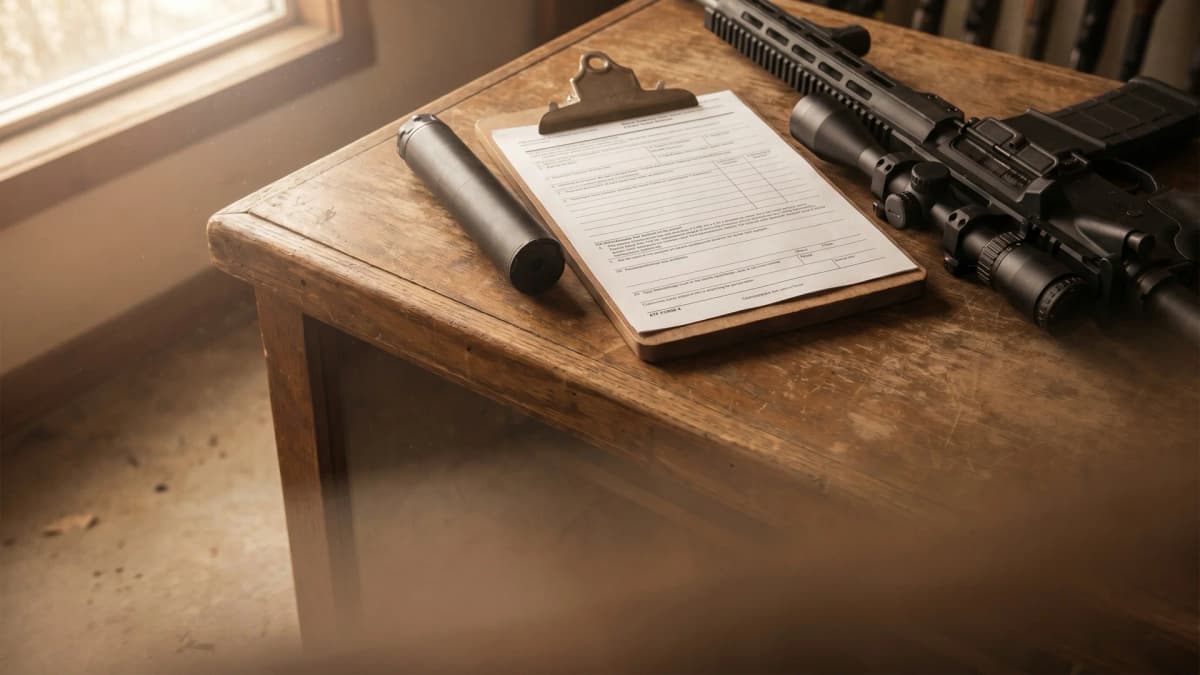
Pay your dealer, file the eForm 4 (federal tax is $0 since OBBBA), pass NICS, wait roughly a week, take it home. The NFA primer below is the short version.

// Content · 02

Browse by Type

6 categories · 19 pages
// Filter · 04

Browse by Caliber

39 cans

Caliber is the first filter that matters. 5.56 and .30 cal split the catalog roughly down the middle. For .300 BLK host pairings specifically, the .300 Blackout buying guide covers barrel length, subsonic vs supersonic, and which cans actually like the cartridge.

// Best in class · 05

Top Picks Ladder

6 slots

Six slots, six categories, no contradictions. For the full 12-can 5.56 ranking with PEW Suppression Ratings and at-ear data, read the dedicated guide. For the heat-mitigation side of the equation, see suppressor covers compared.

// Interactive · 06

Don't Know Where to Start?

3 inputs · 1 pick
// Match finder · interactive3 inputs · 1 pick

Find your can.

// Caliber
// Use case
// Budget
// Recommend // 5.56 / .223 · Range / training
YHM Turbo K

Sub-$600 full-auto-rated K-can. Won't be the quietest, but punches well above the price tag.

Street$579Weight8.8 oz
// Feed · 07

Latest Across the Hub

8 dispatches
// FAQ · 09

Frequently Asked

11 questions

Frequently Asked

Do you still have to pay $200 for a suppressor in 2026?
No. The One Big Beautiful Bill Act (OBBBA) zeroed the federal NFA transfer tax on suppressors, SBRs, SBSs, and AOWs effective January 1, 2026. The transfer tax went from $200 to $0. Form 4 paperwork, fingerprints, NICS background check, and NFA registration are still required.
Can you legally buy a suppressor now?
Yes, in 42 states. Federal law permits civilian ownership after Form 4 approval. Eight states ban or restrict suppressors: California, Delaware, Hawaii, Illinois, Massachusetts, New Jersey, New York, and Rhode Island. Check your state law before paying for a can.
How long is the wait to get a suppressor in 2026?
Per ATF current processing data as of May 22, 2026, eForm 4 approvals run a median of 5 days for individuals (range 1 to 25 days) and 21 days for trusts (range 1 to 43 days). Paper Form 4 submissions are still running 55 to 65 months because the ATF works the oldest paper first. File electronically.
What's the difference between a silencer and a suppressor?
They are the same device. 'Silencer' is the legal term on the ATF Form 4 and in federal statute, dating back to Hiram Maxim's 1909 patent. 'Suppressor' is the engineering and shooting-community term. Use whichever your audience uses; the device is identical.
Can you buy a suppressor at a gun store?
Yes, if the store holds a Class 3 SOT. Most local gun stores do not, so you typically buy through a Class 3 dealer. Silencer Central ships to your home FFL, and Silencer Shop runs in-store kiosks at thousands of FFLs nationwide. The kiosk model handles fingerprints and Form 4 e-filing on the spot.
Is it hard to get approved for a suppressor?
No. If you can pass a NICS background check to buy a handgun, you can pass for a suppressor. The eForm pipeline standardizes the process. Approval is automatic for individuals with no disqualifying record once NICS clears, which happens in days, not months.
What process do you have to go through to get a suppressor?
Five steps: (1) pick a Class 3 dealer, (2) choose the can, (3) file ATF Form 4 electronically (the transfer tax is $0 since OBBBA), (4) NICS background check runs in parallel, (5) pickup at your FFL once the stamped Form 4 lands. Median eForm wait is 5 days for individuals and 21 days for trusts as of May 2026.
Should I buy a suppressor now or wait?
Buy now. The tax is already zero, eForm 4 wait times are at historic lows (median 5 days individual), and supply is the highest in NFA history with new flow-through and HUB-standard cans launching every quarter. The only reason to wait is if your state is poised to legalize and you do not yet have residency to buy.
What is the best 22 LR suppressor for 2026?
The Dead Air Mask HD (welded, ultra-quiet) and the HUXWRX Flow 22 Ti (3.9 oz, multi-caliber, no barrel-length restrictions) are the top rimfire picks. The Mask HD is the welded-baffle benchmark; the Flow 22 Ti is the takedown-and-clean choice that doubles as a 5.7x28 can.
What is the quietest 300 Blackout suppressor in 2026?
The HUXWRX FLOW 762 Ti and the Dead Air Nomad-30 are the top quietness picks for suppressed .300 Blackout in 2026, with subsonic .300 BLK muzzle readings in the 126 to 128 dB range. See our 300 Blackout guide for the full host-and-can pairing recommendation.
What is a suppressor used for?
Reducing muzzle noise to hearing-safer levels, reducing flash signature, slightly reducing recoil, and improving spotter-shooter communication. A suppressor does not 'silence' a gun; it brings the report from harmful (around 165 dB unsuppressed 5.56) to closer-to-OSHA-safe (around 125 to 140 dB suppressed, depending on can and host). Hearing protection is still recommended for indoor and high-volume use.
// Next dispatch

Mount up.

The federal tax is zero, eForm 4 lands in days, and 42 states are open. The only friction left is picking which can to buy and which spoke to read first. Use the match finder above, or skim the ranked 5.56 guide.

SYS · Dossier NFA.26 · 05.23.26rifleconfigurator.com / guides / suppressor-buying-guide© 2026 / For informational use only