Key Takeaways
- →The fiber replaces the radio: control inputs and a near-uncompressed video feed run through glass, so there is no signal for a jammer to overpower and no emission to direction-find.
- →Range is spool length: 5 to 20 km is typical, 10 km was the Ukrainian workhorse through 2025, and Russian fiber drones hit Kramatorsk roughly 19 km behind the lines in October 2025.
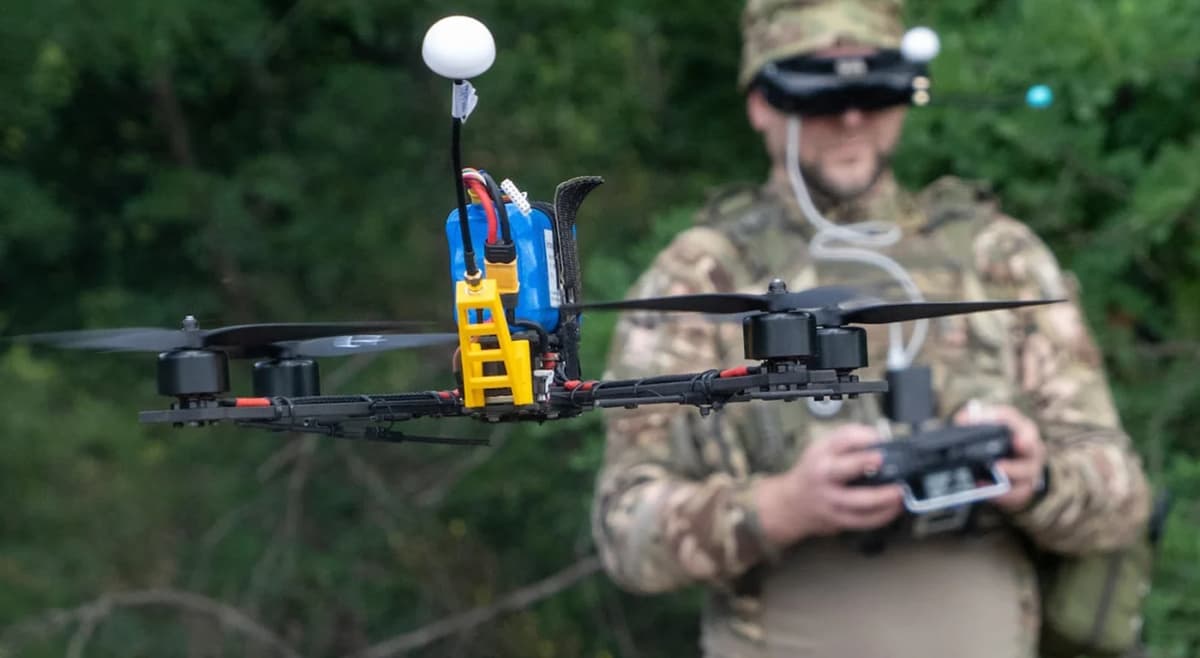
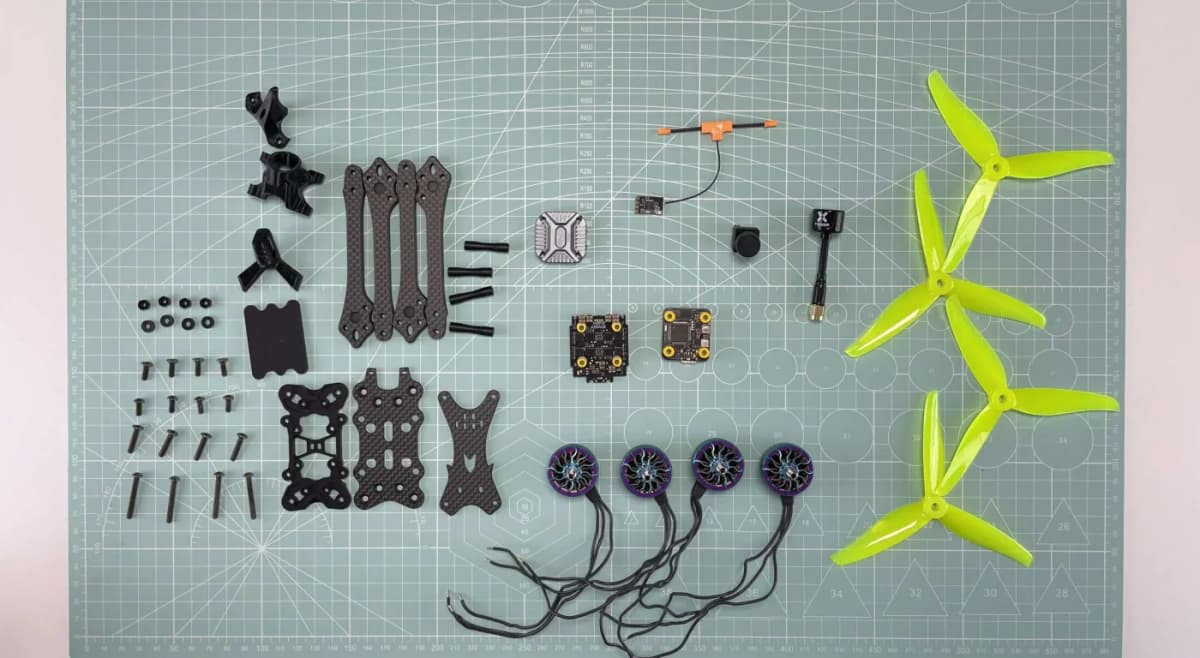
- →Civilian hardware underneath: the airframe is hobby FPV gear, motors, carbon frame, lithium pack, camera, and goggles. The spool is the only purpose-built military part.
- →You pay for immunity: heavier, slower, less maneuverable, easier to shoot down, and roughly $1,200 for a 10 km fiber FPV in May 2025 against $200 to $1,000 for a radio one.
- →Russia first, Ukraine second: fielded by Russia in spring 2024, scaled at Kursk from August 2024, with more than 80 Ukrainian-designed systems approved by February 2026.
How Fiber Optic Drones Work
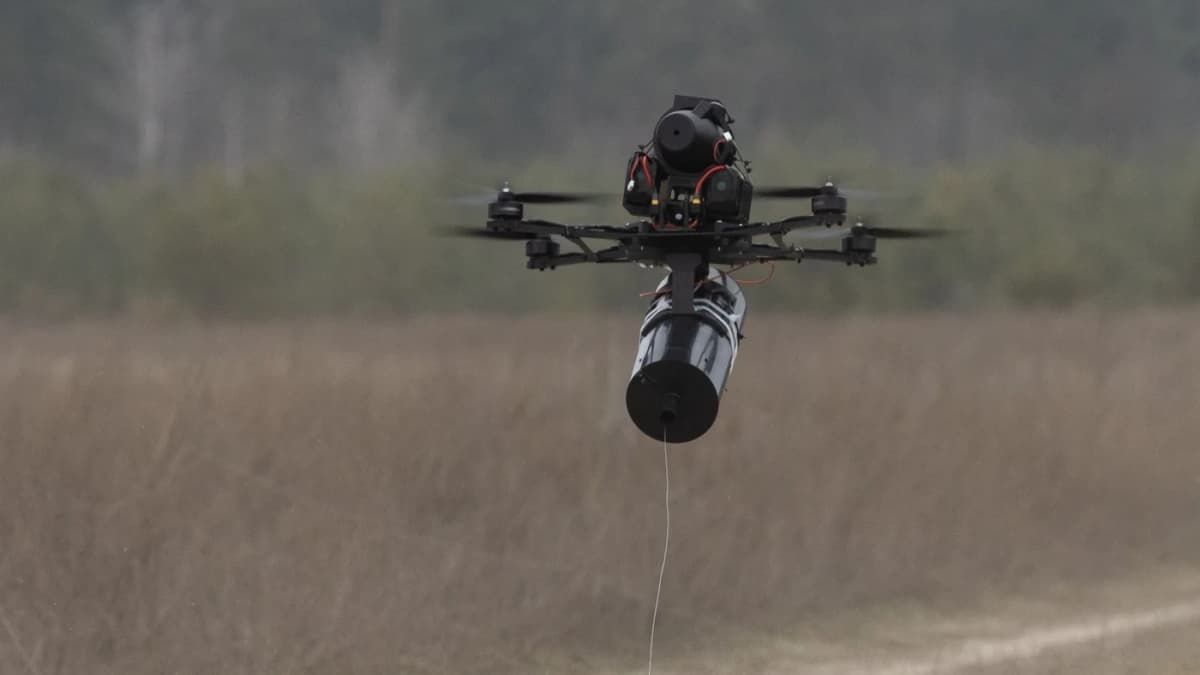
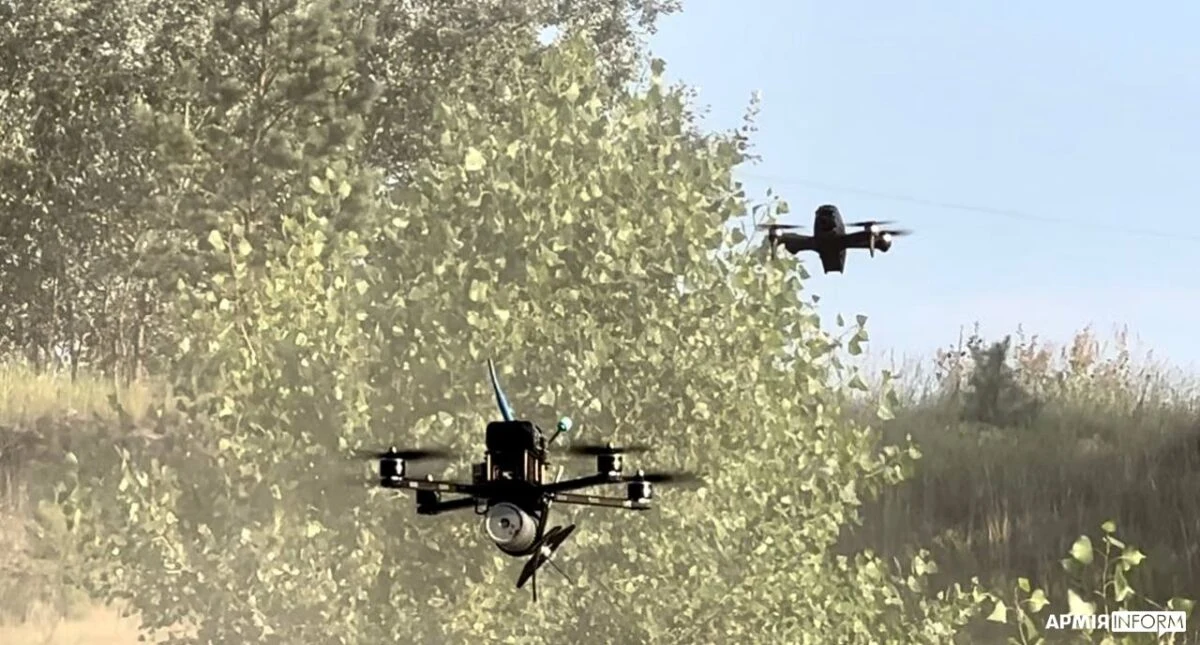
A fiber optic drone is a first-person-view quadcopter that carries a spool of optical fiber and unwinds it behind itself in flight. That strand does the whole job of the radio: the pilot's stick inputs travel out to the aircraft as light, and an uncompressed or lightly compressed first-person video feed comes back down the same fiber to a set of goggles. Nothing is transmitted over the air in either direction.
That single design change is why electronic warfare cannot touch them. Jamming works by flooding a frequency with enough noise that the receiver stops hearing its own operator. A control link running through glass has no frequency to flood, so a jammer can be sitting on the target vehicle at full output and the drone will fly straight into it. The same property works in reverse: a radio FPV announces itself the moment it powers up and can be located by direction finding, while a fiber drone can sit powered down in a treeline for hours waiting to ambush a vehicle, because holding the link costs almost nothing and gives away nothing.
The wired link also buys picture quality. Radio FPV video is compressed, congested, and degrades to static at range or behind terrain. Fiber carries a feed with little to no compression that stays clean at the far end of the spool, which is why these drones are flown through doorways and into buildings to look inside before striking. The concept is not new. DARPA explored a fiber-guided loitering munition under its Close Combat Lethal Recon program in the early 2000s and never fielded it. It took a war where jamming defeated radio control to make the tradeoff worth it.
Why They Appeared: Jamming Beat the Radio Link
Fiber optic drones exist because both sides in Ukraine got good enough at jamming that radio FPV attacks started failing at scale. Electronic warfare moved from a theater-level asset to a squad-level one, with jammers bolted to trench lines and vehicle roofs and pocket-sized units carried by individual soldiers. A strike drone that loses its link becomes a thrown rock.
The counter arrived in the spring of 2024, when Russia fielded the first fiber-guided FPV drones and Ukraine followed shortly after. The Institute for the Study of War recorded the effect in late October 2024, when a Ukrainian brigade in Zaporizhzhia reported Russian FPVs trailing up to 10 kilometers of fiber that its electronic warfare systems simply could not affect. The brigade noted the workaround at the same time, and it has not changed since: personnel had to shoot the drones down with small arms.
The other half of the appeal is what fiber does for flight profile. A radio drone needs altitude and line of sight to hold its link. A fiber drone does not, so it can fly at treetop height down a road, under a canopy, or into a structure, which is exactly the ground that used to be safe from radio-controlled aircraft. Fiber is one rung on a much longer ladder, and where it sits among the other aircraft classes and countermeasures is the subject of our drone warfare overview.
The Hardware Underneath Is Civilian FPV Gear
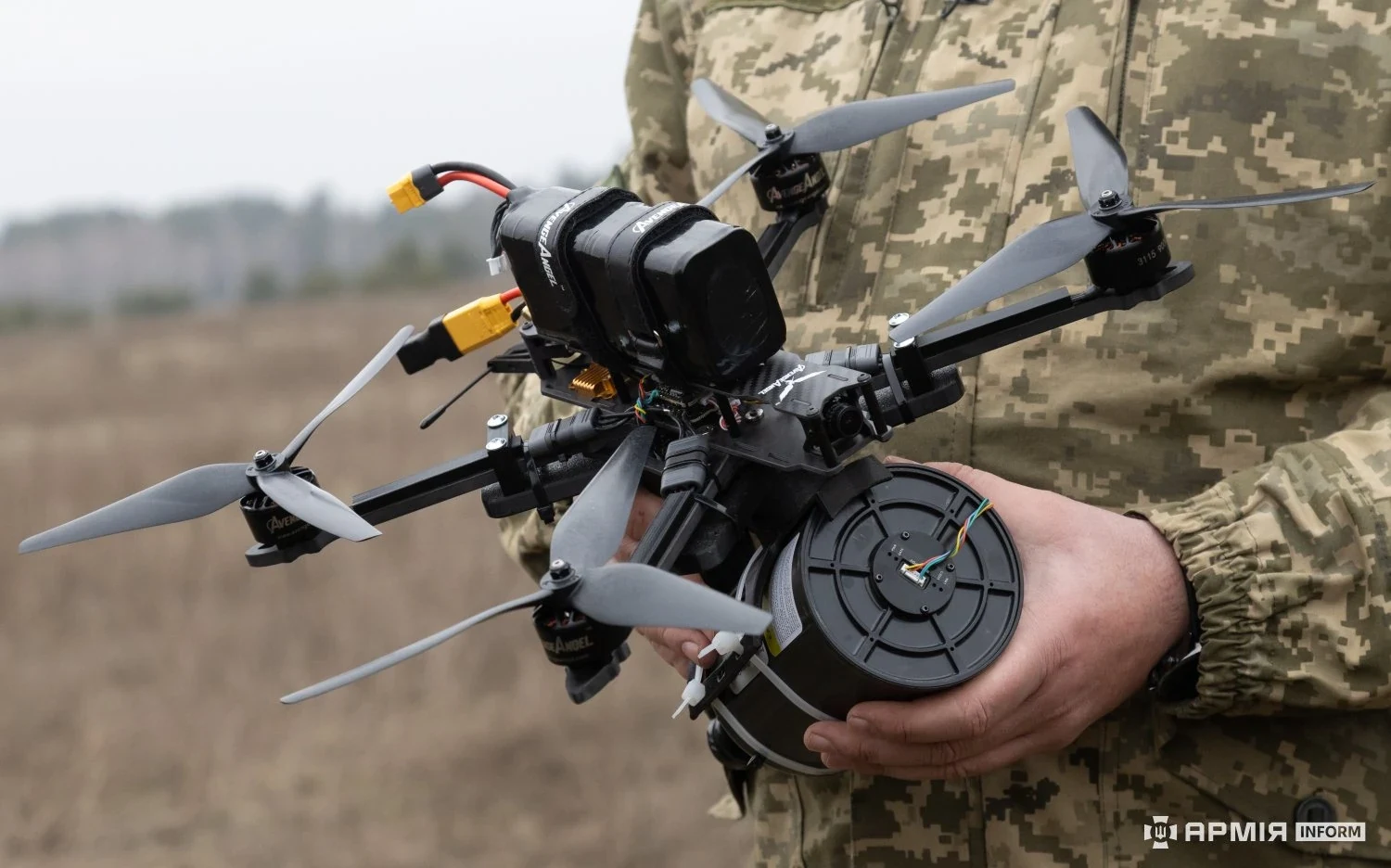
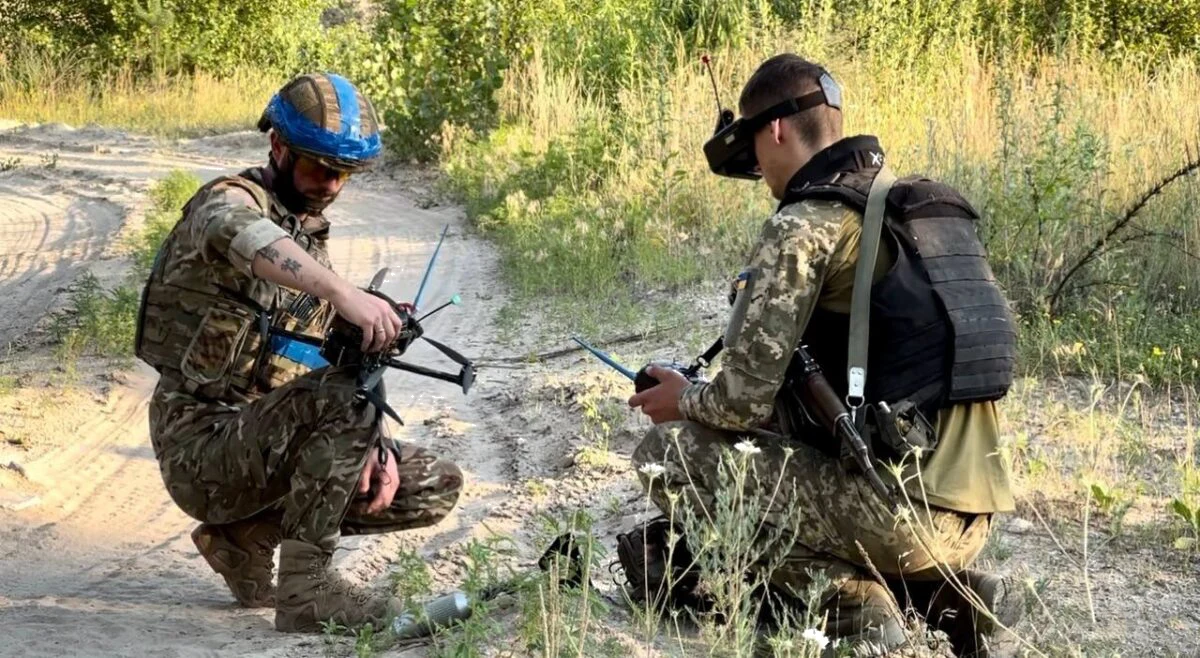
Strip the spool off and a fiber optic drone is a hobby quadcopter. The drone war in Ukraine is fought overwhelmingly with commercial components: consumer DJI Mavic quadcopters, about $2,000 each, do the reconnaissance and artillery spotting, and the strike drones are built on FPV racing frames with brushless motors, lithium packs, flight controllers, and analog or digital FPV cameras bought from the same supply chain that serves civilian drone racing. Those are the same parts on the same shelves a hobbyist buys from, and our FPV drone build guide walks through what each one does on a 5-inch airframe. The pilot wears FPV goggles and holds a hobby transmitter, and that kit is now standard enough that it shows up as a layer in the Ukrainian infantry loadout alongside the helmet and the rifle.
The economics follow from that. CSIS analysts put a Ukrainian FPV strike drone at $200 to $1,000 depending on size and payload, with typical ranges of 5 to 15 kilometers, and described the airframe as a universal platform whose role is set by whatever gets bolted to it. Frames grew with the mission, from 7-inch aircraft in 2022 to 13-inch models in 2024 and 2025 built to haul more equipment. That is a component upgrade path, not a weapons program.
Fiber optic guidance is a layer added on top of that civilian base rather than a new aircraft. The spool is the specialized part, and for most of 2024 and 2025 even that was sourced commercially: Ukrainian units bought Chinese spools through online marketplaces before domestic production ramped, and Ukraine's Unmanned Systems Forces unveiled a homegrown modular spool called Silkworm in late February 2025.
How Far Can Fiber Optic Drones Travel?
A fiber optic drone can travel as far as the fiber on its spool, and no further. Typical spools hold 5 to 20 kilometers. Through 2025 the 10-kilometer spool was the Ukrainian workhorse, with 15-kilometer spools less common and 20-kilometer spools still in testing, according to an operator with the Achilles Strike Drone Regiment. Russian systems have been credited with more than 30 kilometers, a Ukrainian extended-range model fielded by the Birds of Magyar unit with roughly 40 kilometers, and 50-kilometer spools were reported in testing as of October 2025. A Ukrainian firm called Fold was developing a design aimed at close to 100 kilometers as of August 2025, which has not been fielded.
Fiber length is not strike radius. The cable follows the flight path, so terrain-following, orbiting a target, and any hunting for an aiming point all spend fiber that a straight line would not. Wind makes it worse. The practical demonstration of what the long spools bought came on October 6, 2025, when a Russian fiber FPV struck a pickup truck in Kramatorsk, roughly 19 kilometers behind the front line, an area that had been treated as out of reach of small drones.
How Do Fiber Optic Drones Not Get Tangled?
The fiber pays out from a fixed canister instead of a reel the drone has to spin, so the aircraft lays cable behind it rather than dragging it. The strand is wound under controlled tension and stays in the canister until the drone's own motion pulls it free. Because the fiber is thinner than fishing line and weighs almost nothing per meter, it trails slack behind the aircraft rather than coming taut, which is what would otherwise snag it on the first branch.
Tangling has not been eliminated, only made survivable. A drone can clip its own line with a propeller, an aggressive direction change can snap the fiber, and cable draped over trees, pylons, and power lines is a routine cause of lost aircraft. Operators fly around these constraints: low, deliberate, and never back over their own path, since the line already lying there is the thing most likely to catch them. Dense urban terrain, where a drone has to turn hard around hard structures, is the environment where fiber performs worst.
The line is also a target. Ukrainian troops have countered fiber drones with stretched barbed wire spun by a small battery motor, which catches the cable laid across a position and shears it. That works because the drone's advantage and its weakness are the same object.
What Are the Downsides of Fiber Optic Drones?
The spool is dead weight and the aircraft pays for it. Ukrainian operators describe fiber drones as heavier and bulkier than radio FPVs, slower, less maneuverable, and easier to shoot down with small arms, and the payload the spool occupies is payload the warhead does not get. A slower drone on a predictable low-altitude line is the easiest aerial target infantry ever gets.
Cost and skill are the next two. A fiber FPV with a 10-kilometer spool was quoted at roughly $1,200 in Ukrainian service in May 2025, against $200 to $1,000 for a radio equivalent, and at that point fiber accounted for under 5 percent of Ukraine's unmanned inventory because of manufacturing bottlenecks and two-to-three month lead times. Pilots need more training, not less: a mishandled fiber drone loses its cable rather than its signal, and the cable does not come back.
Then there is the trail. Unlike a radio signal, the control link does not disappear when the drone hits its target. Every sortie leaves kilometers of cable draped across roads, fields, and treelines along a front line that runs roughly 1,200 kilometers, and the fiber is reflective enough to glint in sun and frost. Accumulated cable marks where drone activity is concentrated and which direction launches come from, though with fields blanketed in the stuff, tracing one strand back to a specific crew is no longer realistic. The cable stays. It is about as thin as fishing line, with a polymethyl methacrylate core and fluoropolymer cladding, and researchers at the Conflict and Environment Observatory have flagged both the entanglement hazard to birds and small mammals and the PFAS content of the cladding, with degradation estimates running past 600 years. Ukrainian birds have already been documented weaving discarded drone fiber into their nests.
Adoption Timeline: Russia First, Ukraine Chasing
Russia got there first and held the lead for more than a year. Fiber-guided FPVs were fielded by Russian forces in the spring of 2024 and scaled during the Kursk fighting from August 2024, built around the Ushkuynik Prince Vandal of Novgorod, commonly called the KVN. Ukrainian units received their first fiber drones toward the end of winter 2024 to 2025, and Commander-in-Chief Oleksandr Syrskyi acknowledged in 2025 that Russia held the advantage in both quantity and range.
Ukraine closed the gap through 2025 and 2026. Domestic spool production started in early 2025, more than 35 Ukrainian companies were producing fiber drones at scale by October 2025, and by February 2026 more than 80 Ukrainian-designed fiber optic systems had been approved for use. Andriy Hyrtseniuk of Ukraine's Brave1 defense technology incubator summarized it plainly: “This is actually one of the very few areas where Russia was faster than we were, but we are very quickly reducing the [gap].”
The technology has not stayed in Ukraine. Fiber optic drone use has since been reported in Lebanon, Gaza, Mali, and Myanmar, and the Chinese People's Liberation Army is reported to be building the capability into its own inventory. A jam-proof control link built from commercial parts is not a technique that stays regional.
What Actually Stops One
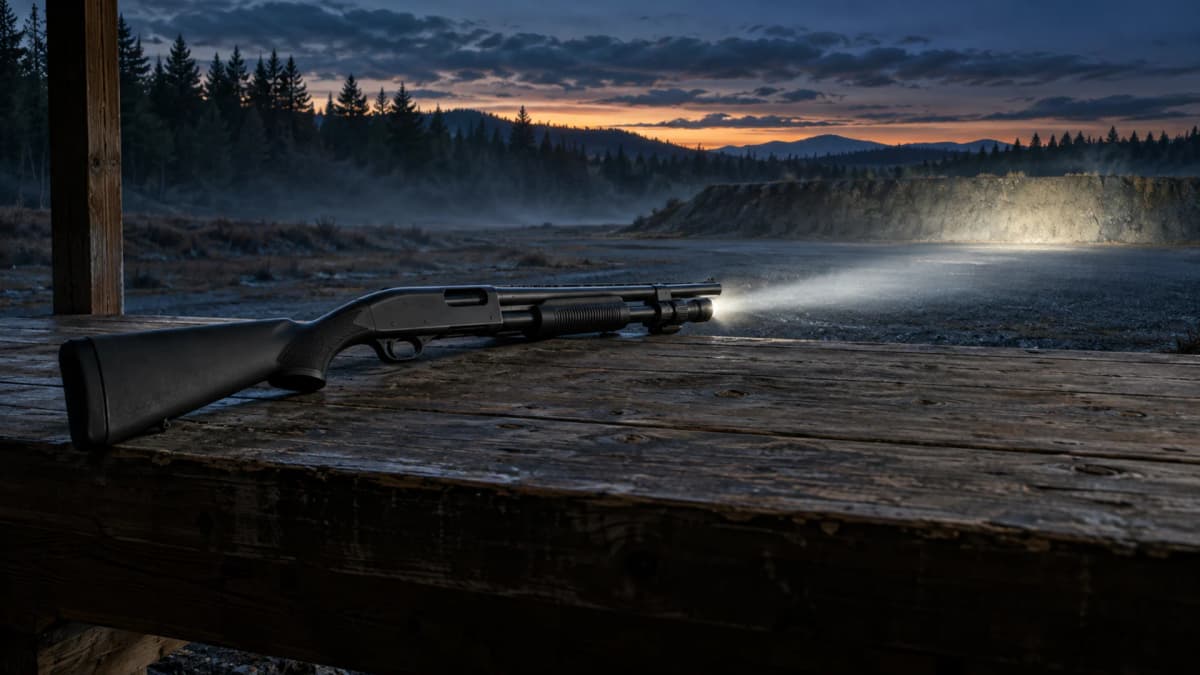
Because the electronic answer does not work, the answer is physical: nets, wire, and gunfire. Ukrainian and Russian positions are strung with anti-drone netting across roads and over buildings, cables are cut when found, and the drone gets shot at when seen. That is why optics makers have started building for the problem. EOTech announced the HWS CUAS counter-drone holographic sight in August 2026, an EXPS3 and XPS3 carrying a reticle with lead references calibrated to a drone crossing at 30 mph, which is a direct admission that reticles cut for targets on the ground do not help above the horizon.
The optic requirements for a small, fast, high-angle target are the same ones that favor a big window and a heads-up posture: fast unmagnified sights over anything magnified, a mount tall enough that the head stays up instead of buried behind the receiver, and a shotgun in the mix, which is why our tactical semi-auto shotgun rankings and holographic sight breakdown are the two pages that matter here. Detection is the harder half, and it is where thermal optics do work a red dot cannot, since a fiber drone emits no radio at all. You can stack any of these on a build to check mount height and clearance before buying.
None of this is a home-defense scenario in the United States. Federal law classifies an unmanned aircraft as an aircraft, which puts shooting one down inside the reach of 18 U.S.C. 32, and counter-drone authority is delegated to specific agencies rather than granted to property owners. What transfers to a civilian rifle or shotgun is the hardware logic, a fast unmagnified sight on a mount that keeps the head up, which is worth having whether or not anything is flying.
Fast Sights and Mounts for Moving Targets

EOTech EXPS3
- The body EOTech built its counter-drone CUAS reticle on
- 68 MOA ring with a 1 MOA dot for fast acquisition on moving targets

Holosun AEMS Core X2
- 1.1 x 0.87 inch window with a 2 MOA dot
- Enclosed emitter keeps the lens clear in rain, mud, and snow
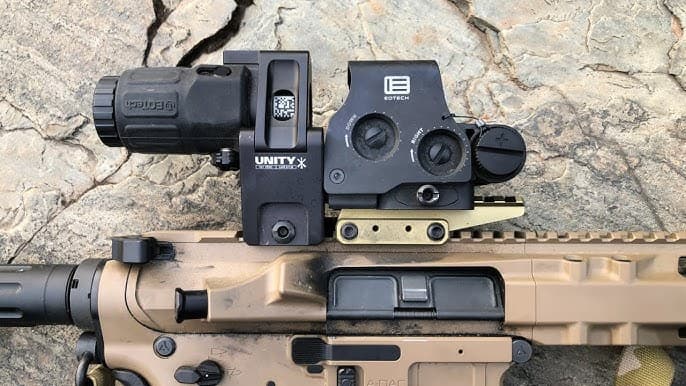
Unity FAST PRO Mount
- 2.26 inch optical centerline for a heads-up shooting position
- Brings the dot to the eye instead of the head down to the optic
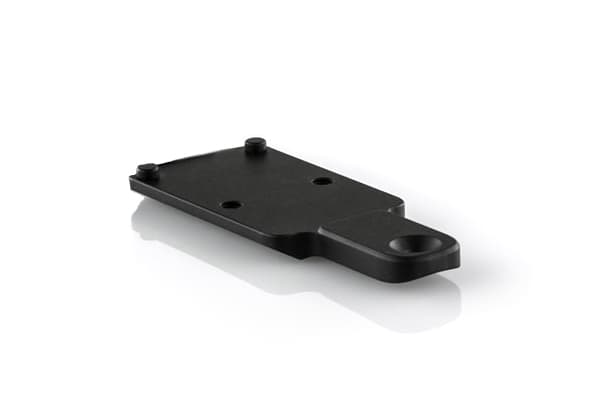
Scalarworks SYNC Shotgun Mount
- Direct RMR/SRO mount for Mossberg 590 and 930 hosts
- Lower-tenth co-witness height for a natural shotgun cheek weld
Affiliate links (?)
Stay Updated on Drone and Counter-Drone Tech
We cover counter-UAS optics, new sights, and the hardware side of drone defense as it lands.